
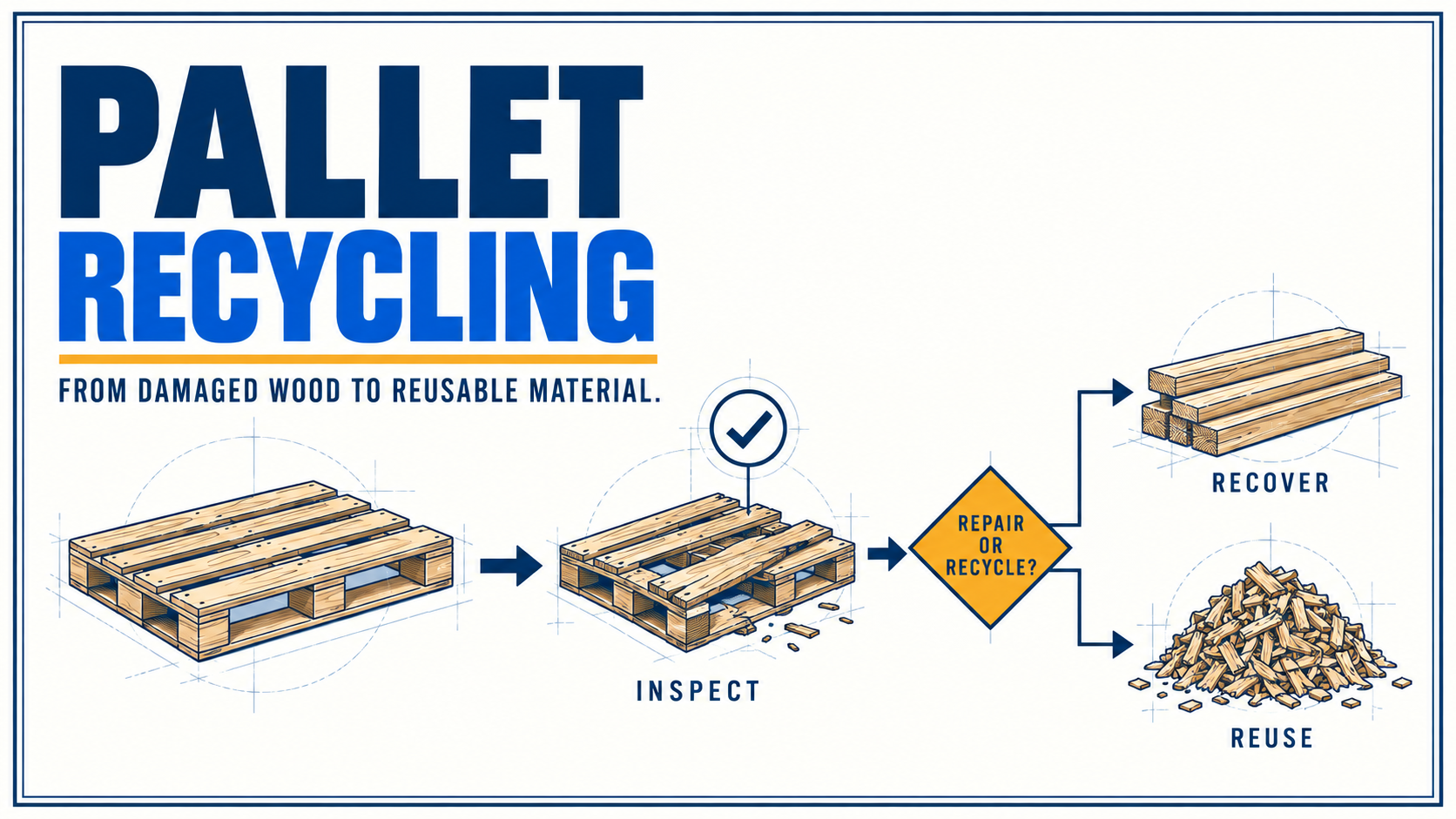
TL;DR
Start with pallet condition, material, contamination, and end use. Repair or reuse pallets that still have structural value; dismantle or shred the remainder only after the recovery path and output requirements are clear.
Key Takeaways
- Repair or reuse remains the first branch when the pallet still has safe structural value.
- Sorting must account for wood type, condition, contamination, and embedded fasteners.
- A pallet shredder reduces the right wood stream; it does not replace inspection, preparation, or downstream separation.
- The end use determines what output size, cleanliness, and handling questions matter.
- A real equipment discussion starts with a documented feedstock and a defined downstream use.
Table of Contents
- Key Takeaways
- What Is Pallet Recycling in an Industrial Workflow?
- How Sorting Decides: Repair, Reuse, Dismantle, or Shred
- What Happens Before a Pallet Reaches the Shredder?
- Where the Pallet Shredder Fits in the Recycling Line
- What Can Recovered Pallet Wood Become?
- What to Document Before Choosing Pallet Recycling Equipment
- Conclusion
- References
What Is Pallet Recycling in an Industrial Workflow?
Pallet recycling is the controlled recovery of used pallet material after the pallet is no longer suitable for its current job. It does not automatically mean feeding every damaged pallet into a shredder. A sound workflow first checks whether the pallet can stay in service, be repaired, or be dismantled for usable parts. Only the remaining wood stream should move toward mechanical size reduction and a defined downstream use.
Recycling is not the same as repair or disposal
Repair keeps the pallet in the pallet loop. A damaged deck board, block, or stringer may be replaced so the unit can safely carry another load. Reuse may require little or no work when the pallet still meets the receiving operation’s requirements. Dismantling is different: the pallet is taken apart so sound boards or blocks can be recovered, while damaged pieces are separated as wood waste.
Recycling begins when the material is being recovered for a new use rather than returned in its original form. That new use may be a wood-based product, a fuel feedstock, a bedding material, or another outlet that accepts the resulting material. The exact pathway depends on the wood, contamination, fasteners, output form, and local or buyer acceptance. A facility should confirm those conditions before promising that a load will be accepted.
The process map in one view
The industrial sequence is easier to understand as a set of gates:
- Receive and identify the stream. Record whether the load contains whole pallets, loose boards, broken components, or mixed materials.
- Inspect and sort. Separate units that can be reused or repaired from those that have no safe pallet role.
- Dismantle or prepare. Recover usable pieces and identify nails, staples, coatings, moisture, and other conditions that affect handling.
- Reduce the remaining wood. Use a suitable shredder or grinder stage when the target output and feed conditions justify it.
- Collect, clean, and route the output. Move the recovered material toward the downstream use that has been defined and accepted.
Working definition: Pallet recycling is a recovery workflow. The machine is one stage inside that workflow, not the definition of the workflow itself.
That distinction matters when an operation starts comparing equipment. A machine can change the size and handling characteristics of wood, but it cannot decide whether a pallet is still safe to use, remove every acceptance risk, or create a downstream market for an undefined output. The material profile and next process should be clear before a machine conversation becomes specific.
The same logic keeps this article separate from local pallet pickup, pallet prices, and plastic-pallet pooling. Those are different jobs with different evidence and different decisions. Here, the goal is to understand the industrial path from damaged wooden pallet to a useful next material state. The site’s single-shaft shredder application guide provides broader machine-stage context without replacing a pallet-specific feed review.
Citation capsule: Industrial pallet recycling should be treated as a recovery sequence, not an automatic shredding instruction. A 2012 BioResources study on wood-pallet repair supports keeping repair and reuse decisions visible before material is routed to a different outlet. Only the residual stream should proceed to preparation, size reduction, and a defined downstream use.
How Sorting Decides: Repair, Reuse, Dismantle, or Shred
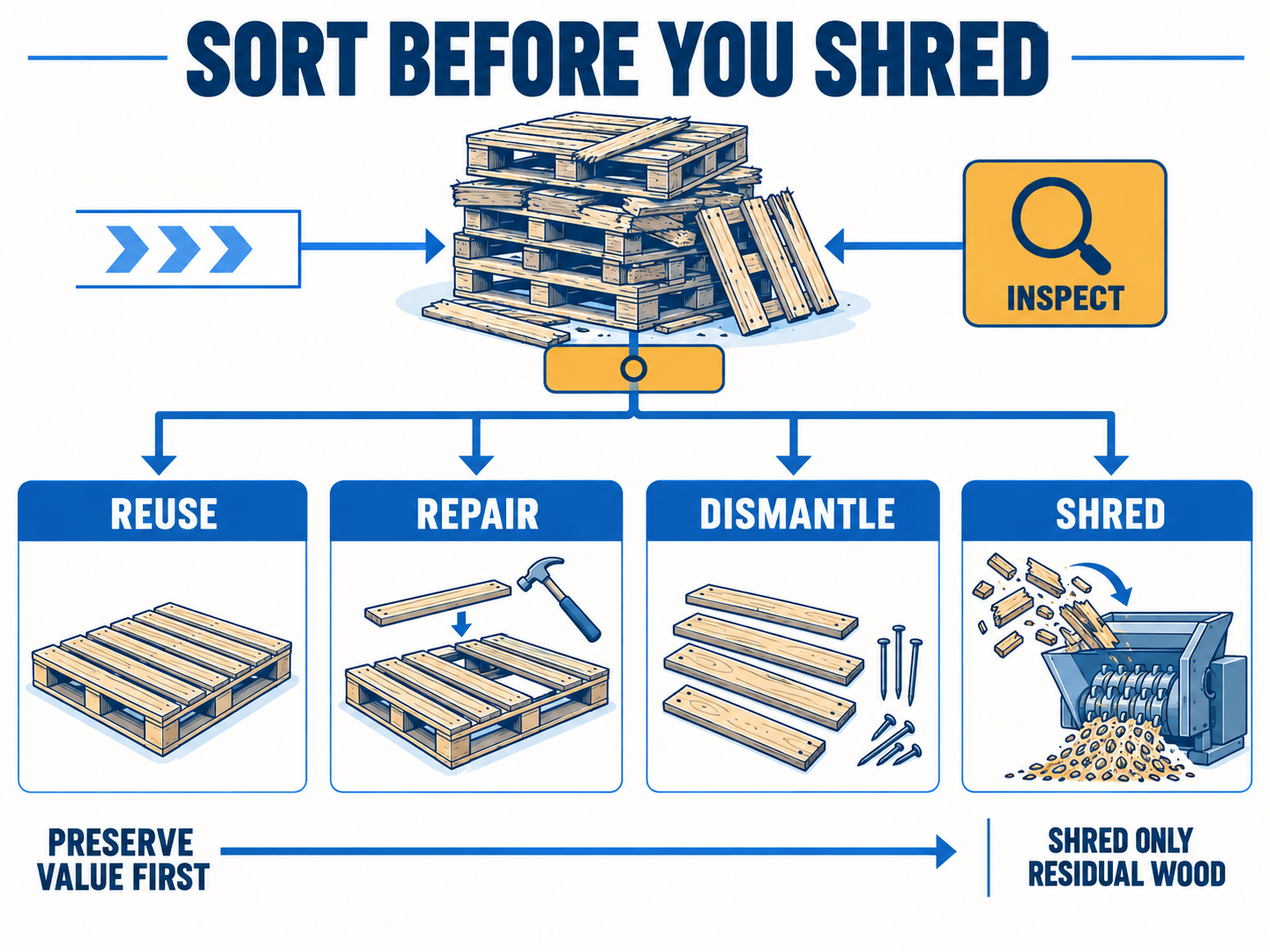
Sorting is the decision point that prevents a recovery line from destroying value too early. A mixed stack of used pallets can contain units that are ready for another trip, units that need a small repair, boards worth saving, and wood that is no longer suitable for a pallet role. Those conditions should not be treated as one feedstock simply because the material arrived on a truck together.
Path 1: reuse or repair
Reuse is the simplest recovery path when the pallet is still structurally sound and the receiving operation accepts its condition. Repair is appropriate when a defined defect can be corrected without creating a new safety problem. Common checks include broken deck boards, split stringers, loose fasteners, damaged blocks, excessive deformation, and contamination that makes the unit unsuitable for the intended load.
The decision should be based on the pallet’s next duty, not on appearance alone. A pallet that looks usable may fail a load or handling requirement, while a pallet with a replaceable board may be worth restoring. The person or operation accepting the repaired pallet owns the final use requirement. A recycling workflow should record that boundary instead of treating repair as a universal pass.
Path 2: dismantle for usable components
Some pallets are not worth repairing as complete units but still contain boards, blocks, or stringer sections that can be recovered. Dismantling separates those components from damaged or contaminated wood. It may reduce the amount of material that needs mechanical processing and preserve a higher-value route for the pieces that still have a practical use.
This path also makes the later wood stream more predictable. Instead of sending a whole pallet, loose hardware, sound boards, and broken fragments into one opening, the operation can remove the parts that have a separate destination. The exact method depends on the pallet construction and the facility’s tools. The article does not assume that one dismantling method suits every pallet design.
Path 3: reduce the remaining wood
Shredding becomes relevant when the remaining wood has no safe or practical pallet role and the operation has a defined material outlet. The feed may include broken boards, damaged stringers, blocks, and other wood pieces after the reusable fraction has been removed. The target is not merely a smaller pile. The target is a form that can be conveyed, stored, screened, or used by the next process.
A pallet shredder can be part of this path, but the appropriate configuration depends on the actual feed and target output. Whole pallets, loose boards, engineered wood, and mixed shop scrap can behave differently. The operation should document the most difficult expected load, not just the cleanest sample.
Path 4: hold, reject, or route separately
Not every pallet should be forced into a planned recycling path. Visible contamination, unusual treatments, moisture problems, embedded material, mixed plastic or metal, or an unknown downstream acceptance rule may require a hold and review. The correct action can be a separate route, a supplier or compliance check, or a decision to delay processing until the material is understood.
Decision rule: If the next use is undefined, the feedstock is not representative, or acceptance is unknown, stop the equipment comparison and resolve that uncertainty first.
Use this sorting checklist before discussing a recycling machine:
- Is the pallet still safe and useful in its original role?
- Can a defined repair restore that role without hiding a structural problem?
- Are any boards, blocks, or stringers worth recovering separately?
- What wood remains after reuse and dismantling decisions?
- Are nails, staples, coatings, moisture, or other contaminants present?
- Does a known downstream user accept the proposed material form?
The purpose of this branch is not to make sorting complicated. It is to keep four different decisions from being mixed together: preserving a pallet, restoring a pallet, recovering a component, and reducing wood to feed a different product. Each branch has a different success condition and a different risk if the material is misrouted. The same feedstock-first logic appears in the site’s plastic shredder selection guide, although the material behavior is different.
Citation capsule: Sorting protects value before the machine sees the material. In a 2012 BioResources study, wood-pallet repair was examined as a distinct process rather than a synonym for disposal. That distinction supports a practical branch: reuse or repair sound units, dismantle recoverable components, and evaluate only residual wood for shredding against a defined output.
What Happens Before a Pallet Reaches the Shredder?
The word pallet is not enough information to define a shredding feed. A recycling operation should describe what is actually arriving, what has already been removed, and what the recovered output must do next. Those details protect the buyer from comparing machines against an idealized sample that does not represent daily loads.
Confirm the feedstock boundary
Start with the physical form of the material. Are loads made up of complete block pallets, stringer pallets, broken frames, loose boards, or a changing mixture? Note the largest recurring item, the typical item, and the difficult item. A line that sees whole pallets has a different receiving and feeding problem from a line that sees pre-dismantled boards.
Record wood variation as well. Hardwood, softwood, engineered panels, painted parts, damp material, and fine scraps may not behave the same way. The purpose is not to create a perfect laboratory classification. It is to give the equipment discussion a realistic range instead of a category label with no boundaries.
Account for nails, staples, and contamination
Fasteners are a normal part of many pallet streams, but normal does not mean irrelevant. Nails and staples can affect cutting, wear, discharge, downstream handling, and the cleanliness expected by the next user. The buyer should say whether fasteners remain in the feed, whether any separation occurs before or after size reduction, and what level of metal carryover the downstream use can tolerate.
Also identify contamination that changes the route. Examples include soil, moisture, chemicals, paint, treated wood, plastic wrap, straps, or unrelated waste mixed into the load. This article does not assign a universal acceptance rule to those conditions because acceptance depends on the facility, the destination, and local requirements. It does require that the conditions be disclosed and checked.
Define the output before selecting the process
The output question should be written before a machine shortlist is made. Is the material intended for mulch, biomass fuel, animal bedding, composite fiber, or another use? Those paths may place different emphasis on cleanliness, form, handling, screening, storage, or downstream separation. A smaller piece is not automatically a better piece if it no longer fits the buyer’s process.
The output description should include the receiving party or next process, the preferred material form, unacceptable contamination, and any handling or storage limits that are already known. If no downstream use is defined, the operation has an education or market-validation problem before it has an equipment-selection problem.
Feedstock note: A representative sample should show the normal material and the difficult edge of the expected stream. Do not use a clean demonstration load to stand in for mixed daily material.
Keep buyer inputs separate from supplier confirmation
The buyer owns the description of incoming material, contamination, volume pattern, site constraints, and intended output. A supplier or equipment engineer can then confirm feeding, cutting, collection, safety, and test requirements against that description. These are related but not interchangeable responsibilities.
The separation matters because a generic application page may say that pallet waste can be reduced, while a real line still needs to establish how the specific stream is received, guarded, conveyed, collected, and accepted downstream. The correct next step is a material-test or bounded technical discussion, not a universal promise based on the noun pallet. The staged logic is also visible in how a tire recycling process is mapped, even though tires and pallets require different preparation decisions.
Use this preparation record:
- Material type and pallet construction observed.
- Whole, broken, dismantled, or loose feed presentation.
- Fasteners, moisture, coatings, and unrelated contamination.
- Normal and difficult load examples.
- Target output and downstream user or process.
- Handling, storage, safety, and site constraints that are already known.
Citation capsule: Before a shredder is selected, the feed boundary must be written down. Recycling Equipment, Inc. describes wood-pallet shredding as an application tied to incoming scrap and the intended reduction task. In a 2012 repair-process study, pallet condition and repair handling were also treated as process variables, reinforcing the need for representative feed samples.
Where the Pallet Shredder Fits in the Recycling Line
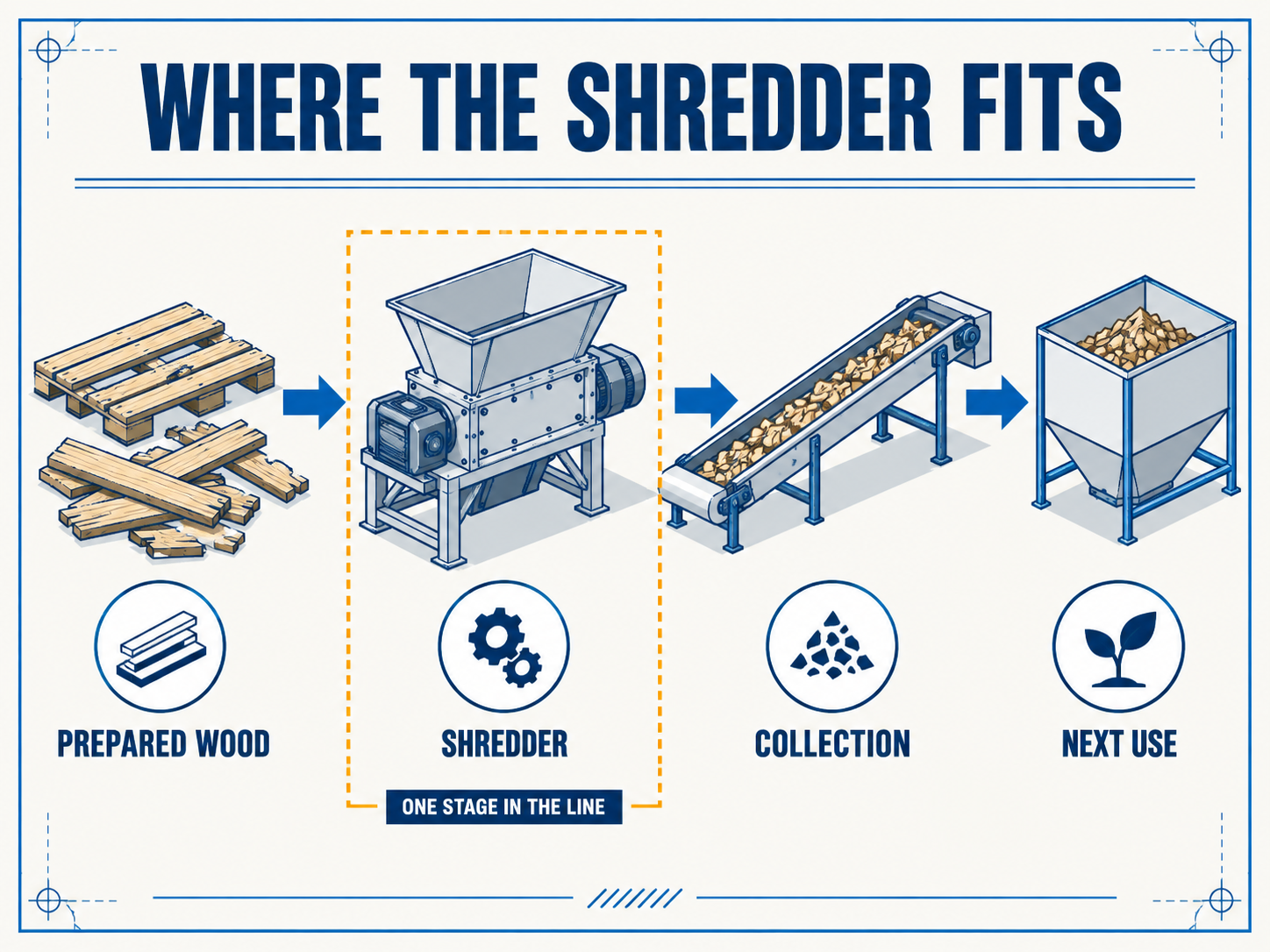
A pallet shredder is the size-reduction stage that changes prepared wood into a more manageable material form. That change can make conveying, collection, screening, storage, or a downstream use more practical. It does not, by itself, determine whether a pallet should have been repaired, whether a contaminated load is acceptable, or what a buyer will do with the recovered output.
What size reduction changes
Whole pallets and broken pallet parts occupy space and can be awkward to move. Size reduction changes the geometry of that material so the next handling step can work with a more consistent stream. In a planned application, the equipment discussion connects the incoming form, the feeding method, the cutting chamber, discharge, collection, and the next process.
The useful question is not simply whether a machine can cut wood. It is whether the resulting material behaves as required after it leaves the machine. Can it be conveyed without creating a bottleneck? Can it be stored without creating a housekeeping or fire concern? Can it be screened or separated as the downstream process expects? The answer depends on the full application boundary.
What the shredder does not replace
The shredder does not replace receiving inspection. It does not decide whether a pallet is reusable, and it does not turn an unknown mixed load into a verified feedstock. It does not automatically remove every nail or contaminant, create a market for the material, or satisfy local safety and environmental requirements.
That is why the preparation steps remain visible in a good pallet recycling plan. Sorting protects reusable value. Dismantling can recover useful components. Feed preparation defines what enters the size-reduction stage. Downstream collection and acceptance determine whether the material can become a useful product rather than another handling problem.
How feeding and collection affect the result
Supporting equipment matters because a shredder cannot operate independently of material flow. Receiving bins, hoppers, conveyors, tippers, discharge conveyors, screens, magnets, or collection systems may be relevant depending on the feed and the output. Their exact arrangement is an application decision, not a universal layout that can be copied from one pallet operation to another.
Document how material arrives at the machine, who loads it, how interruptions are handled, where the output goes, and what happens when an unsuitable item appears. The goal is a stable and safe flow from prepared feed to the next stage. A line that handles whole pallets continuously may need a different material-handling boundary from a line that processes loose boards in batches.
Boundary callout: The shredder changes material size. Inspection, preparation, contamination control, collection, and downstream acceptance remain separate parts of the recycling job.
This also explains why a generic machine comparison can be premature. A single machine label does not disclose the incoming material range, feeding method, target output, or safety boundary. Those questions should be answered with the actual material before performance claims are made. A feedstock-to-machine selection example can provide context, but it does not replace a pallet-specific review. The site’s tire recycling plant overview also shows why receiving, size reduction, and downstream handling belong in one process map.
A practical handoff
The handoff from shredding to the next process should be written in one sentence: prepared pallet wood leaves the size-reduction stage in a defined form and moves to a known collection, screening, storage, or end-use route. If that sentence cannot be completed, the operation is not ready to judge whether a pallet recycling machine is a fit.
Citation capsule: A pallet shredder is one stage in a broader recycling line. Franklin Miller presents wood-pallet shredding as an application step, while a 2012 BioResources study shows why upstream pallet condition and repair decisions remain separate. The practical conclusion is that size reduction must connect to feeding, collection, separation, and a verified downstream use.
What Can Recovered Pallet Wood Become?
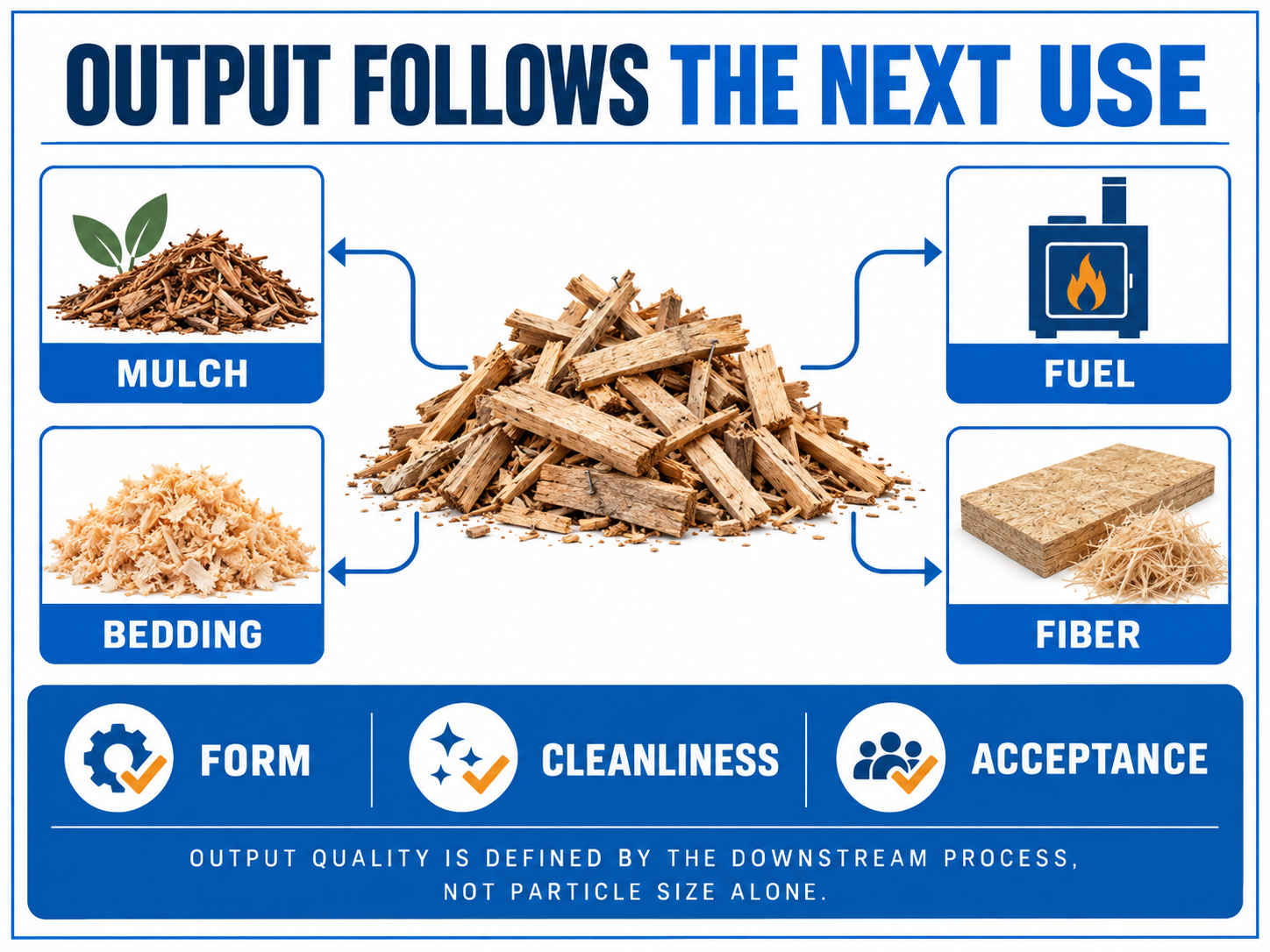
Recovered pallet wood does not have one automatic destination. The right route depends on the material’s condition, cleanliness, form, and the requirements of the next user. A recycling plan should therefore start with the intended output and work backward to the feed preparation and size-reduction decisions.
Mulch, bedding, fuel, and fiber are not interchangeable
Wood chips may be suitable for a landscaping or mulch route when the receiving process accepts the material and the contamination boundary is controlled. A biomass or boiler-fuel route may place different emphasis on moisture, handling, and the energy process. Bedding or litter applications require their own acceptance checks. Composite or fiber uses may need a particular material form and a controlled input stream.
These examples illustrate possible pathways, not guarantees. The same pile of damaged pallets may be accepted for one use and rejected for another. A buyer should confirm the destination before choosing a process that changes the wood permanently. The article intentionally does not assign prices, recovery rates, or universal grades to these outlets.
Match output quality to the downstream use
Write down what the next process can accept. The record may need to describe the material form, expected contamination, fastener carryover, moisture condition, storage method, and whether additional screening or cleaning occurs. If the downstream user needs a different form, the recycling line may need another stage after primary size reduction.
This is also where the phrase pallet recycling machine can become misleading. A machine may reduce the wood, but the final product is defined by the complete route and the receiving specification. The equipment should be evaluated against that route rather than against a generic promise to make pallets smaller.
Why acceptance must be checked before processing
Acceptance is a practical control. It protects the operation from shipping a load that a recycler, fuel user, bedding buyer, or fiber processor cannot use. It also protects the equipment discussion from hidden assumptions about treated wood, contamination, mixed material, or acceptable fastener content.
Ask the downstream user or process owner what is accepted, what is rejected, and how the material is checked. If the answer is not available, mark the output as unconfirmed. That is a useful result because it tells the team to delay a final machine decision until the end-use boundary is clearer.
Output note: A smaller particle is not automatically a better output. It is better only when its form and cleanliness support the next verified use.
The output plan can be represented as four questions:
- What is the intended next use?
- What material form does that use accept?
- What contamination or fastener condition is unacceptable?
- Who confirms acceptance before the material is processed at scale?
Answering those questions turns a vague sustainability goal into an operational handoff. It also gives a supplier something testable to evaluate without inventing a guaranteed market or universal equipment result.
Citation capsule: Recovered pallet wood can follow several end-use paths, but mulch, fuel, bedding, and fiber are not interchangeable. The downstream user or process must define acceptable material form and contamination before the recycling line is selected, because size reduction alone does not determine product value.
What to Document Before Choosing Pallet Recycling Equipment
The strongest equipment request is a material-and-output brief, not a request for the biggest pallet shredder. It should show what comes in, what has already been removed, what the line must produce, and what the downstream user will accept. This keeps buyer inputs separate from supplier-confirmed machine design and makes a later material test more useful.
Feedstock record
Document the pallet construction and presentation. State whether the stream contains whole pallets, broken frames, loose boards, dismantled parts, or a changing mix. Include the largest recurring item, the normal load, and the difficult edge case. Add observations about moisture, coatings, fasteners, plastic wrap, straps, soil, and other contamination.
Do not hide uncertainty behind the word wood. If the material changes by supplier, season, product line, or warehouse, record that range. A sample should represent the material that the line is expected to process, not only the cleanest pieces selected for a demonstration.
Process and safety questions
Ask how the material will be received, loaded, fed, discharged, collected, and inspected for unsuitable items. Clarify what happens when a metal-heavy or contaminated item arrives. Identify the point at which operators can stop the flow, clear a problem, and inspect the equipment safely. The exact safety design belongs to the supplier and site review, but the operating boundary must be stated by the buyer.
Also document the space, utilities, storage, housekeeping, dust, noise, fire, and access conditions that are already known. This is not a request for the article to prescribe a universal compliance solution. It is a reminder that a machine is installed in a real site with real constraints.
Output and acceptance record
Name the next use or process. It may be mulch, biomass fuel, bedding, composite fiber, or another defined route. Then record the preferred material form, unacceptable contamination, expected storage or conveying method, and who confirms acceptance. If additional screening, cleaning, magnetic separation, or another stage is expected, place it in the process map instead of assuming the primary shredder completes it.
Buyer versus supplier: The buyer describes the material and desired outcome. The supplier confirms the suitable feeding, cutting, collection, protection, controls, and test conditions against that evidence.
When to pause the purchase
Delay a final equipment decision when the feedstock is not representative, the output buyer is unknown, contamination is undisclosed, or the operation is comparing machines only by a broad label such as pallet shredder. A delay is not a failure. It prevents the team from selecting equipment before the decision criteria exist.
Use this pre-RFQ checklist:
- Feed description: pallet type, dimensions, whole or broken presentation, and expected variation.
- Condition: repairable share, dismantle-only share, and residual wood stream.
- Contamination: nails, staples, coatings, moisture, plastic, metal, and unrelated material.
- Flow: receiving, loading, feeding, discharge, collection, storage, and handling of rejects.
- Output: intended next use, accepted form, contamination limit, and downstream owner.
- Verification: representative sample, test objective, acceptance criteria, and open unknowns.
The checklist also gives the article’s internal links a clear role. The site’s textile shredder applications guide shows how material-specific pages can explain feedstock boundaries, while the e-waste shredder line guide illustrates why mixed-material handling needs its own process questions. None of those links should be read as a universal fitment claim for an untested pallet stream.
The final decision should be simple to state: the operation knows what material it will process, what output it needs, what the next user accepts, and what must be verified in a material test. If one of those statements is missing, keep researching the application instead of forcing the purchase.
Citation capsule: Before choosing pallet recycling equipment, document the incoming wood, repair and dismantling boundary, fasteners and contamination, feeding and collection conditions, target output, downstream acceptance, and test criteria. A machine comparison becomes meaningful only after those buyer inputs are defined and supplier-confirmed design questions are separated from them.
Conclusion
Pallet recycling starts with classification, not with a machine label. Keep pallets that still have structural value in the reuse or repair path, recover useful components where dismantling makes sense, and send only the residual wood stream to size reduction after its contamination and handling boundary are understood.
The equipment decision becomes clearer when the next use is written down first. Document the real feed presentation, fasteners, moisture, contamination, feeding conditions, target output, and acceptance criteria. Then a supplier or engineer can evaluate the shredder stage against a representative material test instead of a generic promise about pallet waste.
References
- Bush, R. J., Araman, P. A., Hammett, T. A., & others. (2012). Process methods and levels of automation of wood pallet repair in the United States. BioResources. https://bioresources.cnr.ncsu.edu/resources/process-methods-and-levels-of-automation-of-wood-pallet-repair-in-the-united-states/
- Recycling Equipment Inc. (n.d.). Industrial pallet and wood shredders for heavy scrap reduction. https://www.gogreenrei.com/application/wood-pallet/
- Wiscon Envirotech. (n.d.). Pallet shredder for wooden pallet and plastic pallet. https://www.wiscon-tech.com/pallet-shredder
- Olympic Forest Products. (n.d.). What goes into wood pallet recycling? https://www.olyforest.com/pallet-industry-news-blog/wood-pallet-recycling
- Franklin Miller. (n.d.). Wood pallet shredders. https://franklinmiller.com/applications/wood-pallet-shredders
Last reviewed and updated: September 2026. Author: Kingstream team. For tailored guidance, contact our team.