
TL;DR
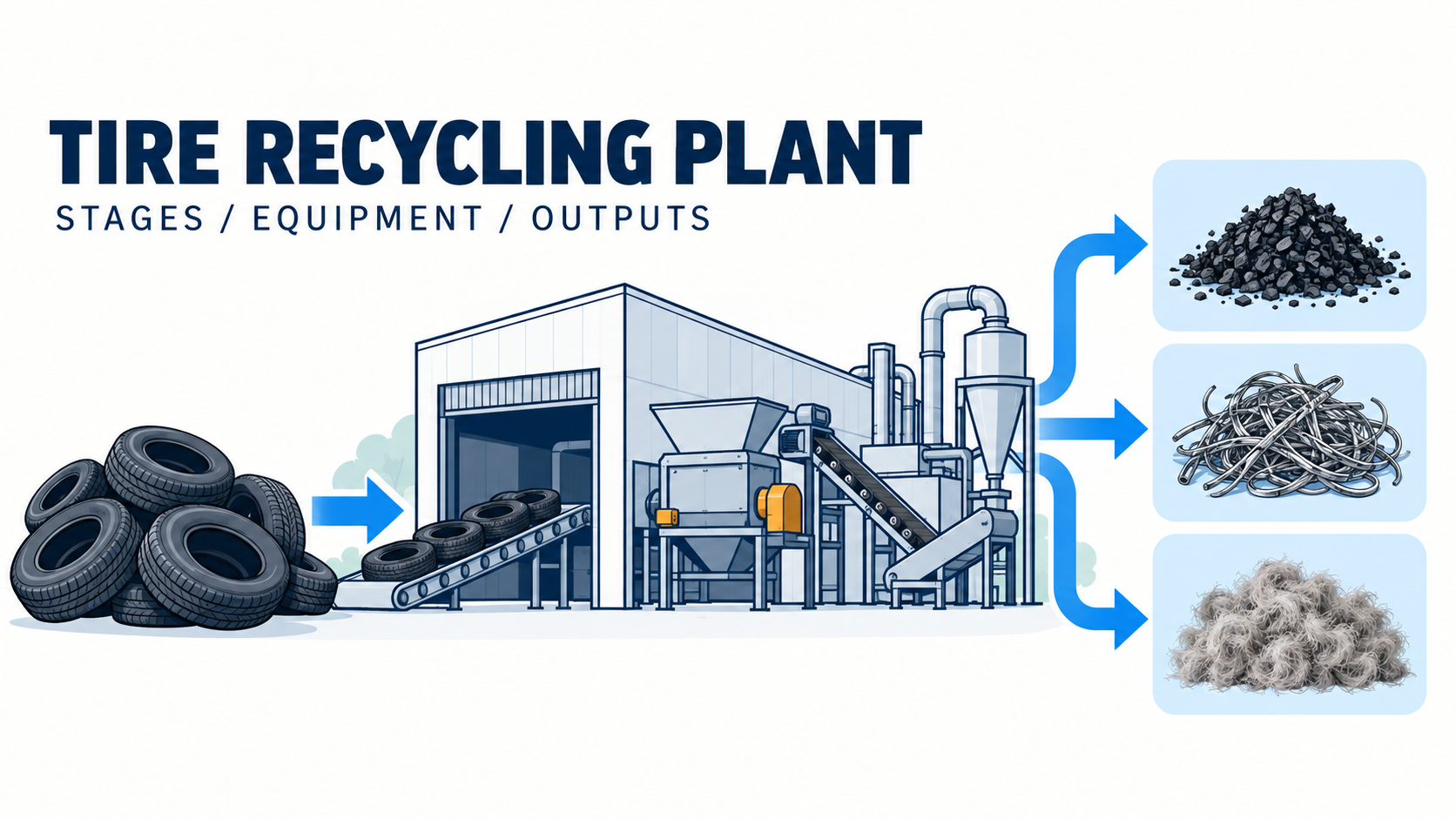
A tire recycling plant is a staged material-flow system, not a single machine. Tires are received and sorted, prepared for safe feeding, reduced in size, and separated into rubber, steel, and textile fractions. The final equipment path depends on the incoming tire mix, contamination, target output, downstream use, and site constraints. Those inputs should be defined before a supplier sizes the line or prepares a quotation.
Abstract
The guide explains how an industrial tire recycling plant moves end-of-life tires through preparation, staged size reduction, separation, screening, and recovered-material handling.
Key Takeaways
- A plant is a connected material-flow system, not one shredder.
- Feedstock type and contamination set the first design boundary.
- Size reduction and separation are staged to free recoverable fractions.
- Output goals determine whether the line stops at chips or continues to finer products.
- A real-material test and written acceptance criteria belong before approval.
Table of Contents
- Abstract
- Key Takeaways
- What Is a Tire Recycling Plant?
- What Enters the Plant and What Must It Produce?
- How a Tire Recycling Plant Works: The Material Flow
- How Output Goals Change the Equipment Path
- How Feedstock Conditions Change the Line
- What to Confirm Before Requesting a Tire Recycling Plant Quote
- Where a General Plant Guide Stops
- Conclusion: Map the Process Before Choosing Machines
- References
What Is a Tire Recycling Plant?
A tire recycling plant is a connected material-processing system for end-of-life tires. It receives a defined tire stream, changes the size and shape of that material, separates the main components, classifies what remains, and routes each fraction to storage or a downstream use. The phrase does not describe one universal machine or one fixed layout.
The plant normally has three jobs:
- make bulky tires safe and manageable to feed;
- liberate rubber from steel and textile reinforcement through staged processing;
- deliver outputs that match the next user’s size, cleanliness, handling, or material requirements.
The equipment list follows those jobs. Receiving and handling equipment controls the incoming stream. Preparation equipment deals with rims, bead areas, difficult sections, or obvious contaminants when required. A primary shredder changes whole tires into a coarse stream. Later grinders or granulators reduce that stream further, while magnetic, air, and screening systems separate and classify the recovered materials.
The result may include coarse tire chips, rubber granules, fine rubber powder, recovered steel, and a textile fraction. A plant may produce one of these outputs, several of them, or intermediate material for another process. The intended output determines how far the material must travel through the line.
Scope note: The article explains the general mechanical workflow and the information needed for an equipment discussion. It does not set a universal capacity, purity, power, price, or regulatory requirement for a specific facility.
Key term: "Tire recycling plant" refers to the full connected workflow. "Tire recycling machine" may refer to one machine inside that workflow. Keeping those terms separate avoids treating one component as the complete solution.
Citation capsule: A tire recycling plant is a staged system that prepares end-of-life tires, reduces their size, separates rubber from steel and textile reinforcement, and classifies the resulting fractions. Its layout is defined by the incoming tire stream and the output required by the next process, not by a single standard machine list.
What Enters the Plant and What Must It Produce?
The plant brief starts at the receiving area, not at the shredder. A supplier needs to understand what arrives, how consistent it is, and what the recovered material must become. Passenger tires, truck tires, agricultural tires, and larger off-the-road tires can differ in diameter, reinforcement, sidewall construction, weight, and handling difficulty. A mixed load can introduce variation even when every item is technically a tire.
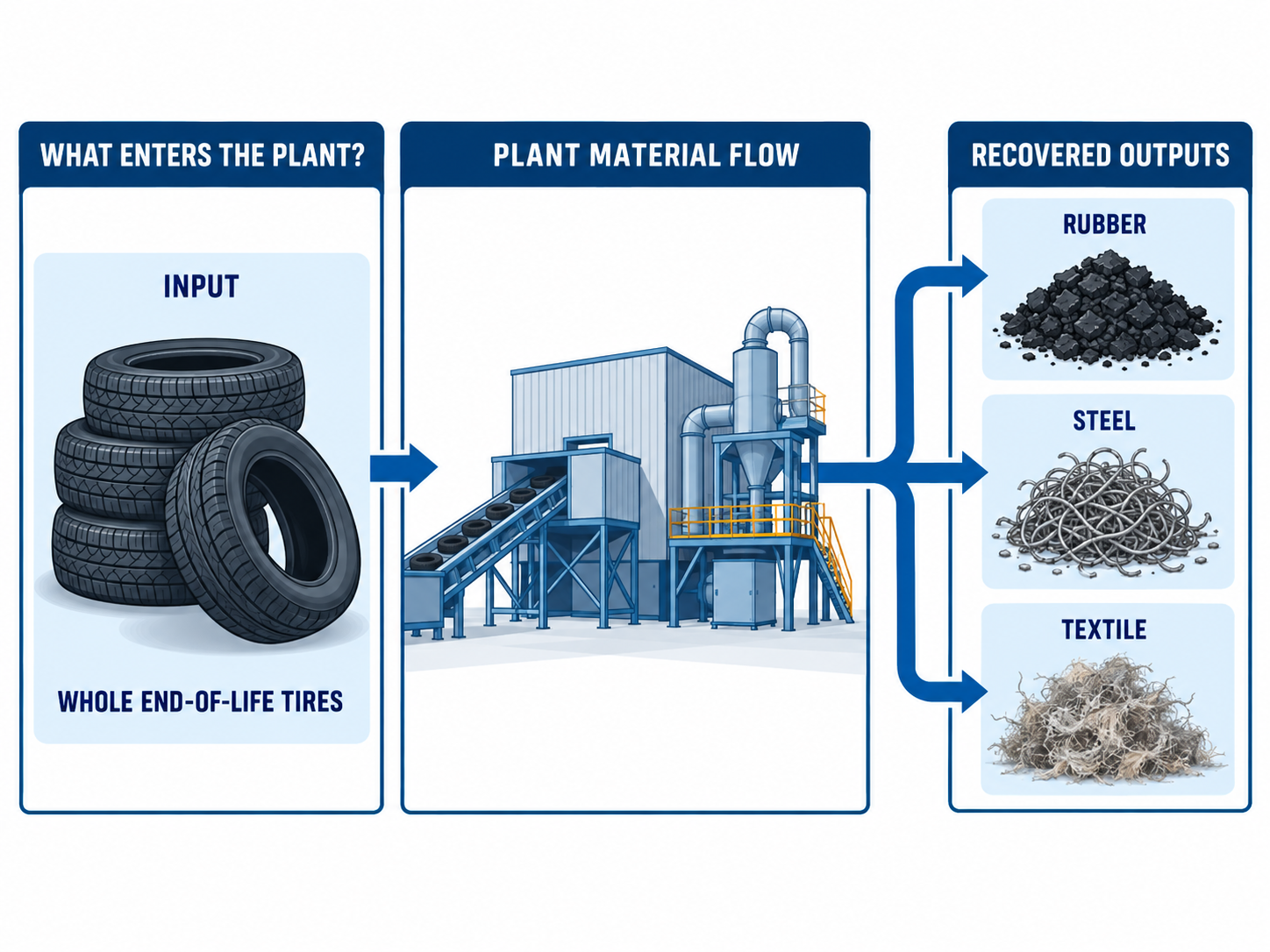
Incoming tire streams
Record the practical condition of the feedstock before discussing equipment. Useful questions include:
- Are the tires mostly passenger, truck, agricultural, or off-the-road units?
- Are rims, mud, stones, or other foreign materials present?
- Does the line receive a steady sorted stream or irregular mixed loads?
- Are unusually large or heavily reinforced tires part of the normal feed, and will the tires be stored before processing or moved differently into the line?
These inputs affect feeding, preparation, wear exposure, material flow, and which supplier-test results are relevant to the actual plant.
Material changes through the line
The material changes in a sequence. Whole tires become manageable pieces. The pieces become a rubber-bearing stream mixed with liberated steel and textile material. Separation then creates different fractions, and screening gives the rubber stream a defined size or route. Some oversize material may return for another reduction pass if the line is designed for recirculation.
Rubber, steel, and textile outputs
Rubber is usually the largest material family discussed in a mechanical recycling line, but it is not the only output. Recovered steel can be collected as a separate ferrous stream. Textile fiber can leave as a light fraction or remain a contamination concern, depending on the process and the required output. The final destination matters because a coarse chip, a rubber granule, a fine powder, a steel stream, and a textile fraction are not interchangeable products.
Planning callout: Define the output in terms that a receiving process can accept. "Recycled rubber" is too broad for a quotation. State whether the goal is coarse chips, graded granules, fine powder, separated steel, a textile fraction, or an intermediate feed for another route.
Material map
Whole end-of-life tires → preparation and size reduction → rubber-bearing stream + liberated steel + textile fraction → separation and screening → classified outputs
Citation capsule: The plant brief has two sides: the feedstock entering the line and the output that must leave it. Tire type, reinforcement, contamination, and storage affect the front end, while the required chip, granule, powder, steel, or textile destination determines how much separation and classification the line must provide.
How a Tire Recycling Plant Works: The Material Flow
The following sequence is a planning model for a mechanical tire recycling plant. It explains the role of each stage and the handoff to the next stage. It is not a universal engineering drawing. Actual layouts can add, remove, or reorder equipment after feedstock tests, site review, safety review, and output acceptance requirements are known.
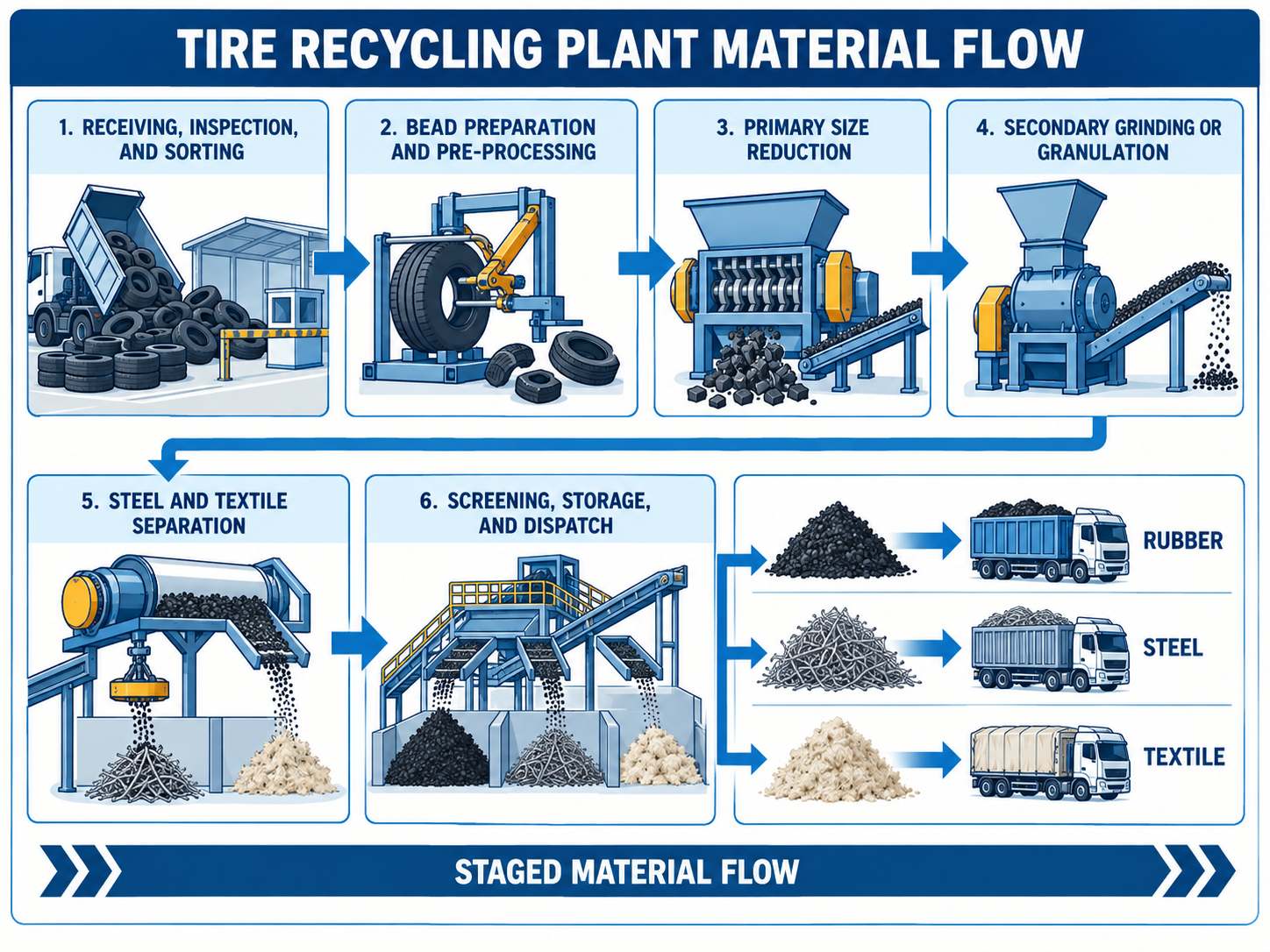
| Stage | What changes | Typical equipment role | Handoff question |
|---|---|---|---|
| Receiving, inspection, and sorting | Whole tires are staged and checked against the accepted feed | Hoppers, conveyors, inspection points, and handling equipment regulate the stream | What tire types and contaminants are allowed into the line? |
| Bead preparation and pre-processing | Difficult sections or obvious preparation issues are addressed when required | Bead, cutting, or preparation equipment makes the feed more manageable | Does the next machine receive material in a form it can safely process? |
| Primary size reduction | Whole-tire geometry becomes a coarse, manageable stream | A primary shredder cuts or tears the tires and controls the first major size change | Is the coarse output suitable for the next separator or reduction stage? |
| Secondary grinding or granulation | Shreds become smaller particles and more reinforcement is liberated | Granulators, grinders, or a further reduction stage refine the material | Is the rubber sufficiently liberated for the intended separation? |
| Steel and textile separation | Ferrous wire and light textile material are pulled away from the rubber stream | Magnetic separators, air separation, screens, or dedicated modules divide fractions | Are the recovered streams clean enough for their defined handoff? |
| Screening, storage, and dispatch | Rubber is classified, routed, stored, or returned for another pass | Screens, conveyors, bins, silos, and bagging or loading systems manage final flow | Does each output have a defined size, container, and receiving process? |
1. Receiving, inspection, and sorting
The receiving stage establishes the boundary for everything downstream. Tires may arrive from different collection sources, and the plant needs a practical way to identify the stream it is designed to accept. Inspection can reveal rims, mud, stones, unusual sizes, or other conditions that change feeding and preparation. Sorting does not need to mean a perfect manual classification of every tire, but the plant brief should state which variations are normal and which require a separate route.
2. Bead preparation and pre-processing
The bead area contains concentrated reinforcement and can present a different cutting condition from the tread or sidewall. Some lines use dedicated preparation or debeading before primary shredding, while others handle the bead within a later stage. The correct choice depends on the tire mix and connected equipment, so bead and difficult sections must be considered before approval.
3. Primary size reduction
Primary shredding is the transition from bulky whole tires to manageable material, not a finished rubber product. The discharge may still contain rubber, steel, textile, and oversize pieces. A screen, conveyor, separator, or buffer determines the next handoff. For a deeper machine-selection question, use the site’s tire shredder selection.
4. Secondary grinding or granulation
Further reduction exposes more of the embedded reinforcement and changes the particle form. The line may use one or more downstream reduction stages, depending on whether the target is a coarse chip, a rubber granule, a fine powder, or an intermediate stream. Do not attach a universal particle-size promise to the phrase "secondary grinding." The output must be defined and tested for the intended receiving process.
5. Steel and textile separation
Steel separation is often staged around size reduction because wire must be liberated before it can be removed effectively. Magnets can be placed at points where the material is exposed and moving in a controlled layer. A second separation point may be useful when later processing frees additional wire. Textile material behaves differently from rubber and steel, so air, screening, or a dedicated fiber step may be used when the target output requires it.
6. Screening, storage, and dispatch
Screening sorts the stream by size or handling behavior. It can create a finished fraction, return oversize material, or divide material into separate downstream routes. Storage and conveying are part of the plant, not an afterthought. A good process map shows where each fraction goes, how it is contained, and what prevents the outputs from being mixed again before dispatch.
Citation capsule: Mechanical tire recycling works as a sequence of handoffs. Receiving defines the feed, primary shredding changes whole-tire geometry, later reduction liberates material, separation removes steel and textile fractions, and screening routes the remaining rubber by the requirement of the next process. The equipment list is meaningful only when those handoffs are explicit.
How Output Goals Change the Equipment Path
The same incoming tire can enter different process paths when the required output changes. A plant that needs a manageable coarse stream has a different stopping point from a plant that must deliver classified rubber with steel and textile fractions removed. The output decision should therefore come before a supplier recommends the final process depth.
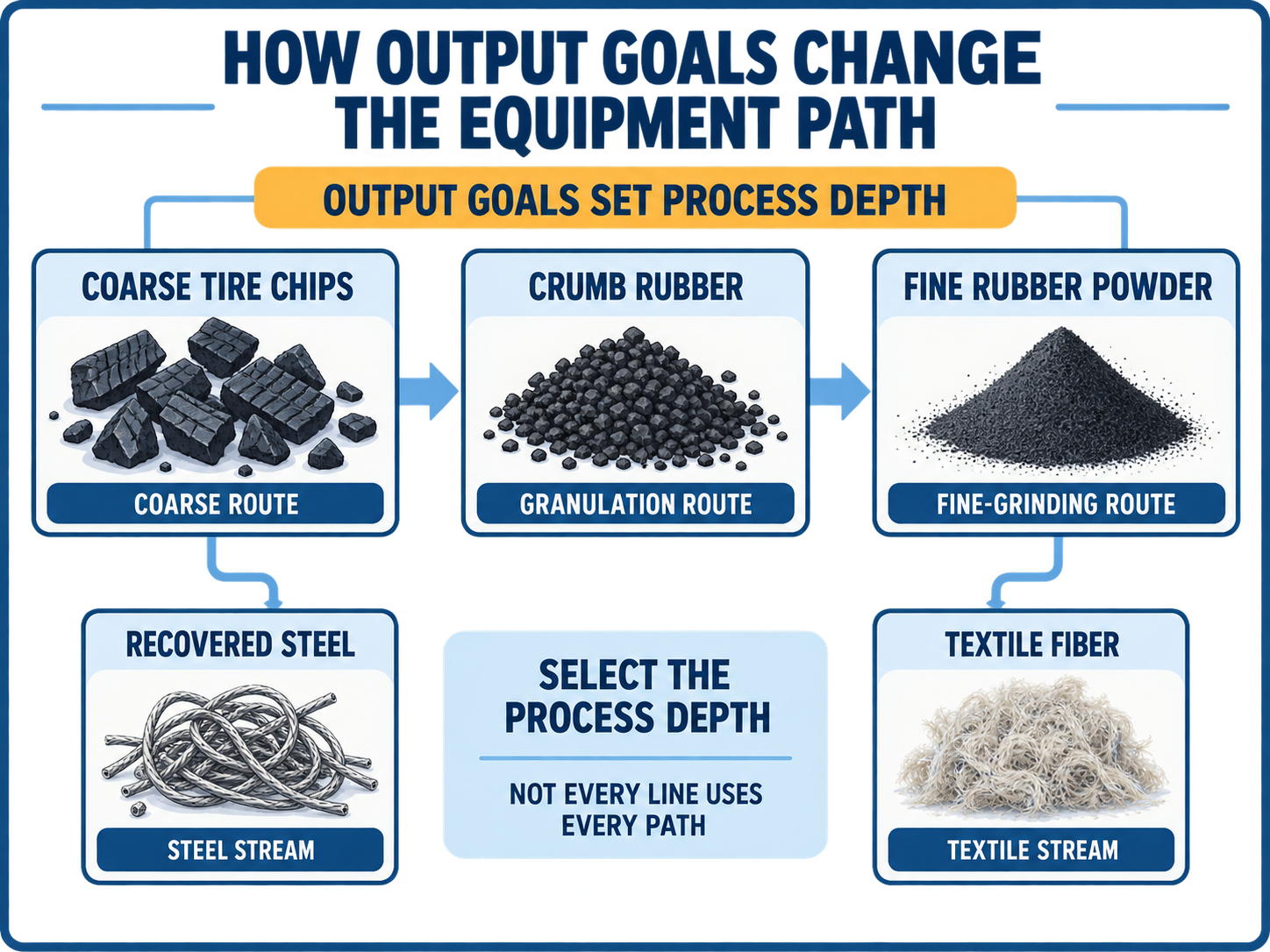
Coarse tire chips
The coarse route focuses on making whole tires easier to handle, store, transport, or feed into a defined downstream use. Primary size reduction may be the main transformation, with inspection and major contaminant management around it. The buyer still needs to define an acceptable chip form and the receiving process. A coarse stream should not be described as clean crumb rubber if steel or textile material remains mixed into it.
Crumb rubber and granules
Granule routes continue size reduction after primary shredding and add separation and screening steps that the coarse route may not need. The important questions are how the rubber is liberated, how steel is removed, how textile carryover is handled, and how the material is classified. A granule route is complete only when the receiving application can accept the resulting size and contamination condition.
Fine rubber powder
Fine powder requires a deeper process boundary than a coarse chip. Additional grinding, classification, and contaminant control may be required, but the need cannot be confirmed from the word "powder" alone. The target mesh or particle distribution, test method, moisture condition, packaging method, and receiving specification belong in the project brief. If those fields are unknown, a fine-powder promise is premature.
Recovered steel and textile fractions
Steel and textile are not merely waste left after the rubber is made. They are separate streams that affect the quality of the rubber output and the handling plan for the plant. Magnetic separation can recover ferrous wire, while airflow or screening can address lighter textile material. The exact route depends on how much material is liberated, how clean the receiving outlet must be, and whether a separated fraction has a defined use.
Output path cards
Coarse route
- Choose when the next process accepts a manageable tire-chip stream.
- Confirm chip definition, major contaminant limits, and storage method.
- Do not assume fine rubber separation is included.
Granule route
- Choose when a smaller, classified rubber fraction is required.
- Confirm steel and textile separation points and screening logic.
- Test the actual feed because reinforcement and contamination change the result.
Fine route
- Choose when the receiving process needs a finer rubber fraction.
- Confirm target distribution, test method, packaging, and acceptance criteria.
- Treat further grinding as a design decision, not an automatic upgrade.
The site’s tire recycling process provides a broader process reference. The page adds the plant-level question: where should the line stop, and what must be verified at that boundary?
Citation capsule: Output goals set process depth. Coarse chips, rubber granules, fine powder, recovered steel, and textile fractions require different handoffs and acceptance checks. A responsible plant brief defines the receiving requirement first, then asks the supplier to verify the reduction, separation, screening, storage, and testing steps that support it.
How Feedstock Conditions Change the Line
The process logic is stable, but a line cannot be specified from the word "tire" alone. Size, reinforcement, contamination, moisture, and load consistency change feeding, preparation, and buffering. These inputs should be described before a supplier confirms the equipment arrangement.
Passenger and truck tires
Passenger and truck tires can arrive together, but a mixed stream should be treated as an operating condition, not hidden inside a generic label. Differences in diameter, sidewall construction, weight, and steel content can affect feeding and cutting behavior. If the line receives a separated stream, record the separation rule. If it receives mixed loads, make that variation part of the test material and acceptance discussion.
Large or OTR tires
Large off-the-road tires can create a different front-end problem from passenger tires. Their size and construction may require handling, cutting, or preparation arrangements that a smaller stream does not. Ask whether the complete feed path can receive, prepare, reduce, move, and separate the largest normal item without an unplanned manual bottleneck.
Contamination and moisture
Mud, stones, rims, and other foreign material can change wear exposure and separation behavior. Moisture can also affect storage, flow, and the behavior of light fractions. The buyer should state whether these conditions are occasional exceptions or part of the daily feed. A supplier can then decide which inspection, cleaning, screening, or protection steps need to be tested rather than treating contamination as a vague adjective.
Mixed feedstock and buffer handling
Material flow does not end at the cutting chamber. Irregular receiving volumes and downstream interruptions can create a need for hoppers, conveyors, buffer storage, or separate routing. Show where material waits, where it is inspected, and how a fraction avoids returning to the wrong stream.
Decision framework
Ask four questions in order. First, define the normal feed and the largest or most difficult accepted item. Next, separate routine conditions from material that should be rejected or handled separately. Then define the output the next process must accept. Finish by identifying the point that requires a real-material test before approval.
The framework keeps a general guide from pretending to be a machine specification. Each proposal should state its feed assumptions, process boundary, handoffs, and verification method.
Glossary
- Feedstock: the tire stream entering the plant, including its type, size, condition, and consistency.
- Liberation: the point at which rubber is freed enough from steel or textile reinforcement for the intended separation step.
- Process boundary: the point where the plant stops and hands material to storage, dispatch, or another process.
- Acceptance criteria: the measurable or observable conditions used to decide whether an output is suitable for its receiving process.
Citation capsule: A tire recycling line is shaped by the feed it must accept. Mixed sizes, large tires, embedded reinforcement, contamination, moisture, and irregular supply can change feeding, preparation, separation, and buffering needs. Those conditions belong in the test brief and quotation assumptions, not in an unqualified universal machine claim.
What to Confirm Before Requesting a Tire Recycling Plant Quote
A useful request for quotation describes a process problem, not only a desired machine name. The more clearly the buyer defines the incoming material, target outputs, site conditions, and acceptance checks, the easier it is to compare proposals on the same basis. The list below is a preparation tool, not a promise that every item can be decided before a supplier test.
Feedstock brief
- List the normal tire categories and the expected mix.
- Identify the largest routine tire and any unusually reinforced items.
- Describe rims, mud, stones, moisture, and other contamination.
- State whether the feed arrives sorted, mixed, baled, loose, or irregular, and explain how tires are received, staged, and moved to the first machine.
The purpose is to make the feed assumption visible. Proposals using different tire mixes should not be compared directly unless the difference is documented.
Output and acceptance brief
- Define whether the first target is coarse chips, granules, powder, or a separated material stream.
- Describe the receiving process or customer for each output.
- State the required size description and test method, then define how steel and textile carryover will be checked.
- Identify packaging, storage, loading, or return-to-process requirements.
Avoid the phrase "high purity" without a method and threshold. It does not tell a supplier how to test the material, and it does not tell a buyer when the line has met the requirement. The same principle applies to "fine," "clean," "uniform," and "high capacity."
Site, safety, and integration brief
- Provide the available footprint, access route, floor or foundation information, and maintenance clearances.
- Identify electrical, dust-control, fire-protection, noise, and material-storage requirements that must be reviewed locally.
- Show where conveyors, bins, bagging, loading, and rejected material will be placed.
- Explain which existing machines or utilities must connect to the new line, and name the inspection, maintenance, and operating responsibilities on the buyer side.
These details identify the questions that need qualified site review before a layout or control arrangement is accepted.
Real-material testing and sign-off
Send representative material, not only a clean sample chosen because it is easy to process. Confirm what the test is meant to show: feeding, reduction, steel removal, textile handling, screening, output consistency, or the complete sequence. Record the feed description, process conditions, output observations, and test limitations.
Before approval, ask for written acceptance criteria and state what happens when a result falls outside them. A drawing and a machine list show intent. A documented test shows whether the proposed process addresses the actual material and receiving requirement.
Pre-RFQ checklist
feedstock profile + target outputs + site constraints + process boundary + test method + acceptance criteria + ownership of unresolved fields
The checklist is also a useful filter for supplier questions. If a proposal skips the feed assumptions or output test, ask for those items before comparing price or lead time.
Citation capsule: A meaningful tire recycling plant RFQ connects four items: the feedstock that will enter, the outputs that must leave, the site and integration limits, and the test or acceptance method used to verify the result. Without that chain, two quotations may describe different process assumptions even when they use the same machine names.
Where a General Plant Guide Stops
An educational article can explain the relationship between stages, but it cannot select a complete line for an unnamed facility. Capacity, power, wear rate, separation quality, particle-size distribution, layout, fire protection, dust control, and compliance requirements depend on the real feed, site, operating schedule, and receiving process. None should be treated as a universal value because a web page uses a familiar machine name.
Claims that require site verification
Verify any claim that changes the purchase decision. That includes guaranteed throughput, output size, recovery or contamination limits, energy use, maintenance interval, expected wear, noise, dust performance, and the ability to process a particular tire category. The relevant evidence may be a real-material test, a drawing, a control description, a maintenance plan, a local review, or a written acceptance clause. The correct evidence depends on the claim.
Safety and regulatory boundaries
Scrap tires are combustible, and a working plant includes storage, conveying, size reduction, dust management, access, emergency response, and maintenance risks. Local authorities and qualified site professionals must confirm the applicable fire, electrical, environmental, worker-safety, and permitting requirements. The page does not replace that review.
When to delay a machine decision
Pause the purchase discussion when any of these remain undefined:
- the normal and worst-case feedstock;
- the output that the receiving process will accept;
- the location of steel, textile, oversize, and rejected streams;
- the test method and acceptance criteria, together with the site constraints and safety responsibilities.
Delaying a model choice is not the same as delaying the project. It is a way to remove ambiguity before a price, drawing, or delivery promise creates a false sense of certainty. For component-level questions, the site’s shredder blades page can support a later wear and replacement discussion, but it does not replace plant-level process verification.
Boundary callout: A process map explains what must connect. It does not prove that a particular line will meet a particular output requirement. Make that proof a named step in the supplier discussion.
Conclusion: Map the Process Before Choosing Machines
A tire recycling plant should be understood as a sequence of material handoffs. Tires are received and assessed, prepared when necessary, reduced in size, separated, screened, stored, and routed to the next use. Rubber, steel, textile, oversize, and rejected material each need a visible place in that map.
The practical next step is to write a short process brief with four headings: feedstock, target outputs, site and integration limits, and verification criteria. That brief gives a supplier something testable to respond to. It also makes internal discussions clearer because the team can see whether it is solving a feeding problem, a size-reduction problem, a separation problem, or an output-acceptance problem.
The plant-level question comes before the machine-level question. Once the process boundary is clear, a buyer can decide which stages are needed, which are optional, and which still require a test or qualified site review. That is the difference between collecting equipment names and planning a line that has a defined job.
For a broader background explanation, follow the site’s tire recycling process. When the next question becomes a specific shredder configuration, use the separate tire shredder selection guide so the two search tasks remain distinct.
References
- Laftah, W. A., & Wan Abdul Rahman, W. A. (2025). A comprehensive review of tire recycling technologies and applications. Materials Advances, 6(15), 4992-5010. https://doi.org/10.1039/d5ma00463b
- United States Environmental Protection Agency. (2016). Markets/uses, scrap tires. https://archive.epa.gov/epawaste/conserve/materials/tires/web/html/markets.html
- Bunting Magnetics Co. (2021). Metal removal in rubber tire recycling: Magnetic separation. https://buntingmagnetics.com/blog/metal-removal-in-rubber-tire-recycling-magnetic-separation
Last reviewed and updated: September 2026. Author: Kingstream team. For tailored guidance, contact our team.