
TL;DR
Start with the tire mix and the next process, not with a machine name. Define the material, target output, reinforcement content, feeding conditions, and site limits. Then ask suppliers to validate the proposed application on representative material before comparing configurations.
Key Takeaways
- Define the next process before choosing a tire shredder configuration.
- Record the actual tire mix and representative dimensions.
- Treat steel, bead, and textile content as test inputs, not generic percentages.
- Compare application evidence and acceptance criteria, not horsepower alone.
- Delay the purchase when feedstock or downstream output is still undefined.
Table of Contents
- Key Takeaways
- Why tire shredder selection starts with the next stage
- The four fields in a defensible tire-shredder brief
- Use case one: primary size reduction for whole scrap tires
- Use case two: preparing material for separation or further processing
- Application paths: compare the question, not just the machine
- What to verify in a supplier material test
- What to ignore in tire-shredder marketing claims
- When to delay the tire-shredder purchase
- Conclusion
- References
Why tire shredder selection starts with the next stage
A tire shredder reduces a defined tire feedstock for a defined downstream purpose. It does not, by itself, set the final product quality or complete every separation step. End-of-life tire management can lead to more than one recovery or disposal pathway, so the intended use has to be stated before a machine comparison becomes meaningful. (U.S. Environmental Protection Agency, 2024)
In the article, a tire shredder means size-reduction equipment evaluated as one stage in a defined material pathway. Its fit is therefore a relationship between the tire stream, feeding conditions, intended output, and next process, rather than a general claim that the machine handles tires.
A shredder is one stage, not the whole recycling line
Mechanical tire processing may include size reduction and recovery of rubber, steel, and fiber fractions. The next equipment stage determines which material condition matters: a conveyor may need a stable flow, a separator may need a defined feed, and a finer rubber process may need additional size reduction. (Federal Highway Administration, 1997)
The practical question is not only, "Which tire shredder can process tires?" It is, "Which tire stream must be prepared for what comes next?" A buyer who answers the second question gives suppliers a usable basis for fitment review.
The same tire stream can lead to different equipment questions
Whole passenger tires, truck tires, agricultural tires, and oversized tires can create different loading, reinforcement, and downstream questions. Those labels are a starting description, not proof that one configuration suits every stream. The buyer should state the actual mix, the representative sample, the target output form, and the next process.
Working rule: Define the material and the next stage first. Treat machine selection as the response to that brief, not as a substitute for it.
Fine rubber products require processing beyond initial size reduction, which is why a tire shredder should be evaluated as part of a line rather than as a promise of a finished material. (Federal Highway Administration, 1997)
The first useful handoff is a short application brief. The next section turns that brief into four fields that a supplier can review without guessing.
The four fields in a defensible tire-shredder brief
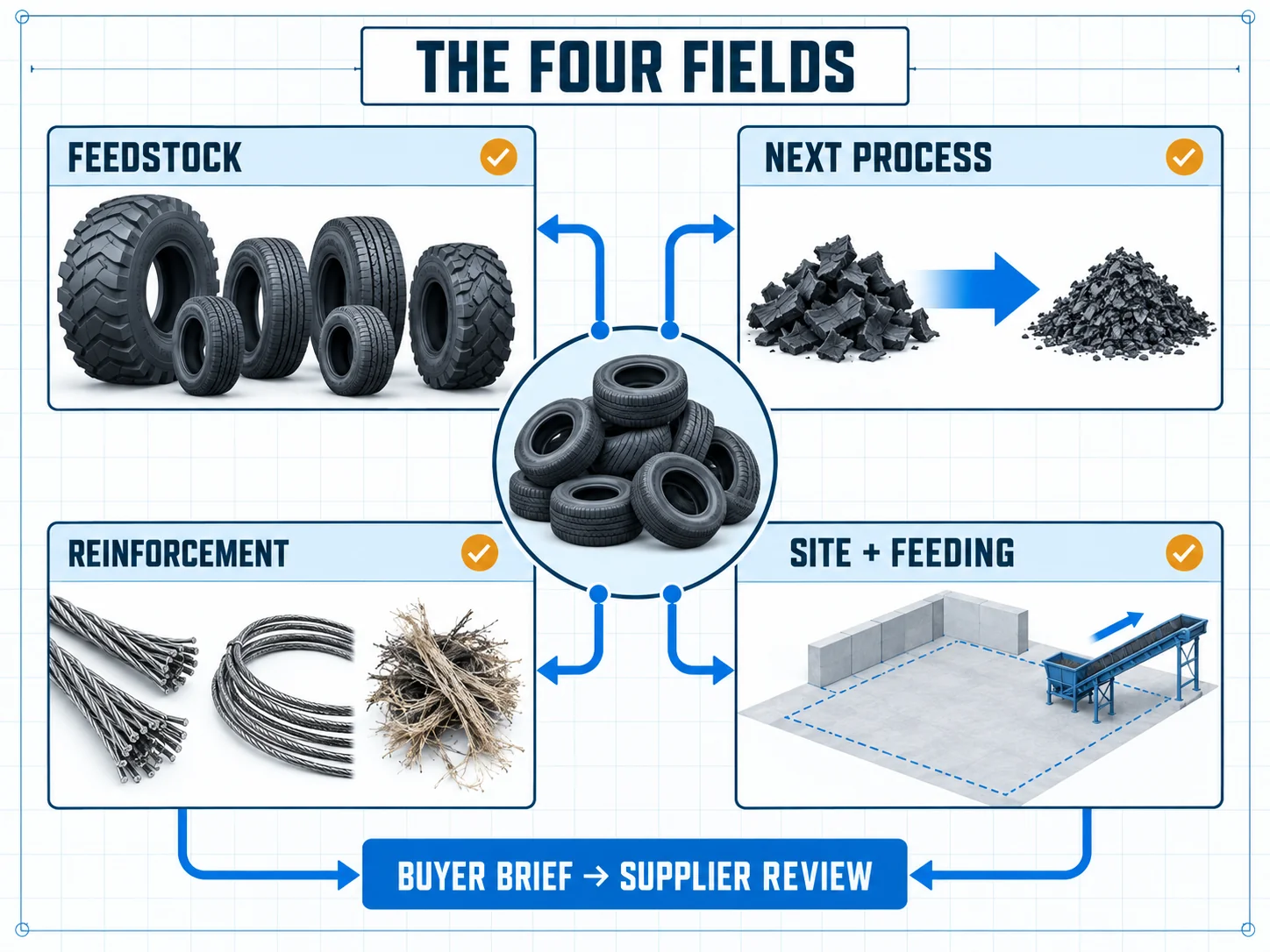
Before asking for a tire shredder recommendation, prepare four inputs: the actual feedstock, the intended output and next process, the reinforcement content, and the feeding and site conditions. These fields describe the job. They do not act as universal machine limits.
Feedstock type and size mix
Name the tire types that will actually enter the line. A stream may include passenger, truck, agricultural, or OTR tires, with a mixture of sizes and construction. Record the representative dimensions and explain whether the mix changes by season, supplier, or collection source. A single clean sample can hide the condition that creates the hardest loading or cutting question.
The buyer action is simple: send a representative sample description, not only the phrase "scrap tires." Keep unusual or oversized pieces in the description if they are part of normal supply.
Target output and downstream process
State what the tire shredder must prepare and name the next stage. Primary volume reduction, screening, magnetic separation, fiber handling, granulation, and other downstream steps can lead to different questions. The brief should describe the required output form or classification in language the next process uses.
Avoid turning the output field into an unsupported size promise. The useful question is what the next stage can accept and how that condition will be checked.
Steel, bead, and textile content
Describe the reinforcement and separation requirements visible in the representative material. Steel, bead, and textile content affect the discussion about cutting, discharge, separation, wear parts, and downstream handling. The exact concern depends on the tire construction and the selected processing stage.
The buyer action is to identify what must remain, what must be removed, and what the next process can tolerate. The supplier action is to confirm how the proposed configuration addresses those conditions during a material test.
Feeding and site constraints
Describe how tires will be loaded, where the machine can sit, and how material will move in and out. Include available footprint, utilities, conveying direction, access for maintenance, and the safety integration that belongs to the installation. Exact requirements depend on the site and line design, so a brochure cannot replace a fitment review.
Buyer-to-supplier handoff: Send the material description, target output, reinforcement concerns, feeding method, site information, and requested test evidence in one brief. Ask the supplier to mark unknowns instead of filling them with assumptions.
Use the following checklist before comparing proposals:
- Actual tire types, size mix, and representative sample are described.
- The next process and its output acceptance condition are named.
- Steel, bead, and textile concerns are separated from machine claims.
- Feeding, footprint, utilities, conveying, and maintenance access are listed.
The four fields create a common question set. The next step is to apply it to a specific use case instead of judging a tire shredder by a single headline specification.
The decision unit is the application brief: material, feeding, output purpose, and handoff evidence considered together. Keeping those fields together makes an equipment question precise without turning any one field into an unsupported machine promise.
The Federal Highway Administration’s 1997 material description separates whole tires, primary and secondary shredding, and ground-rubber processing. That distinction supports an application-first brief: state whether the tire shredder prepares a coarse feed, a separation input, or a later processing feed, then request evidence under the stated material conditions. (Federal Highway Administration, 1997)
Use case one: primary size reduction for whole scrap tires
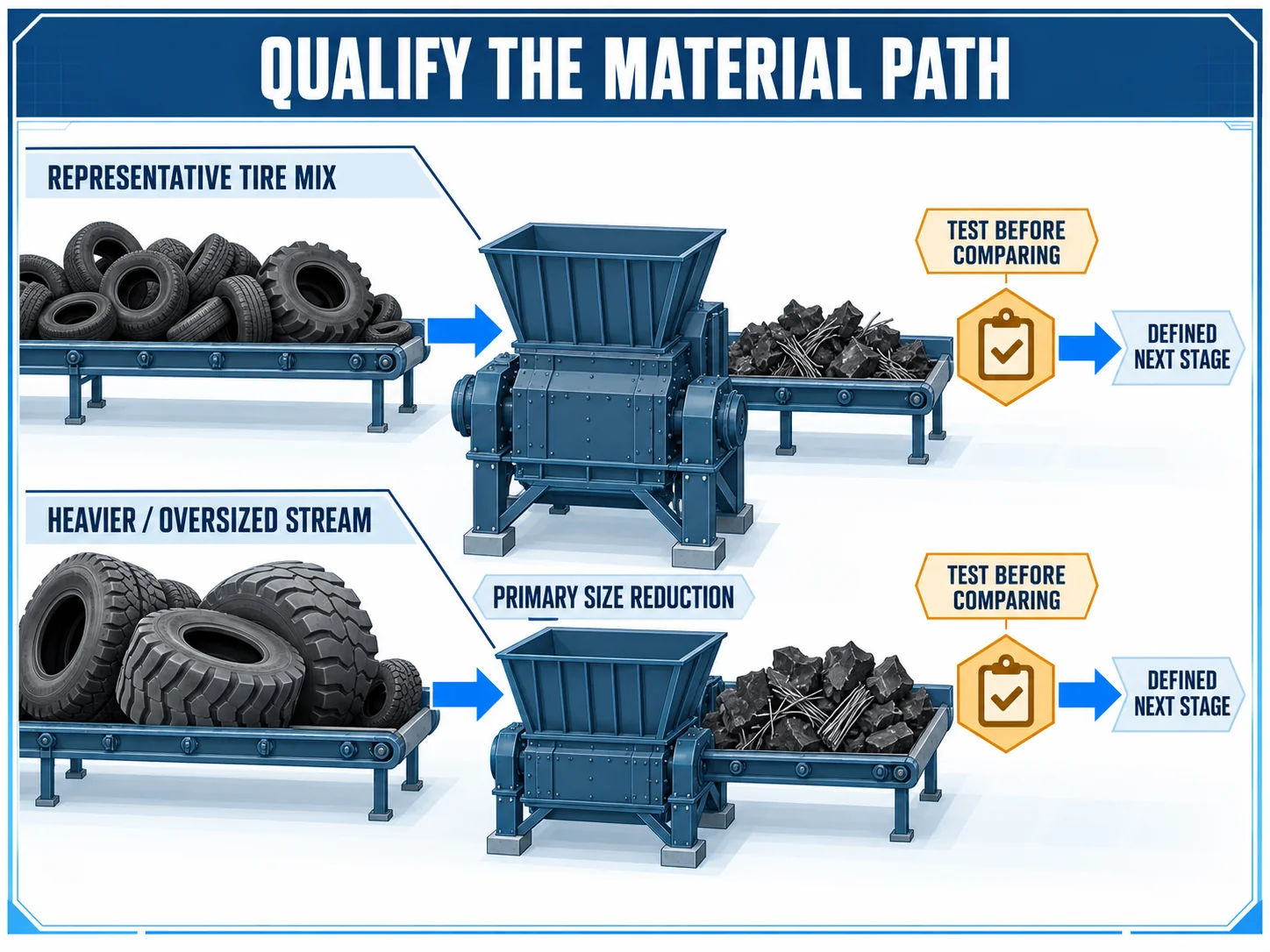
Primary size reduction is the application path used when whole scrap tires must be prepared for easier handling or for a later process. The selection question is whether the proposed tire shredder can accept the representative material under the intended feeding conditions and produce an output that the next stage can use. It is not a claim that one machine handles every tire class.
When the main goal is volume reduction
Start by describing what "reduction" means for the site. The goal may be easier conveying, storage, transport, or preparation for separation. The downstream purpose decides how the output is judged. If the next stage only needs a consistent feed presentation, its acceptance question differs from a process that needs a more controlled material classification.
A whole tire stream should therefore be described with its normal mix, not with the easiest piece available. Passenger and light-truck tires may be one representative lane. Heavier or oversized material may be another. The distinction is a qualification request, not a universal boundary between machine types.
Questions about tire construction and feeding
Before requesting a quote, ask whether the test sample includes the tire construction, bead condition, steel content, textile content, and size variation expected in daily operation. Confirm how the tires reach the cutting chamber and whether the site can maintain the proposed feed method. Loading conditions can change the application even when two projects use the same broad tire label.
Use the following checklist:
- Describe the normal tire mix and identify the largest or hardest routine pieces.
- State whether volume reduction, downstream separation, or another purpose is the immediate goal.
- Record steel, bead, and textile conditions in the sample description.
- Confirm feeding direction, loading method, access, and site constraints.
- Ask for a representative-material test before treating a configuration as fit.
If a configuration discussion is needed, the site’s double-shaft shredder review can be used as a contextual reference. It does not replace application-specific confirmation. The evidence request should remain tied to the actual tire stream and the next process. (Federal Highway Administration, 1997)
Primary reduction is only the first path. When the shredder feeds separation or finer processing, the output question becomes more specific.
Use case two: preparing material for separation or further processing
A tire shredder can prepare material for a later stage, but it should not be described as the complete separation or fine-rubber system. Mechanical tire processing may involve rubber, steel, and fiber recovery, while the equipment sequence depends on the plant objective and the condition required by the next stage. (Federal Highway Administration, 1997)
When the shredder feeds separation equipment
Name the separation step before comparing machines. A line may continue with screening, magnetic separation, or fiber handling, but no single sequence applies to every installation. The buyer should state which fraction the next stage must identify, remove, or carry forward, along with the condition that counts as acceptable feed.
That changes the supplier conversation. Instead of asking only whether a tire shredder can process the material, ask how the proposed output will be presented to the separator, how reinforcement is expected to behave, and which observations will be recorded during the test. The answers should be tied to the actual sample, not a generic tire photograph.
When the line continues to granulation or fine processing
Granulation and fine rubber processing introduce another boundary. A primary shredder may prepare the feed, while later equipment controls further size reduction, screening, or material recovery. Later routes, including cryogenic tire recycling, have their own processing stages. A fine product therefore needs a downstream specification and acceptance method. It should not be inferred from the fact that a machine can reduce whole tires. (Federal Highway Administration, 1997; Anderson, 2021)
The buyer can make the brief clearer by naming the next machine, the required input condition, and the evidence needed to approve the handoff. If those details are not fixed, keep the language at the application level and mark the output as an open design question.
Glossary
Primary size reduction: The first reduction stage applied to a whole or coarse tire feedstock before a later handling, separation, or processing step.
Downstream process: The next equipment stage or material-use step that receives the shredder output.
Representative material: A sample that reflects the tire types, construction, size variation, and reinforcement conditions expected in the stated application.
The distinction between these terms keeps a tire shredder brief focused on the handoff the line must support.
Application paths: compare the question, not just the machine
Supplier proposals become easier to compare when every response addresses the same application fields. The matrix below uses application paths rather than machine rankings. It keeps buyer inputs, supplier evidence, and unresolved questions visible in one place.
A practical application matrix
| Application path | Material information to provide | Downstream question | Supplier evidence to request | Common scope mistake |
|---|---|---|---|---|
| Primary volume reduction | Tire type, size mix, representative pieces, loading method | What condition must the next handling or processing stage accept? | Test observations using the stated material and feed method | Treating a broad tire label as fitment proof |
| Preparation for separation | Steel, bead, textile, and contamination concerns | Which fraction must be identified, removed, or carried forward? | Output observations tied to the named separation step | Judging the shredder as the complete separator |
| Feed preparation for granulation | Target input condition and later classification | What input condition does the granulation stage require? | A defined handoff test and acceptance record | Inferring a fine product from primary reduction |
| Variable or oversized stream | Normal variation, exceptional pieces, site feeding limits | Which material is routine and which requires a separate qualification? | Confirmation of test scope and configuration boundaries | Assuming an all-tire promise covers every case |
How to use the matrix in an RFQ
Copy the relevant row into the request for quotation, then add the project’s actual material and site information. Ask each supplier to answer the same four questions: what material was considered, what output was evaluated, what test evidence is available, and which assumptions remain open. That format exposes differences in scope before isolated numbers dominate the discussion.
The matrix is also useful internally. Procurement can check whether proposals describe the same job. Engineering can check whether feeding and downstream conditions are addressed. Operations can identify the observations that matter during a trial. A proposal that omits one of these fields is not automatically wrong, but it needs a follow-up question before approval.
Use the following short review list:
- Compare application scope before comparing headline specifications.
- Keep buyer-supplied conditions separate from supplier-confirmed performance.
- Ask for the same material-test evidence from every shortlisted supplier.
- Record open assumptions beside the proposal instead of leaving them in email threads.
The comparison becomes defensible when the question, sample, output purpose, and evidence method remain constant across suppliers.
What to verify in a supplier material test
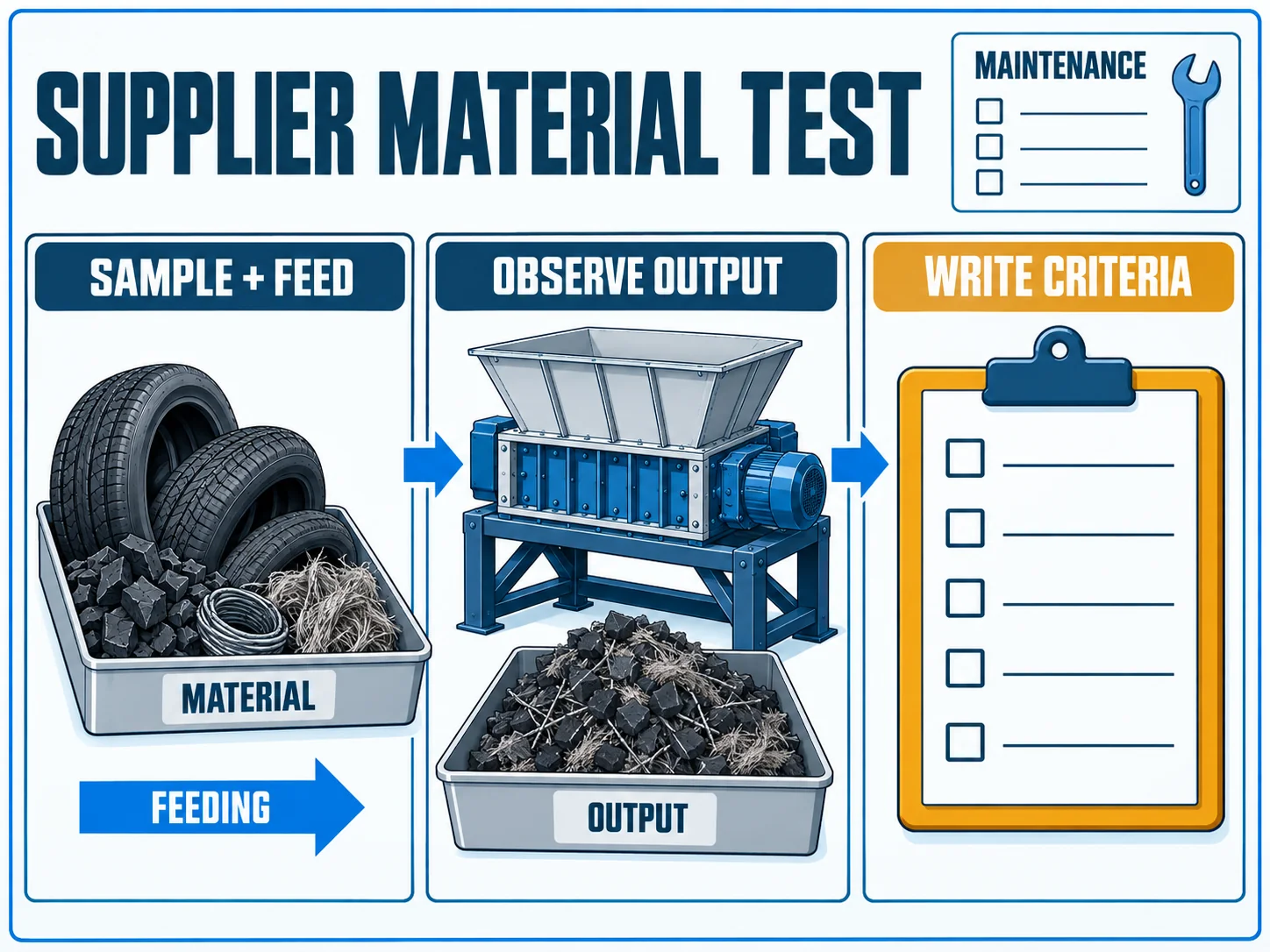
A material test is useful when it answers the buyer’s stated application question. A video of a generic tire, a brochure sentence, or an unscoped performance figure does not show whether a proposed tire shredder fits the material and downstream purpose under review. The test plan should be bounded before the sample is sent.
Use representative material
Describe the sample before the test starts. Include the tire types, size mix, construction differences, steel and bead conditions, textile content, contamination concerns, and any pieces considered routine but difficult. State how the sample was selected and whether it represents the feed expected after commissioning.
The feed method belongs in the record too. A hand-fed demonstration, a prepared sample, and the site’s intended loading method may not pose the same question. The supplier should confirm which condition was tested and which conditions remain untested.
Write acceptance criteria before the test
Write down what the buyer needs to observe. The criteria may cover output presentation, downstream feed suitability, separation expectations, stoppage or overload observations, access for maintenance, and the records required for review. The exact criteria depend on the line, so they should be agreed by the buyer and supplier rather than copied from a generic template.
Do not turn an open question into a pass result. If the test observes a condition but does not measure the buyer’s acceptance requirement, record the gap and define the next check.
Separate buyer inputs from supplier confirmations
The buyer owns the material description, target output, site conditions, and downstream acceptance criteria. The supplier should confirm the proposed configuration, test conditions, observed performance, wear-part plan, and any limits that remain. Keeping the two roles visible prevents a quote from appearing more specific than the evidence supports.
Request a test record containing:
- material description and sample selection method;
- feeding method and operating conditions;
- output observation and downstream handoff question;
- separation or contamination expectations;
- stoppage, overload, and maintenance-access observations;
- written acceptance criteria, open gaps, and next actions.
Verification rule: Approve a tire shredder against the written application brief and the agreed material test. Do not treat generic footage or a headline claim as a substitute for fitment evidence.
The test is the point where a buyer can distinguish a documented application response from a broad compatibility statement.
A 1997 Federal Highway Administration reference describes primary and secondary tire shredding as separate processing stages and notes that exposed steel can remain in shreds or chips. For a buyer, the implication is practical: define the sample and downstream acceptance condition before treating a demonstration as fitment evidence. (Federal Highway Administration, 1997)
What to ignore in tire-shredder marketing claims
Use every specification as a question about scope. Ask which material was tested, how it was fed, what output was observed, and how the result was accepted. A figure without those conditions may still describe a real test, but it cannot answer the buyer’s application question on its own.
Horsepower without material context
A power figure does not identify the tire mix, feeding condition, operating target, or downstream requirement behind a proposal. Ask the supplier to connect the configuration discussion to representative material and a defined test record.
A size claim without a defined test condition
An output-size statement needs a material description, process stage, and measurement method. Otherwise the buyer cannot tell whether it describes primary reduction, a later stage, or a special sample that does not reflect normal feed.
A generic promise of all-tire compatibility
Treat broad compatibility language as a request for clarification. Ask which tire types and size variations are included, which conditions are excluded, and what evidence supports the stated scope. The right response is a bounded application statement, not a wider promise.
Filter: Replace "Can it handle tires?" with "Can it handle our stated material, feed method, output purpose, and acceptance test?"
That question keeps the review factual and leaves unknowns visible.
When to delay the tire-shredder purchase
Delay a tire shredder comparison when the application brief cannot describe the material, the next process, or the evidence needed for approval. A quote can be requested early for planning, but a final configuration decision should wait until the missing conditions are defined.
The material stream is still changing
Pause when the normal tire mix is unknown, oversized pieces are being excluded from the sample, or reinforcement and contamination conditions have not been described. Collect a representative sample description first.
The next process has no acceptance target
Pause when the output is described only as "shredded tire" and no downstream stage has stated what it can accept. Name the next process, its input condition, and the observation that will support approval.
Use the following release checklist:
- Feedstock type, size mix, and representative sample are defined.
- Output purpose and downstream acceptance condition are written.
- Feeding, footprint, utilities, conveying, and maintenance access are known.
- Supplier test conditions and evidence records are agreed.
For the broader sequence, review the tire recycling process guide after the application brief is clear. Then return to the tire shredder question with the next stage identified.
Decision point: If one of the four fields is still an assumption, keep the purchase in application definition rather than treating a generic quote as a fitment decision.
Conclusion
A sound tire shredder decision ends with a defined handoff: the actual tire mix is described, the next process states what it can accept, site feeding is understood, and a supplier test is judged against written criteria. When one of those elements is missing, the responsible next step is to clarify the brief. Once they are present, proposals can be compared on the same application question rather than on isolated brochure language.
References
- U.S. Environmental Protection Agency. (2024, August 7). Where rubber meets the road: EPA researchers study the environmental and health impacts of tires. U.S. Environmental Protection Agency. https://www.epa.gov/sciencematters/where-rubber-meets-road-epa-researchers-study-environmental-and-health-impacts-tires
- Federal Highway Administration. (1997). Scrap tires: Material description (FHWA-RD-97-148). U.S. Department of Transportation. https://www.fhwa.dot.gov/publications/research/infrastructure/structures/97148/st1.cfm
- Anderson, J. (2021). Cryogenic tire recycling. In Tire waste and recycling (pp. 81-96). Elsevier. https://doi.org/10.1016/b978-0-12-820685-0.00007-7
Last reviewed and updated: September 2026. Author: Kingstream team. For tailored guidance, contact our team.