
TL;DR
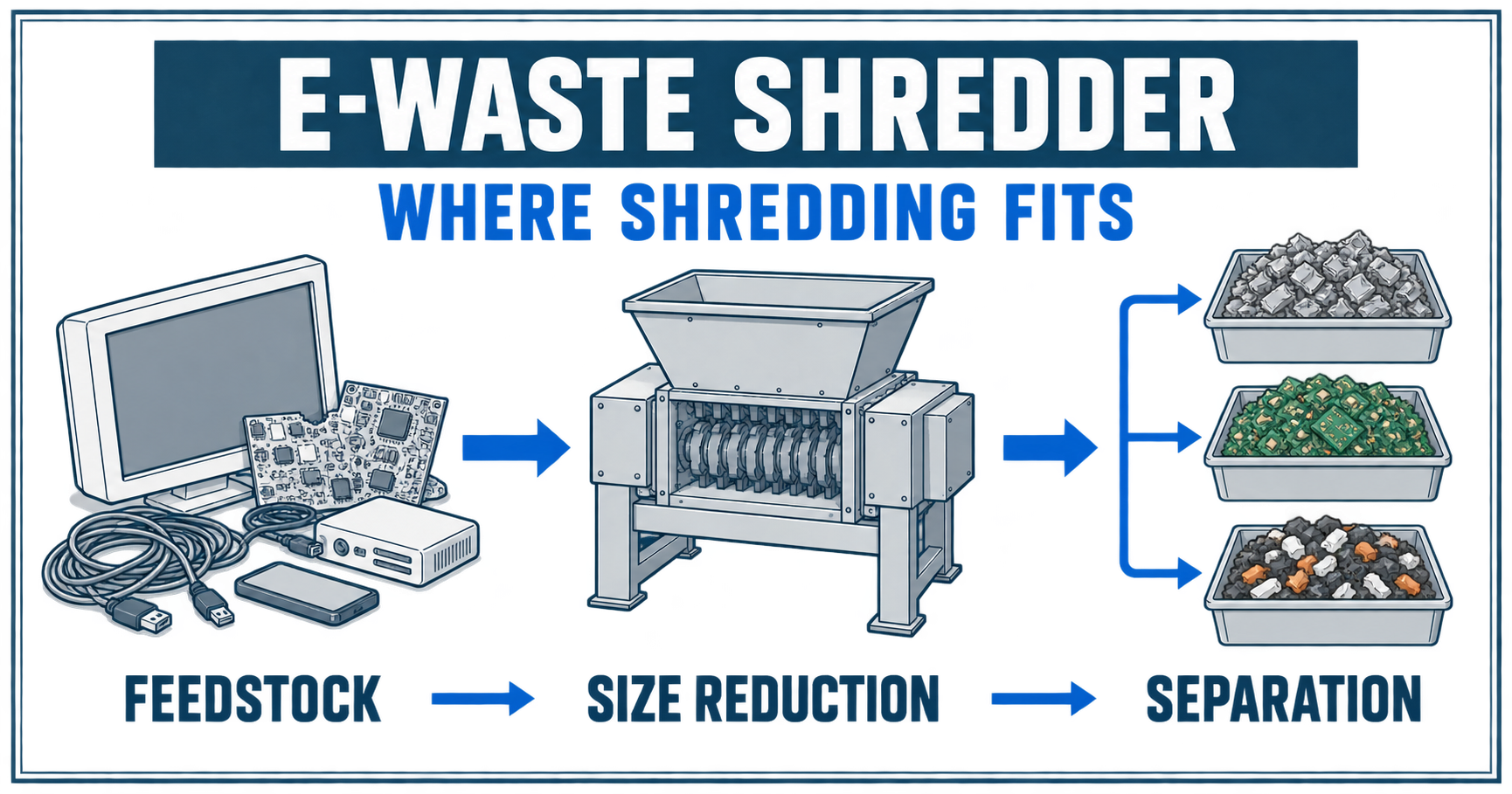
An e-waste shredder does not replace sorting or separation. Start with the devices and components entering the line, remove items that require separate handling, define the output stream, then size the shredding stage around the next process.
Key Takeaways
- Define the feedstock by device type, material mix, and components requiring separate handling.
- Use shredding to prepare a stream for the next separation stage, not as a substitute for the whole line.
- Let the downstream output and buyer specification determine the required process depth.
- Confirm real-material behavior, safety boundaries, and acceptance criteria before requesting final equipment sizing.
Table of Contents
- Key Takeaways
- What an e-waste shredder does in a recycling line
- Define the incoming electronics before choosing the process boundary
- How mixed electronics move from preparation to separated outputs
- Choose the process depth by the target output, not the machine name
- Pre-RFQ verification checklist for an e-waste shredding line
- Further Reading
- Conclusion
- References
What an e-waste shredder does in a recycling line
An e-waste shredder is the size-reduction stage in an electronics recycling workflow. It takes a defined stream of discarded electronic equipment and changes its form so the material can be handled, screened, or separated downstream. It is not the whole recycling line, and the phrase does not describe one universal machine configuration.
The short definition
The useful definition is simple: an e-waste shredder reduces mixed electronic scrap and helps expose or liberate material for the next process. Depending on the feed, that next process may involve screening, metal separation, air classification, further size reduction, or another controlled handoff. The correct target is therefore the output stream, not the machine label alone.
A common mistake is to treat “e-waste shredder” as a complete recycling solution. The term describes one size-reduction stage, not the sorting, separate handling, downstream separation, or acceptance work around it.
What the shredder stage does not decide
The shredder does not decide what should enter the line, which components require separate handling, which output a downstream buyer will accept, or whether the full process meets local safety and environmental requirements. Those questions belong to the application boundary around the machine. Treating them as part of a generic product description is how an apparently suitable shredder becomes a poor fit for the actual feed.
Note: Start with the material profile and the next process. A shredder recommendation without a defined feedstock and output target is only a starting conversation.
Working terms
- Feedstock: the devices, assemblies, materials, and contamination that arrive at the line.
- Size reduction: cutting or breaking material into a form that the following handling or separation stage can accept.
- Material liberation: separating bonded or enclosed materials enough for downstream recovery steps to act on them.
Citation capsule: An e-waste shredder is one process stage within a wider recycling system. Its role is to reduce and open a defined electronic-scrap stream so later handling and separation can proceed. Feedstock preparation, separate-component handling, output requirements, and local controls remain application decisions rather than universal machine properties.
Define the incoming electronics before choosing the process boundary
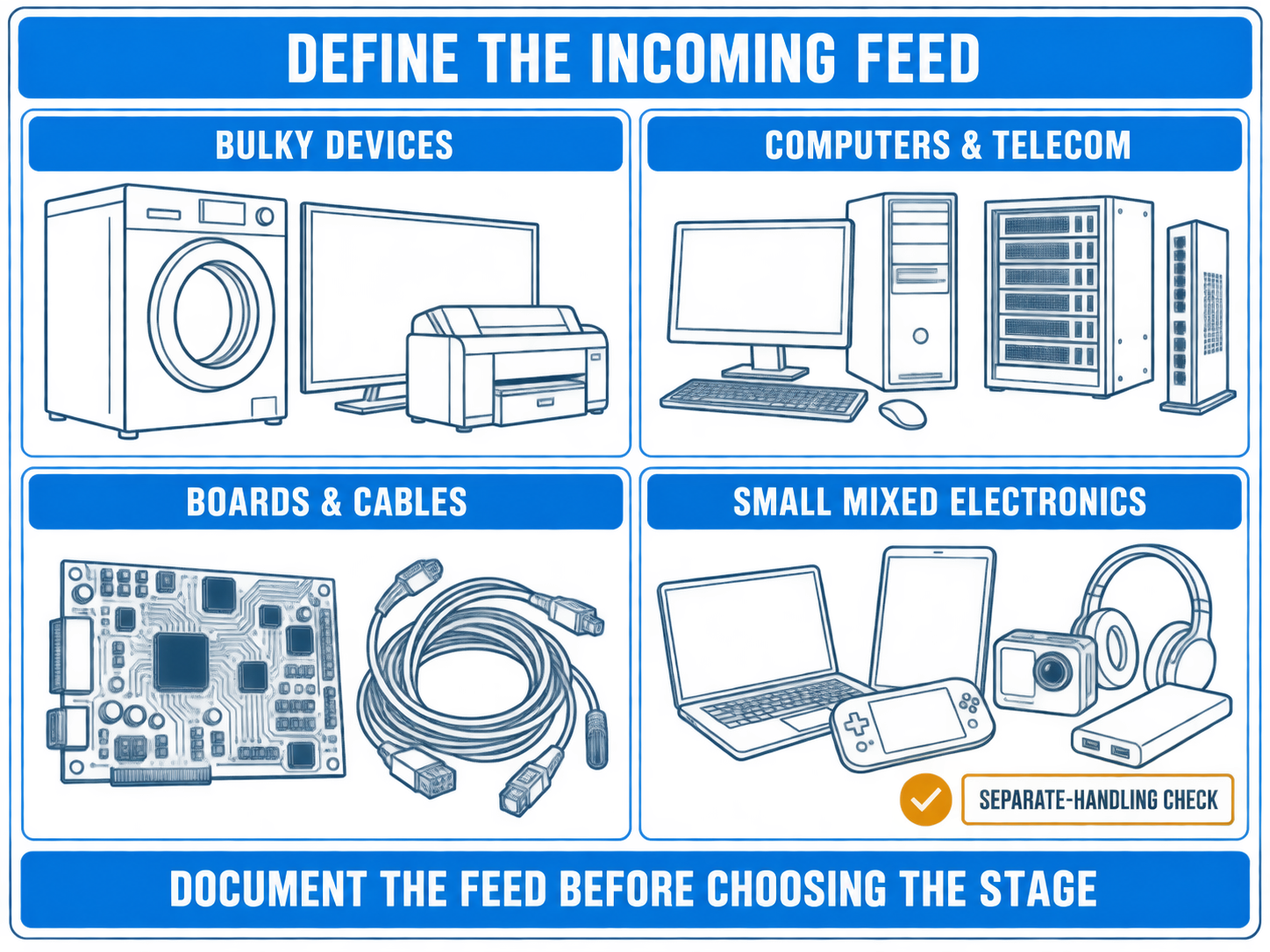
“Mixed e-waste” is too broad to use as a complete equipment brief. A recycling line may receive bulky housings, computers, telecom equipment, circuit boards, cable bundles, small appliances, or several of these streams together. Each combination changes how the material arrives, what preparation is practical, and what the next stage must accomplish.
Bulky devices and assemblies
Large housings and assembled equipment can combine steel, aluminum, plastics, glass, wiring, fasteners, and enclosed components. The relevant question is not simply whether the item can be shredded. It is whether the receiving and preparation steps can present that item consistently to the size-reduction stage, while keeping unsuitable or separately handled components outside the main flow.
Document the largest incoming item, the typical item, the variation between loads, and any parts that arrive loose. A photo set and a representative material sample are usually more useful for an early discussion than a generic label such as appliances or IT equipment.
Computers and telecom equipment
Computers, servers, network equipment, and communications hardware can contain housings, boards, cooling parts, cables, storage media, and mixed fasteners in one assembly. A line that is designed around one consistent stream may behave differently when the share of bulky frames, fine boards, or cable-rich material changes. Equipment descriptions should therefore state what has been observed in the feed, not only the category name.
Boards, cables, and mixed small electronics
Circuit boards and cable bundles often create a different handling problem from a complete enclosure. They may need a separate route, a different preparation step, or a different downstream separation objective. Small electronic devices can also arrive with batteries or other components that require a separate handling decision. The right action depends on the actual material and local requirements, so the buyer should document the question for supplier and compliance review rather than assume a universal rule.
The feedstock questions to document
- What device families make up the incoming load?
- Are items whole, dismantled, baled, loose, or mixed together?
- Which materials are expected in meaningful quantities: ferrous metal, non-ferrous metal, plastics, glass, boards, cables, or residue?
- Which components must be removed or routed separately before mechanical processing?
- What changes between the cleanest, typical, and most difficult loads?
Caution: Do not use the term mixed e-waste as a substitute for a sample. The feed description should show the device mix, the material mix, and the components that may change the preparation boundary.
Citation capsule: Electronics recycling begins with a varied stream of devices and materials, not with a machine name. A useful process boundary records the incoming equipment, the material classes inside it, and any components that need a separate handling decision before size reduction.
How mixed electronics move from preparation to separated outputs
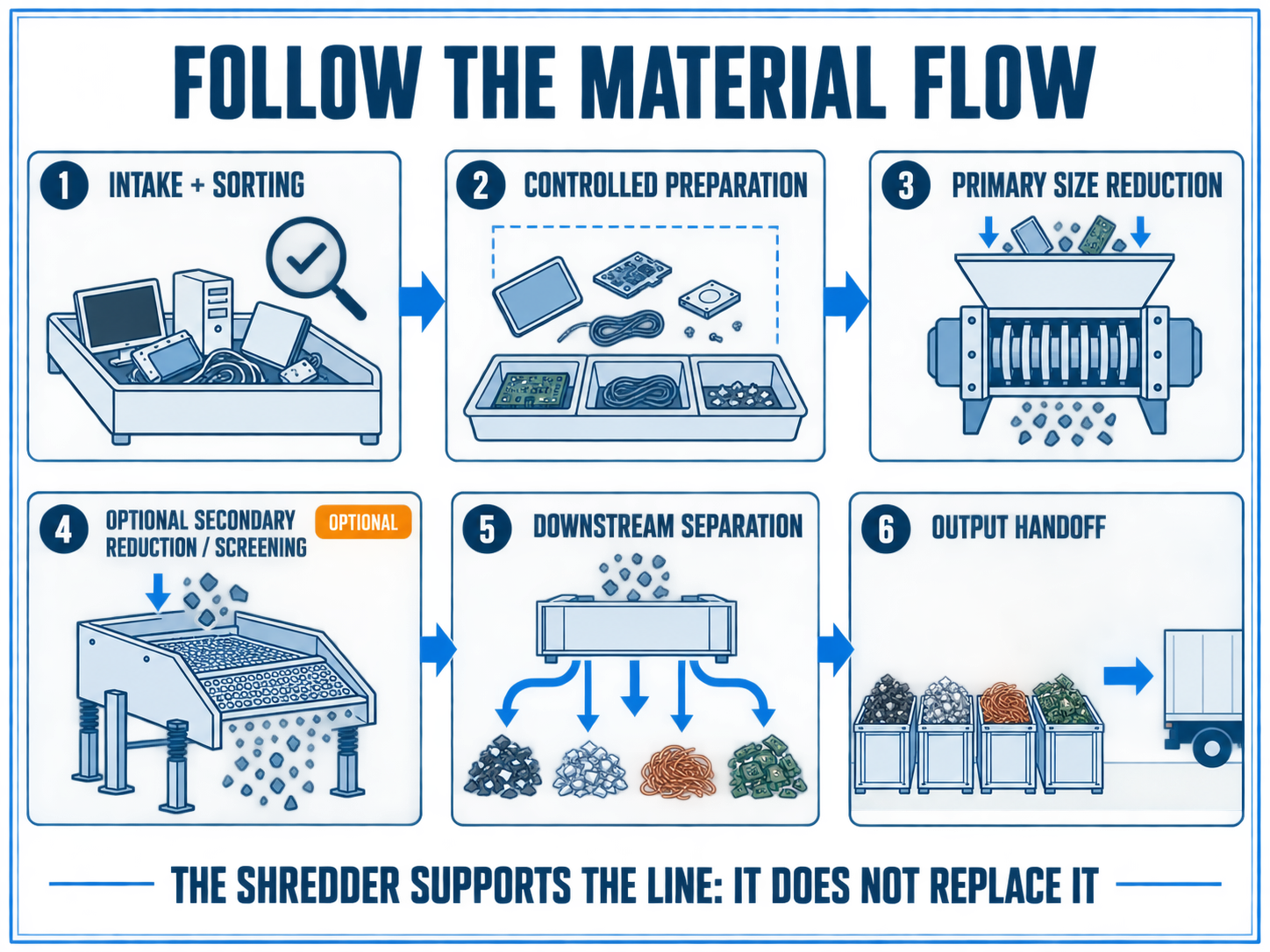
The role of an e-waste shredder becomes clearer when the material flow is read from left to right. The line starts with an incoming stream, prepares that stream for mechanical processing, reduces the size, and then sends the result toward separation and recovery. The exact equipment sequence varies by feedstock and output, but the decision logic stays consistent: each stage must prepare the material for the next one.
Intake and controlled preparation
At intake, the operator defines what is being accepted and identifies obvious differences between loads. Sorting can separate device families, remove oversized items, and establish a more consistent feed. Controlled preparation then addresses the components or conditions that should not simply be sent through the main shredder. The point is to protect the process boundary and make the material description testable, not to claim that every line follows one universal preparation recipe.
Primary size reduction
The primary shredding stage changes bulky or assembled material into a more manageable stream. It may reduce volume, expose internal materials, and make the feed easier to convey or present to the next process. The correct outcome is not a generic small particle. It is a stream that matches the handling and separation work that follows.
Secondary reduction and screening when required
Some applications need another reduction or screening step, while others can move from the initial stage into separation. This is an application question. If the downstream process needs a narrower or more liberated feed, a second stage may be considered. If it does not, adding another stage can increase complexity without solving the actual bottleneck. Any decision should be based on representative material and a defined output requirement.
Downstream separation
After size reduction, the material may move through one or more separation steps. Magnetic, non-ferrous, air, density, optical, or other methods can be relevant, but the choice depends on the material properties and the desired output. The shredder creates a more workable feed for these methods; it does not perform every separation job by itself.
Output streams and the next process
The useful endpoint is a set of output streams that can be handled, sold, reused, refined, or disposed of through the buyer’s downstream route. A line can therefore be judged at several handoffs: the prepared feed entering the shredder, the reduced material leaving it, the separated fractions, and the final acceptance point. If the downstream buyer has a specification, that specification should be part of the equipment discussion from the beginning.
Note: The optional stages belong in the flow only when they remove a real material or output obstacle. Do not add a second shredder, screen, or separator merely because it appears in another facility’s process diagram.
❝ The useful question is not “Can this machine shred e-waste?” It is “What must the next stage be able to do with the material after shredding?” ❞
Citation capsule: A practical e-waste line links intake and preparation to size reduction, then to separation and downstream output handling. Shredding can reduce bulk and help expose mixed materials, but the required process depth depends on the feedstock and the output that the next stage or buyer can accept.
Choose the process depth by the target output, not the machine name
The same word, shredder, can describe very different application needs. One buyer may need a more manageable stream for internal handling. Another may need material liberation before a separation step. A third may need a controlled output that meets a downstream buyer’s acceptance rule. These are different process questions, even when the incoming material is described as e-waste.
When volume reduction is the immediate goal
If the first obstacle is bulky material, the discussion should focus on intake, feeding, size reduction, conveying, and storage. The buyer still needs to define the difficult items in the load and the conditions that can interrupt the process. The aim is a workable stream, not an unsupported promise about a universal output size.
When liberation and separation are the real goal
If valuable or usable materials remain enclosed or bonded inside assemblies, the shredder must be considered together with the separation stages that follow. The important questions become how the material will be exposed, how it will be conveyed, and how the next process will distinguish the fractions. A machine choice made without this handoff can solve size reduction while leaving the recovery problem unchanged.
When the downstream buyer controls the specification
Some lines are defined by the requirements of the next processor. In that case, the target output, contamination limits, storage method, and sampling plan should be stated before a supplier proposes a configuration. The supplier can then evaluate the process boundary against a real acceptance condition rather than a general request for an e-waste shredder.
Decision rule: Define the output and the next handoff first. Then decide how much preparation, shredding, screening, and separation the line actually needs.
The practical choice
Use the shallowest process that can reliably meet the real downstream requirement, and add stages only when a material test shows that they solve a defined obstacle. This keeps the discussion focused on the material flow instead of turning a machine category into a complete plant specification.
The trade-off is practical: a shallower process keeps the line simpler, but it may leave a downstream separation problem unresolved. Adding stages can improve control, but only when a defined material obstacle justifies the extra complexity.
Pre-RFQ verification checklist for an e-waste shredding line
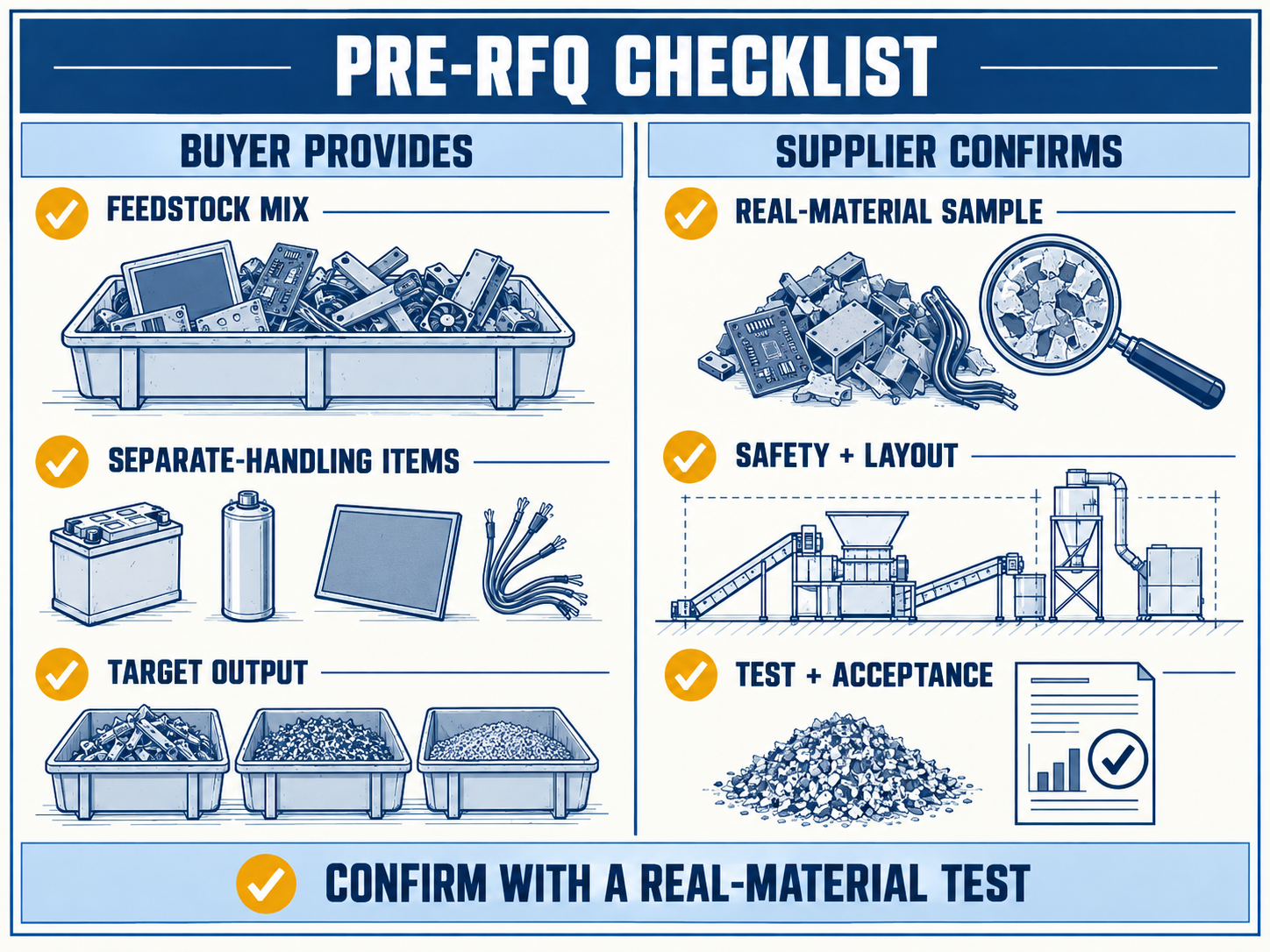
A useful request for quotation is an application brief, not a product label. The buyer should describe the material and the intended output. The supplier should then confirm what can be tested, which stages are required, and what acceptance criteria can be written down. Keeping these responsibilities separate makes the eventual recommendation easier to evaluate.
Feedstock and preparation
- Feedstock mix: describe the device families, material classes, condition, and expected variation between loads.
- Separate-handling items: list components or conditions that need review before entering the mechanical process. Confirm the boundary with the appropriate local and technical specialists.
- Preparation method: explain what is already removed, dismantled, sorted, or inspected before feeding.
- Representative sample: provide material that reflects the ordinary load as well as the difficult cases, not only a clean demonstration piece.
Output and downstream handoff
- Target output: state whether the immediate goal is volume reduction, material liberation, a separated fraction, or a downstream processor’s defined acceptance stream.
- Next process: identify the conveyor, screen, separator, storage point, buyer, or processor that receives the reduced material.
- Sampling and verification: agree how the output will be checked and which observations count as acceptable.
Safety, layout, and acceptance testing
Ask the supplier to confirm the proposed process boundary, feeding arrangement, access for inspection and maintenance, dust and fire-control assumptions, interlocks, and the limits of the material test. These are not generic promises to copy from another machine page. They are items to verify against the site, the feed, and the intended operating method.
Important: A real-material test and written acceptance criteria are more useful than a broad claim that a machine handles e-waste. Keep the test material, target output, and handoff conditions in the same conversation.
What a complete brief should contain
Before the RFQ is sent, the reader should be able to answer four questions: what enters, what must be removed or handled separately, what output is needed, and what evidence will show that the proposed process works. If any answer is still undefined, delay final equipment selection and resolve that uncertainty first.
Further Reading
For related material-flow decisions, see the guides on tire recycling plant workflow, single-shaft shredder applications, textile shredder applications, and plastic feedstock selection. Each uses a different material example, so use them for process concepts rather than as e-waste specifications.
Conclusion
An e-waste shredder is best specified as one stage in a material flow. The useful question is not whether a machine can accept the label e-waste, but whether the prepared feed, reduced stream, and downstream separation path are defined well enough to evaluate together.
Before an RFQ, document the device mix, separate-handling items, target output, next process, site constraints, and material-test acceptance criteria. Then ask suppliers to confirm the process boundary against representative material. The limitation is that a generic e-waste label cannot establish capacity, output size, purity, or safety requirements. Those items depend on the actual feed and operating context.
References
- United States Environmental Protection Agency. (n.d.). Electronics donation and recycling. https://www.epa.gov/recycle/electronics-donation-and-recycling
- Shred-Tech. (n.d.). E-waste shredders for e-waste recycling. https://shred-tech.com/e-waste-shredders/
- WEIMA. (n.d.). Electronic waste | Scrap (WEEE) shredders for recycling. https://weima.com/us/electronic-waste-e-waste-weee-shredders/
- Franklin Miller. (n.d.). Electronic waste shredders. https://franklinmiller.com/applications/electronic-waste
- GEP ECOTECH. (2026). E-waste shredding solutions: Unlocking value from electronic waste recycling. https://www.shredderwaste.com/materials/e-waste-shredding-solutions-unlocking-value-from-electronic-waste-recycling/
Last reviewed and updated: September 2026. Author: Kingstream team. For tailored guidance, contact our team.