
TL;DR
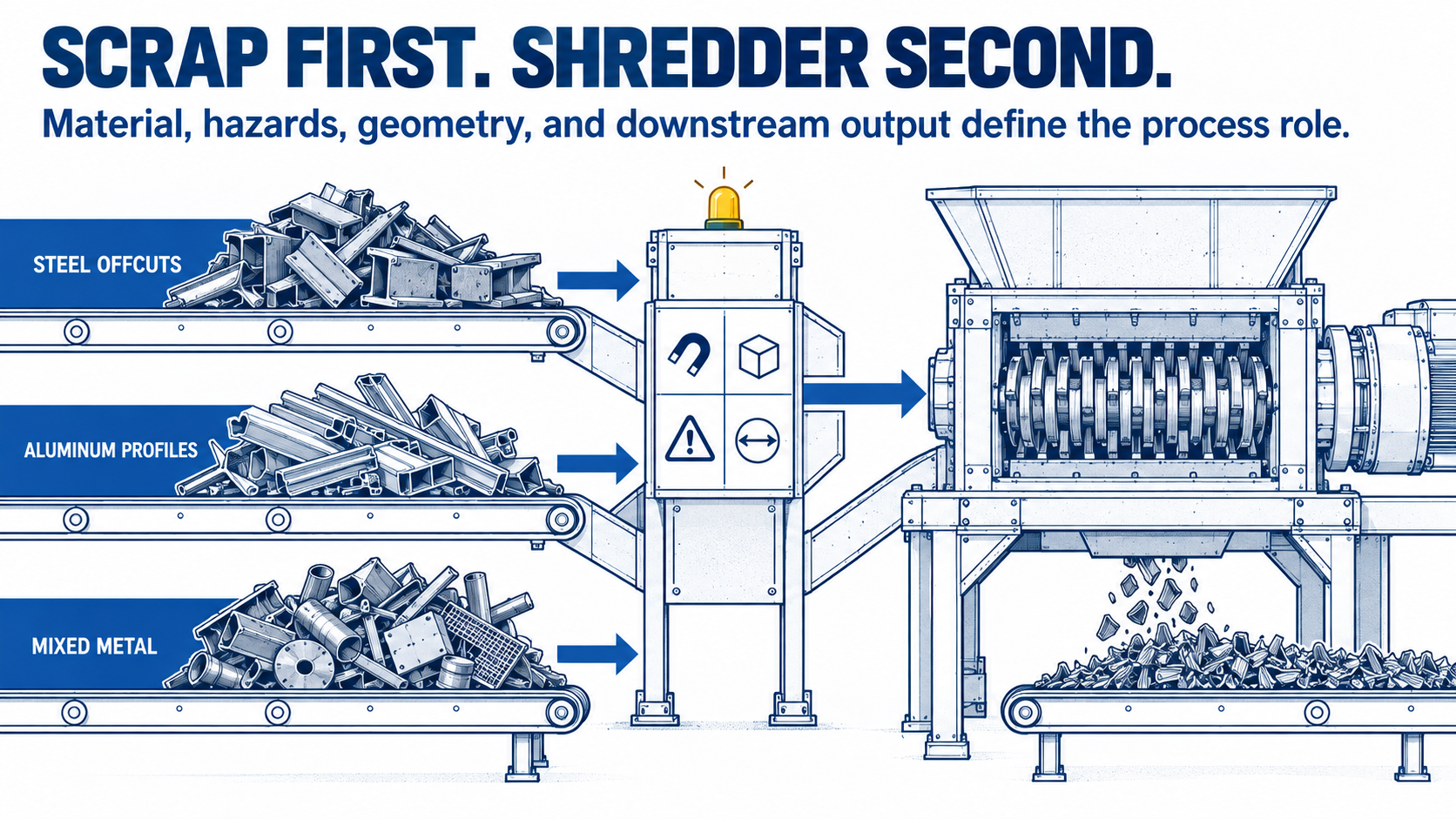
A metal shredder is a process step, not a universal metal-compatibility label. Start with the scrap family, largest feed shape, contamination and hazards, and the output or separation step that follows. Use those facts to decide whether to pre-sort, test, shred, or delay the purchase.
Abstract
This guide explains how feedstock family, object geometry, embedded hazards, and downstream output determine whether an industrial metal shredder is an appropriate process step.
Key Takeaways
- Treat scrap family as a starting point, not proof of machine fit.
- Record the largest recurring feed shape and thickness before discussing equipment.
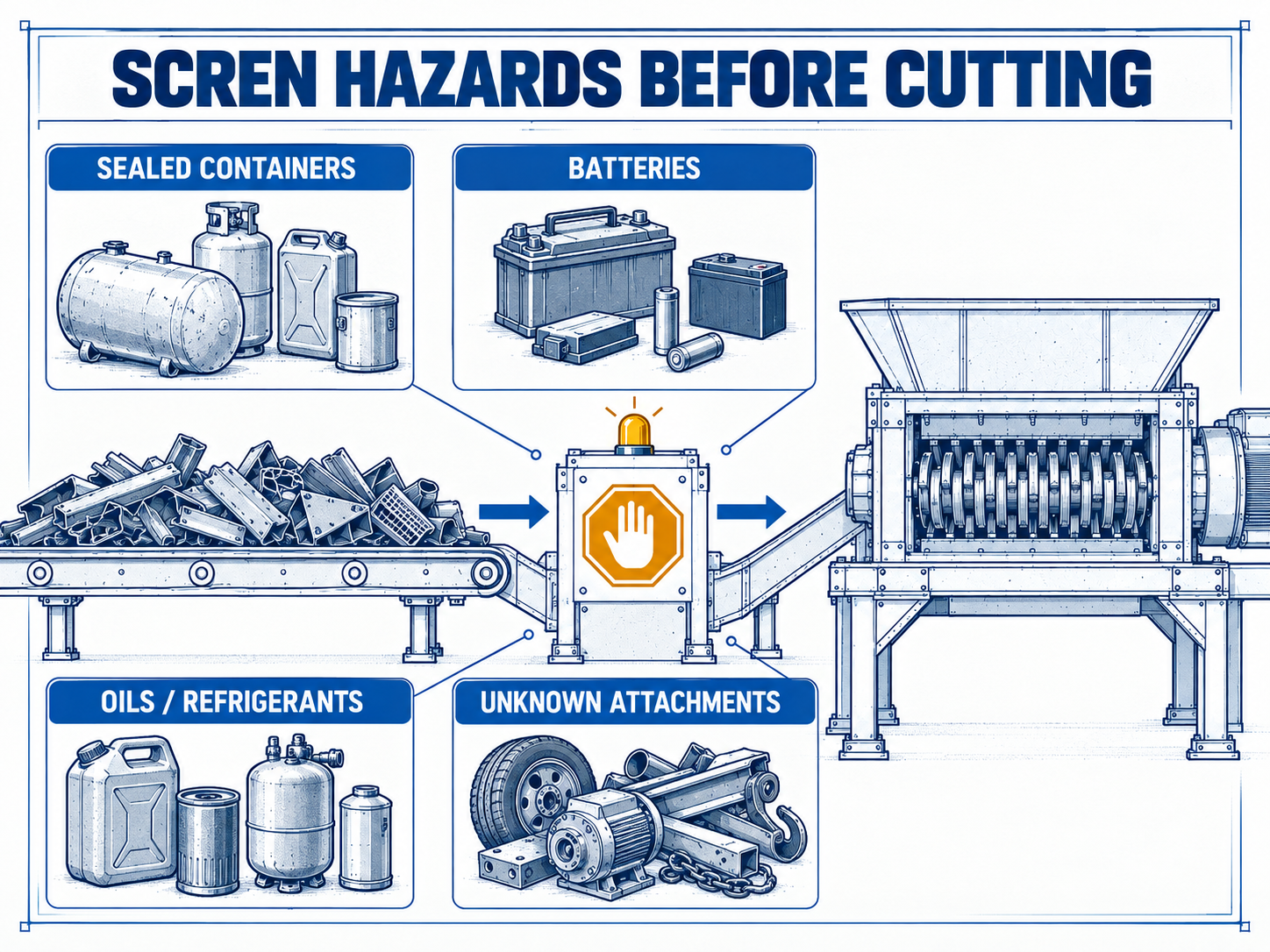
- Screen sealed containers, batteries, oils, refrigerants, and unknown attachments before shredding.
- Define the downstream separation or sizing target before choosing a shredder role.
- Use a representative material test when the feedstock or hazard profile is uncertain.
Table of Contents
- Abstract
- Key Takeaways
- Start with the scrap stream, not the machine name
- The four inputs that determine whether shredding fits
- Application path 1: bulky ferrous and mixed scrap
- Application path 2: aluminum and other non-ferrous streams
- Single-shaft or double-shaft: choose by process role
- Build the downstream path before choosing the shredder
- What to verify in a material-test or supplier review
- Marketing claims and shortcuts to ignore
- When to delay the purchase
- FAQ
- Conclusion
- References
Start with the scrap stream, not the machine name
A metal shredder is a process step, not a universal label for every metal object. Steel, aluminum, mixed scrap, appliances, drums, profiles, and metal attached to other materials can behave very differently at the infeed. The useful question is not simply “Can this machine shred metal?” It is “What does this stream look like, what hazard does it carry, and what must happen after size reduction?”
A common mistake is to treat a metal name as a complete feed specification. The material label is only the first field; geometry, hazards, and downstream duty still control the review.
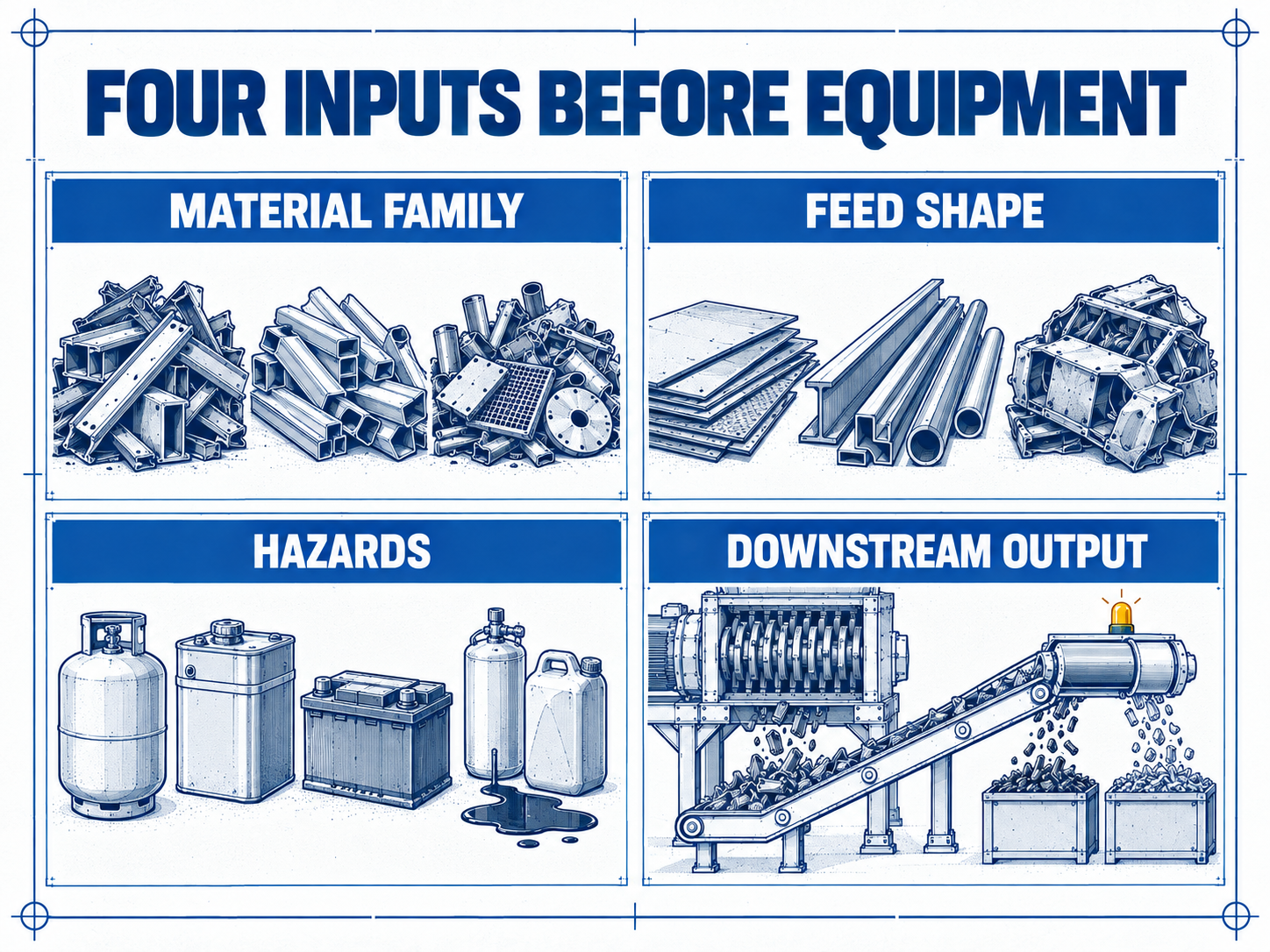
Start by separating three decisions that are often mixed together:
- Material fit: what metal family and attachments are actually present?
- Mechanical fit: what is the largest recurring piece, thickness, shape, and density?
- Line fit: is the target rough volume reduction, a controlled output, or preparation for sorting, baling, or another downstream operation?
This guide uses those questions to explain common metal shredder applications. It does not replace a representative material test, a hazard review, or a supplier’s engineering confirmation. A general material name can open a conversation, but it cannot confirm a machine, cutter, chamber, or output result for a specific site.
Decision rule: If the feed geometry, embedded hazards, or downstream output is still unknown, the project is not ready for a confident metal shredder recommendation.
The four inputs that determine whether shredding fits
Before comparing a metal shredder machine, write down four inputs. They create a much more useful starting point than a list of metal names because they connect the feedstock to the machine role and the next process. The general distinction between ferrous and non-ferrous scrap is useful, but the actual buyer decision still depends on the material presented to the infeed.
| Input | What to record | Why it changes the decision |
|---|---|---|
| Material family | Ferrous, non-ferrous, mixed metal, or metal attached to plastic, rubber, glass, or other material | Changes the expected cutting behavior, contamination review, and later separation path |
| Largest feed piece and shape | Dimensions, thickness, bundles, drums, profiles, appliances, and irregular objects | Defines the feeding and chamber question; an average piece is not enough |
| Contamination and embedded hazards | Sealed containers, batteries, oils, refrigerants, coatings, glass, and unknown attachments | Determines pre-sorting, risk controls, and whether the stream should be tested or diverted first |
| Target output and downstream process | Rough reduction, screened size, magnetic separation, eddy-current separation, baling, or melting preparation | Prevents a shredder from being selected for an output that the rest of the line cannot use |
The fourth input is often missed. Shredding may support separation of ferrous and non-ferrous metals from non-metallic material, but it is rarely the complete recycling line by itself. The buyer needs to describe what “ready for the next stage” means in that facility.
Use the four fields in order: identify the stream, describe the largest recurring piece, clear the hazard questions, then state what the next stage must accept. This is a screening method, not a machine specification.
Use the table as a pre-selection checklist, not as a specification sheet. A supplier can confirm a process role only after the buyer supplies representative material information and the downstream acceptance criteria. Those are buyer inputs until a test or fitment review confirms them.
Application path 1: bulky ferrous and mixed scrap
Bulky ferrous or mixed scrap is a common reason a recycling operation investigates an industrial metal shredder. The goal may be to reduce awkward pieces, open up composite objects, create a more manageable feed for separation, or prepare material for another handling step. The correct machine role depends on the object size, shape, density, attachments, and desired output rather than on the word “steel” alone.
For this application, start with the largest recurring object. Photograph the full piece beside a scale reference, record its approximate dimensions and thickness, and note whether it arrives loose, bundled, nested, or mixed with non-metallic material. A large occasional object can matter more than a typical small piece if it controls the hopper and feeding decision.
Then separate ordinary contamination from a hazard that should not enter the shredder without a specific control plan. Sealed containers, batteries, pressurized items, oils, refrigerants, and unknown enclosed spaces need screening or a site-specific review. EPA guidance identifies releases from oils, lead-acid battery contents, and refrigerants as pollution-prevention concerns in scrap-metal operations.
- Reasonable application question: Can the defined stream be reduced to support the next process?
- Not enough evidence: “The machine handles steel” without a feed description or test conditions.
- Next step: Confirm the largest feed shape, hazard controls, and downstream output before comparing shredder configurations.
Application path 2: aluminum and other non-ferrous streams
Aluminum and other non-ferrous scrap can also be a metal shredder application, but the material name still does not answer the fitment question. A clean, loose stream of thin profiles is different from tangled assemblies, coated pieces, mixed attachments, or bulky objects that contain other materials. Shape, thickness, contamination, and the recovery route should be described together.
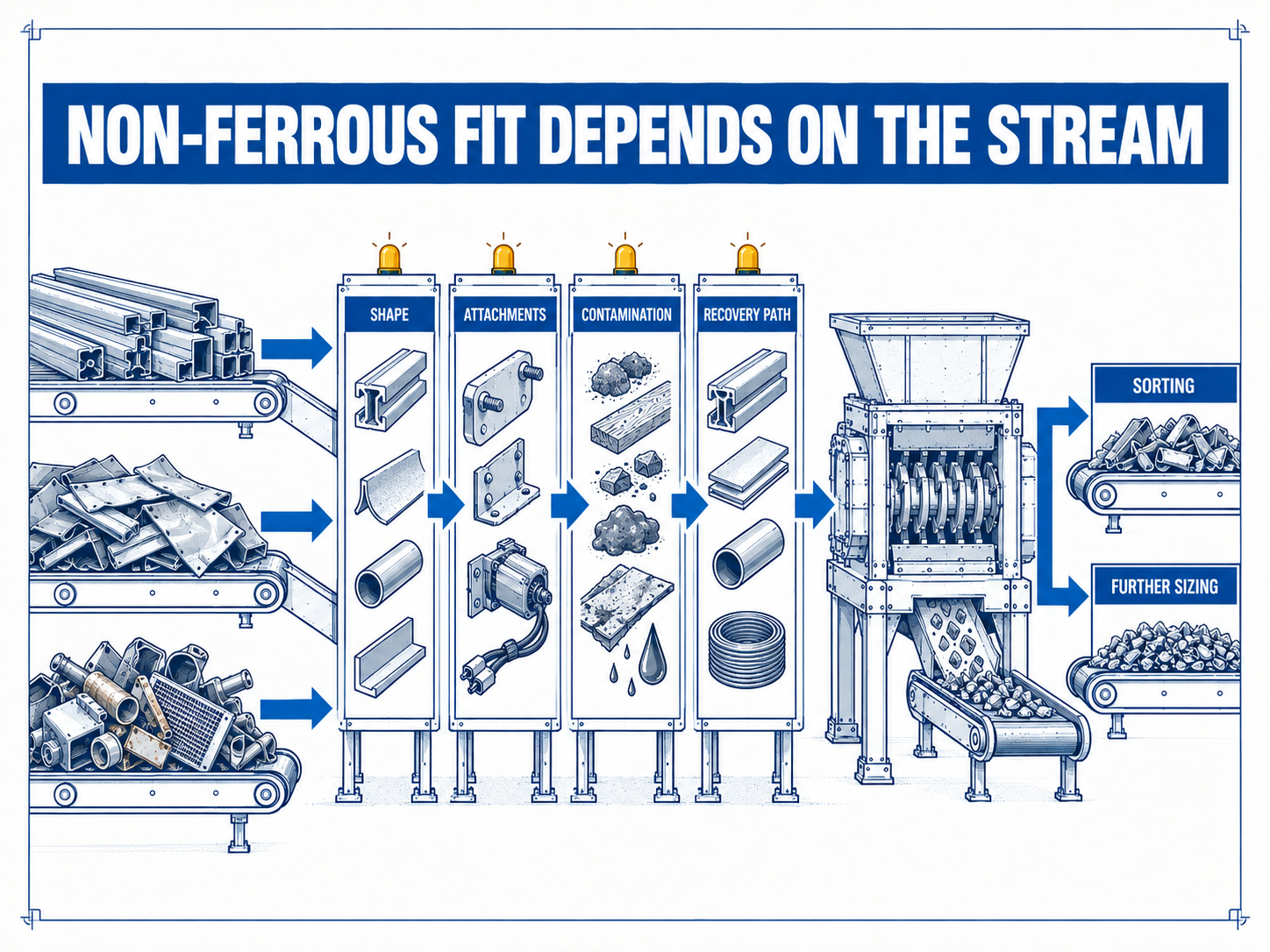
For an aluminum shredder inquiry, record whether the material arrives as profiles, cast pieces, cans, housings, wire-rich assemblies, or irregular mixed objects. Note coatings, plastic inserts, rubber, glass, fasteners, and any liquid or sealed component. These details affect feeding, cutter exposure, wear review, and the way the output will be separated or cleaned.
The downstream objective matters just as much. If the operation needs a material stream for magnetic or non-ferrous separation, the shredder is only one stage in that route. If the goal is simply to reduce volume for handling, a different output requirement may be acceptable. Do not select an aluminum shredder from a clean product photo when the real feed contains attachments or contamination.
Non-ferrous checkpoint: Define the shape, attachments, contamination, and recovery path as one application brief. “Aluminum” by itself is not a complete feed specification.
The same discipline applies to copper, brass, bronze, and mixed non-ferrous streams. Use the material family as the first label, then verify the actual pieces and the process that follows.
Single-shaft or double-shaft: choose by process role
Single-shaft and double-shaft machines are not interchangeable labels for “a stronger shredder.” They describe different machine arrangements that may serve different stages of a line. A single-shaft configuration is often considered when the process needs more controlled reduction or a screened output. A double-shaft configuration is often considered for coarse opening, bulky feed, or primary reduction before another stage. Those are application tendencies, not universal performance claims.
The trade-off is straightforward: a coarse opening role can leave sizing or separation to later stages, while a controlled-output role still depends on the actual feed and hazards. Shaft count alone cannot settle that choice.
| Process question | Single-shaft role to investigate | Double-shaft role to investigate | Evidence still required |
|---|---|---|---|
| Does the feed need controlled reduction? | Review when output consistency and screen interaction matter | Review when the first stage mainly needs to open or reduce bulky material | Target output and acceptable variation |
| Is the incoming material bulky or irregular? | Confirm feeding limits and chamber fit | Confirm whether the arrangement suits the largest recurring object | Largest piece, thickness, density, and attachments |
| Is the shredder the first stage? | May be part of a controlled sizing route | May be considered for primary or coarse reduction | Complete line sequence and downstream duty |
| Is contamination present? | Review wear, screening, and protection requirements | Review the same hazards before assuming coarse duty solves them | Pre-sorting and hazard controls |
The comparison should end with a testable question: which arrangement can produce the output that the next stage accepts from this actual feed? Do not turn shaft count into a ranking. A supplier needs the material brief, target output, and hazard information before confirming the cutter, chamber, drive, protection, or replacement-parts path.
Build the downstream path before choosing the shredder
A metal shredder does not automatically create saleable or furnace-ready material. It changes the size and presentation of the feed so later handling or separation can work more effectively. In a recycling line, the next step may involve conveyors, magnetic separation for ferrous material, eddy-current separation for selected non-ferrous material, air classification, screening, baling, or another operation chosen for the target stream. The exact sequence depends on the feed and recovery objective.
Describe the downstream path in plain language before asking for a metal shredder machine:
- Input: what arrives, in what shape, and with what contamination?
- Shredding job: open, reduce, liberate, or prepare the material for another step?
- Output: what size, presentation, or separation condition is acceptable?
- Next stage: which machine or manual step receives the output?
This sequence protects the buyer from a common mismatch. A shredder can look effective at the hopper while still producing an output that bridges, carries too much non-metallic material, or fails the next separation step. The process decision belongs to the whole line, not to the shredder name alone.
If the downstream requirement is not defined, keep the machine discussion at the application-screening stage. First agree on the output that will be accepted, then test the feed against that requirement.
What to verify in a material-test or supplier review
A useful metal shredder inquiry gives the supplier enough information to reproduce the real decision. Send representative material, not only a clean sample or a catalog description. Include photos of the full objects and close views of attachments, dimensions of the largest recurring pieces, approximate thickness or bundle condition, and a written note about contamination and hazards. These are buyer-supplied facts until the supplier confirms the applicable process route.
Use this short test brief:
- Identify the material family and the percentage of mixed or attached material.
- Show the largest recurring object, its shape, thickness, and how it reaches the hopper.
- List sealed containers, batteries, oils, refrigerants, coatings, glass, or unknown cavities.
- State whether the goal is rough reduction, controlled sizing, liberation, separation preparation, baling, or another defined step.
- Define what counts as an acceptable test result, including the next-stage handling requirement.
- Ask which cutter, chamber, shaft, screen, protection, and replacement parts require a fitment review.
The final item is a supplier-confirmation field, not a number to copy from another machine. A material test is useful only when the sample and acceptance criteria represent the production stream. If the sample is cleaner, smaller, or safer than normal, record that limitation beside the result.
Marketing claims and shortcuts to ignore
The following statements may start a conversation, but none is fitment proof by itself:
- “Processes all metals.” Ask which material families, shapes, sizes, attachments, and conditions were actually tested.
- A long material list with no feed limits. A list does not tell you how the objects arrive or what the output must become.
- A capacity number without conditions. Throughput depends on the feed, presentation, target output, and complete line. Do not treat a generic number as a project promise.
- “No pre-sorting required.” Hazardous or enclosed items still need a safety and site review.
- A clean output photo without acceptance criteria. Ask what was fed, what was removed, and how the next stage judged the result.
Better question: What exact material was tested, what condition was it in, what output was accepted, and which parts of that result still require project confirmation?
The aim is not to distrust every supplier statement. It is to separate an industry rule, a product-specific fact, and a buyer input so each claim is checked by the right source.
When to delay the purchase
Delay the metal shredder decision when the feedstock is still described only as “scrap,” the largest recurring object is unknown, sealed or hazardous items have not been screened, or the downstream output has not been agreed. A missing input is not a reason to fill the gap with a generic machine claim.
Pause for a material and safety review when the stream may contain batteries, oils, refrigerants, pressurized or sealed containers, unknown cavities, or other hazards. OSHA identifies moving-part hazards and the need for machine guarding and hazardous-energy control in recycling facilities. Those controls belong to the complete installation and site procedure, not to a blog checklist alone.
- No representative sample: collect one before comparing configurations.
- No acceptance criteria: define the next-stage output first.
- No hazard decision: screen or divert the material before testing.
The purchase becomes easier to defend when the material brief, test result, downstream duty, and supplier confirmation all point to the same process role.
FAQ
What is a metal shredder?
A metal shredder is an industrial size-reduction machine used as one step in a material-handling or recycling process. Its role depends on the feed shape, material condition, hazard controls, target output, and downstream line. The term does not guarantee that every machine can accept every metal object.
What metals can an industrial shredder process?
Potential applications can include ferrous, non-ferrous, and mixed metal streams, but the material name is only the first screening field. Confirm the largest piece, attachments, contamination, hazard profile, and output requirement before treating a stream as a suitable application.
What is the difference between a metal shredder and a metal crusher?
The terms can describe different size-reduction roles, but the useful distinction is the process duty and output, not the label alone. Ask whether the line needs coarse opening, controlled reduction, screened sizing, or preparation for separation. The feed and downstream acceptance criteria decide which machine class should be reviewed.
How does a metal shredder fit into a recycling line?
It usually sits between incoming preparation and later handling, sizing, or separation. The output may move to magnetic, eddy-current, screening, air, baling, or another process selected for the material route. The shredder should be evaluated against what the next stage can accept.
What should be checked before selecting a metal shredder?
Check the material family, largest feed piece and shape, contamination and embedded hazards, target output, and downstream process. Then send representative material and written acceptance criteria for a material test or fitment review. If any of those fields is unknown, delay a confident purchase decision.
Conclusion
A metal shredder should be evaluated as one process step in a defined scrap and downstream route. Confirm the material family, largest recurring feed shape, contamination and hazards, and target output, then use representative material and acceptance criteria for a supplier or material-test review. If any of those inputs is unknown, delay the purchase decision.
References
- United States Environmental Protection Agency. (n.d.). Scrap metal merchants sector insights bulletin. https://www.epa.gov/p2/scrap-metal-merchants-sector-insights-bulletin
- United States Environmental Protection Agency. (n.d.). Midwest Metallics response site profile. https://response.epa.gov/site/site_profile.aspx?site_id=1990
- Occupational Safety and Health Administration. (n.d.). Waste management and recycling. https://www.osha.gov/green-jobs/recycling/waste-management
- Occupational Safety and Health Administration. (n.d.). The control of hazardous energy (lockout/tagout), 29 C.F.R. § 1910.147. https://www.osha.gov/laws-regs/regulations/standardnumber/1910/1910.147
- Energycle. (n.d.). Industrial metal shredder for scrap metal recycling. https://www.energycle.com/plastic-shredders/heavy-duty-metal-shredder/
Last reviewed and updated: September 2026. Author: Kingstream team. For tailored guidance, contact our team.