
TL;DR
The steel recycling process is a set of route-dependent stages: mills receive and assess scrap, prepare it when needed, make steel through EAF or integrated BF-BOF routes, then cast and form the product. Cutting or shredding is conditional on scrap form and mill requirements.
Abstract
Steel scrap becomes new steel through a route shaped by the incoming material and the receiving mill. This overview begins at receipt and follows acceptance, preparation when needed, steelmaking, casting, and product forming. The World Steel Association process map shows crude steel cast into semi-finished forms before hot rolling.
Key Takeaways
- Scrap source and condition shape preparation, but do not alone establish a mill grade.
- EAF and integrated BF-BOF routes use scrap differently.
- Receiving, sorting, and acceptance checks precede any facility-specific preparation decision.
- Cutting or shredding is optional and depends on scrap form and mill requirements.
- Casting and rolling connect liquid steel to product forms, with steps varying by mill and product.
Steel recycling is a route map, not one fixed sequence
The steel recycling process in this overview starts when scrap reaches a receiving mill; collection and transport before receipt are outside scope. The mill assesses the material against its requirements, adds preparation when needed, then moves it through steelmaking, casting, and product forming. The World Steel Association’s raw-material guidance describes both EAF and integrated BF-BOF routes, while accepted scrap and preparation depend on the receiving mill.
| Process block | What happens | Why the route can change |
|---|---|---|
| Receive and assess | The operation identifies the incoming material and checks it against its acceptance needs. | Scrap source and condition differ. |
| Prepare if needed | Scrap may be sorted, cut, or shredded before it is sent onward. | The material form and receiving mill requirements determine whether size reduction is useful. |
| Make steel | Scrap can enter an electric arc furnace (EAF) or an integrated blast furnace-basic oxygen furnace (BF-BOF) route. | Scrap has a different role in each route. |
| Cast and form | Liquid steel is cast into an intermediate form and then processed for a product. | Mill equipment and the target product shape the downstream steps. |
The World Steel Association’s process map shows the broad sequence from raw-material preparation through steelmaking, casting, and rolled products. The table adds receipt and mill-specific preparation decisions, which the diagram does not prescribe.
Preparation may take place at a recycler before delivery or at the receiving mill after receipt. Nucor’s process description places sorting and cutting or shredding before shipment in one operator example; the World Steel Association’s map treats raw-material preparation as a broad stage before steelmaking. These are process functions, not a requirement that every site perform the same steps.
Source capsule: The World Steel Association’s 2021 scrap fact sheet identifies scrap as a steelmaking raw material. Its raw-material guidance describes EAF and integrated BF-BOF routes. The U.S. EPA’s AP-42 chapter describes ironmaking, steelmaking, and semifinished product preparation as interrelated operations.
Which steel scrap streams enter the process
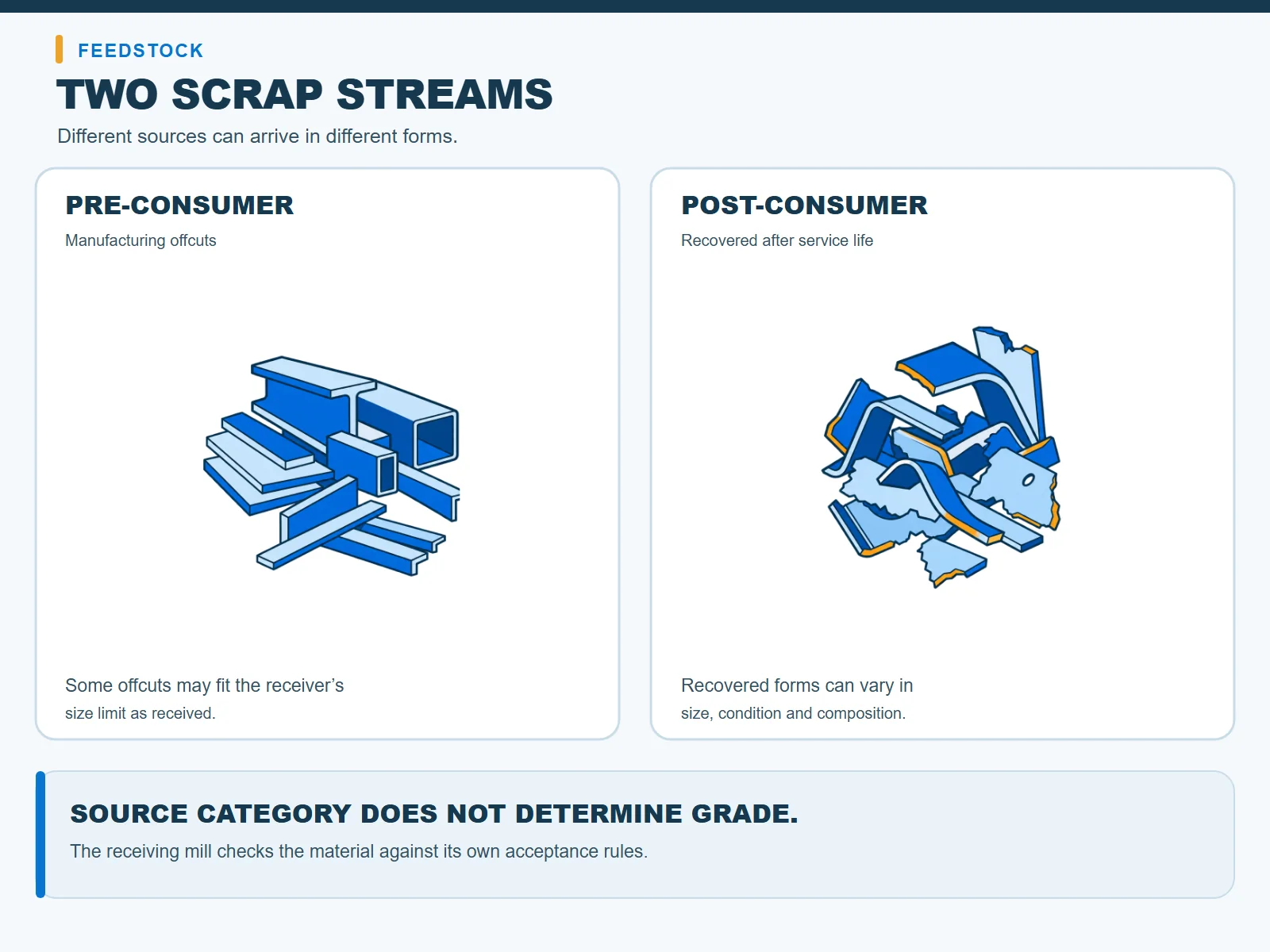
Two broad source categories help explain why incoming steel scrap can need different handling. Manufacturing scrap is generated while products or components are made. End-of-life scrap is recovered after a product has served its original use. The World Steel Association describes these as pre-consumer and post-consumer scrap streams.
The distinction describes where the material came from, not its mill grade. A manufacturing offcut may have a known origin, while end-of-life material may arrive in mixed forms. That does not by itself establish chemistry, cleanliness, dimensions, or whether a particular mill will accept it. Those questions belong to the receiving operation’s specifications and inspection.
A short glossary
- Pre-consumer scrap: steel recovered from manufacturing before a product reaches its end user.
- Post-consumer scrap: steel recovered after a product has completed its original service life.
- Scrap grade: a classification used by buyers and processors to describe material properties and acceptance conditions. The source category alone is not a grade.
For a concrete example, Nucor distinguishes manufacturing offcuts and punch-outs from end-of-life items such as vehicles and appliances, and includes cutting or shredding in its own process description. That contrast shows why incoming form can change the preparation question; it does not make size reduction mandatory for either stream.
EAF and BF-BOF routes use scrap differently
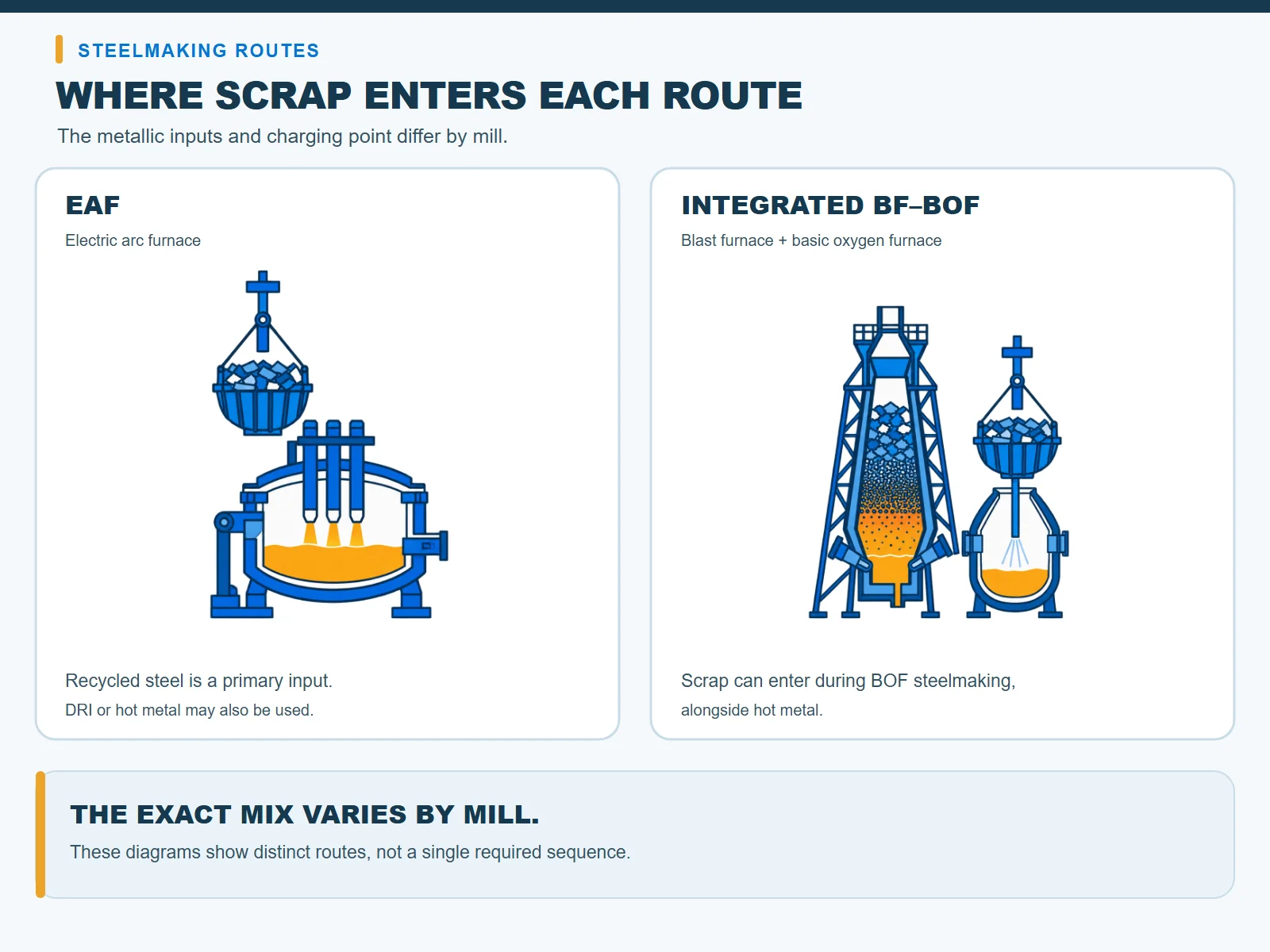
Source capsule: World Steel Association guidance describes two routes with different scrap roles. An electric arc furnace (EAF) primarily uses recycled steel, though direct reduced iron (DRI) or hot metal may also be used. In an integrated BF-BOF route, ironmaking precedes steelmaking, where scrap can be used.
| Route | Route context | Scrap’s position |
|---|---|---|
| Electric arc furnace (EAF) | Steel is made in an electric arc furnace. | Recycled steel is the primary input; DRI or hot metal may also be used. |
| Integrated blast furnace-basic oxygen furnace (BF-BOF) | Ironmaking inputs produce hot metal before the basic oxygen furnace stage. | Scrap is used during steelmaking. |
Read the route names at different levels. EAF identifies the steelmaking furnace; BF-BOF identifies an integrated production path with an ironmaking stage followed by steelmaking. That sequence is visible in the name: blast furnace (BF) describes the ironmaking part, while basic oxygen furnace (BOF) names the steelmaking stage. The distinction helps when sketching a process map, because the integrated route is a linked sequence and the EAF label refers to a furnace step. It makes the comparison about where stages sit, not about two equivalent furnace names.
Research on route substitution points to scrap quality and supply, plus regional conditions, as factors in route suitability. A 2025 peer-reviewed review of steel-production routes supports that distinction. A two-route map therefore describes different process positions, but it cannot establish whether a particular scrap stream fits a particular buyer.
Note: When comparing outlets, a supplier can ask each buyer how the offered stream would fit its route and which role it could serve.
How receiving mills sort and accept steel scrap
Receiving and acceptance come before a facility can decide whether to cut or shred a load. The operation has to identify the incoming material and compare its condition with the applicable purchasing or process requirements. These controls vary by facility, so a generic article cannot specify one universal inspection sequence.
A practical review keeps three questions separate:
- What is arriving? Record the source and visible form well enough to distinguish manufacturing material from recovered end-of-life scrap.
- What must be separated or clarified? The receiving operation sets its contamination and material acceptance criteria. Do not assume the same checks apply to every load.
- Which grade or specification applies? Confirm the buyer’s classification and requirements directly. A magnet can help identify ferrous material, but magnetism alone does not establish a steel grade.
The World Steel Association notes steel’s inherent magnetism, and Nucor describes magnetic separation as one sorting method. These sources support magnetism as a handling aid, not a claim that every yard uses the same separator or that a magnet verifies chemistry. Grade identification and acceptance remain separate from simple material attraction. The U.S. Department of Energy identifies copper and tin removal from scrap as a steelmaking contamination challenge.
Once the receiving mill confirms the material it can use, preparation can be planned around that decision. Keeping acceptance separate from size reduction avoids treating shredding as a test for whether scrap is acceptable.
When scrap needs cutting or shredding
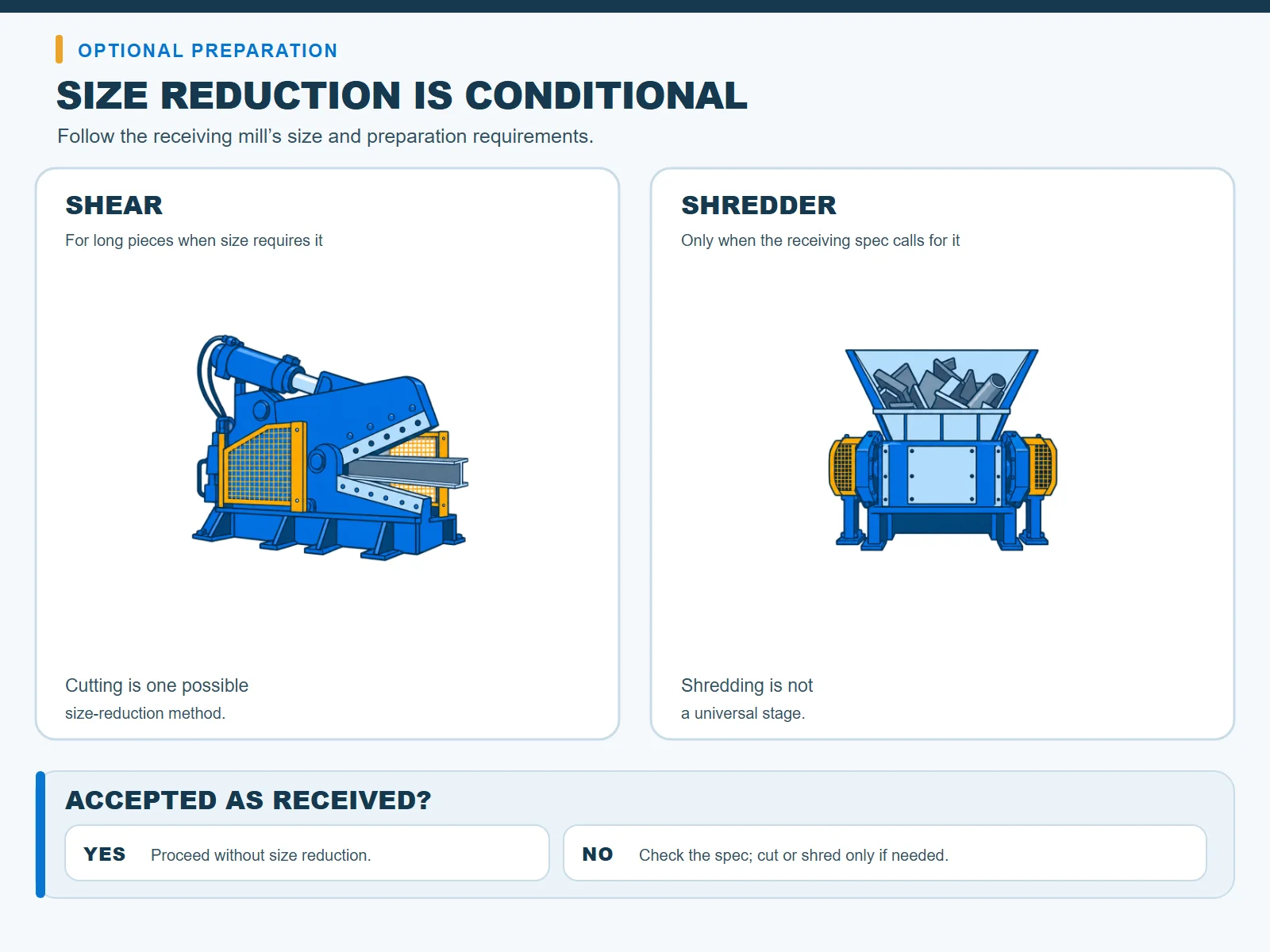
Cutting and shredding are conditional preparation steps. They can reduce or change the form of some incoming scrap before it reaches steelmaking, but the steel recycling process does not require every item to pass through a shredder. The material’s size and form, along with the receiving mill’s requirements, determine whether preparation is needed.
A useful sequence of questions is:
- Is the scrap acceptable as received? Start with the receiving specification, not a machine assumption.
- Does its present form need to change? Oversized or irregular pieces may call for cutting or other preparation, depending on the route.
- What method does the operation approve? Shredding is one possible method. It is not a universal stage and the overview does not determine machine size or configuration.
Note: Nucor’s 2025 process description gives one operator example of scrap preparation that includes cutting or shredding. It supports the existence of that route, not a claim that every mill follows it.
The distinction matters for equipment planning. If an article draws a single arrow from scrap receipt to a shredder, it can make an optional step look mandatory. The more accurate map branches: accepted scrap may proceed without size reduction, while other material needs a preparation step that matches its condition and the receiver’s criteria.
How liquid steel becomes a finished product
After scrap enters steelmaking, the mill produces crude steel. The World Steel Association’s process map shows it cast into three semi-finished shapes (slabs, billets, and blooms) and then hot-rolled into a range of flat and long products.
The process map names slabs, billets, and blooms as semi-finished shapes. Examples of hot-rolled flat products include plate and coils; long products include rebar, bars, wire rod, tubes, structural shapes, and rails. It also shows finishing operations such as coating and cold rolling. These are examples of common product paths, not a claim that every mill uses each operation. Product and facility requirements determine the subsequent forming and finishing steps.
- Casting forms crude steel into an intermediate shape, such as a slab, billet, or bloom.
- Rolling converts semi-finished steel into flat or long products; later finishing operations vary by mill and product.
These are downstream conversion steps: scrap preparation ends before steelmaking, while casting and rolling help determine the product form.
What determines where a shredder belongs
To locate preparation in a scrap route, compare the incoming material’s form and condition with the change it still needs and the receiving mill’s acceptance rules. The mill can confirm whether the load can be received as delivered or requires another preparation step.
The process overview can identify those checks, but it cannot select a shredder, blade, capacity, or facility layout. Those decisions require verified feedstock details and the receiving mill’s specifications. Treating a generic process diagram as equipment-sizing advice would move beyond the evidence available here.
For a broader view of where industrial shredding fits across materials and applications, see Metal Shredder Applications. That guide covers application contexts; the mill’s own acceptance criteria remain the source for a specific scrap stream.
For an equipment discussion, prepare a short feed brief with the material stream, any confirmed grade, representative piece dimensions, visible contamination concerns, expected throughput, and target output size. Label estimates and unknowns clearly. State whether the request concerns cutting, shredding, or only pre-processing advice; ask the supplier which machine details depend on those inputs rather than treating a process diagram as an equipment specification.
Conclusion
A useful steel recycling process map starts at receipt, then follows assessment, the mill’s EAF or integrated BF-BOF route, preparation when required, steelmaking, casting, and product forming. For a specific load, confirm its accepted grade and delivery form with the receiving mill before planning further preparation.
References
- Davis, C., Li, Z., Styring, P., Curry, R., & Holliman, P. J. (2025). Routes to reducing emissions from steel production. Nature Reviews Clean Technology, 1(12), 890–902. https://doi.org/10.1038/s44359-025-00118-1
- Nucor Corporation. (2025, July 31). How is steel recycled? The process from scrap to new steel. https://nucor.com/2025/07/31/how-is-steel-recycled-the-process-from-scrap-to-new-steel/
- U.S. Department of Energy. (n.d.). Iron and steel manufacturing. https://www.energy.gov/cmei/ito/iron-and-steel-manufacturing
- U.S. Environmental Protection Agency. (1995). AP-42, Chapter 12.5: Iron and steel production. https://www.epa.gov/sites/default/files/2020-11/documents/c12s05.pdf
- World Steel Association. (2021). Scrap use in the steel industry: Fact sheet. https://worldsteel.org/wp-content/uploads/Fact-sheet-on-scrap_2021.pdf
- World Steel Association. (n.d.). Raw materials. https://worldsteel.org/about-steel/raw-materials/
- World Steel Association. (n.d.). The steelmaking process. https://worldsteel.org/about-steel/steelmaking-process/
Last reviewed and updated: September 2026. Author: Kingstream Editorial Team. The company describes its work as industrial blades, shredders, and replacement parts; this overview synthesizes the public sources above and does not claim first-hand steel-mill operating experience. About Kingstream | Contact our team.