
TL;DR
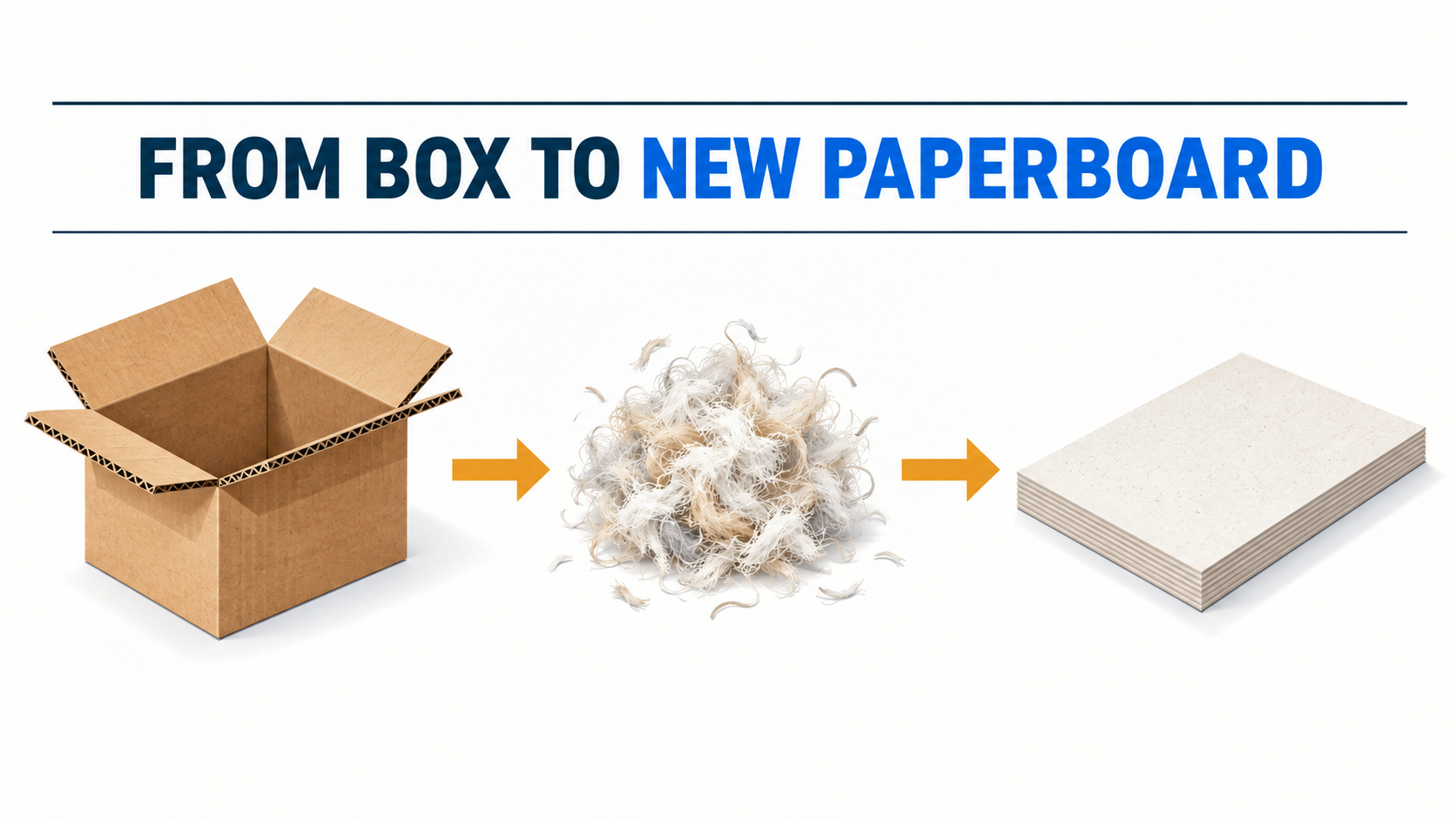
Used corrugated cardboard is collected and sorted, commonly compacted for transport to a paper mill, repulped, cleaned, and formed and dried into new paperboard. The reviewed process sources do not establish a separate shredder as a universal step.
The cardboard recycling process, from box to new paperboard
The short answer to "how is cardboard recycled?" depends on what the word cardboard means. The guide follows old corrugated containers, or OCC, through a representative route from recovery to new paperboard. It separates community or commercial collection from the fiber-recovery work at a paper mill. The sequence below is a map of the material, not a promise that every facility has an identical layout.
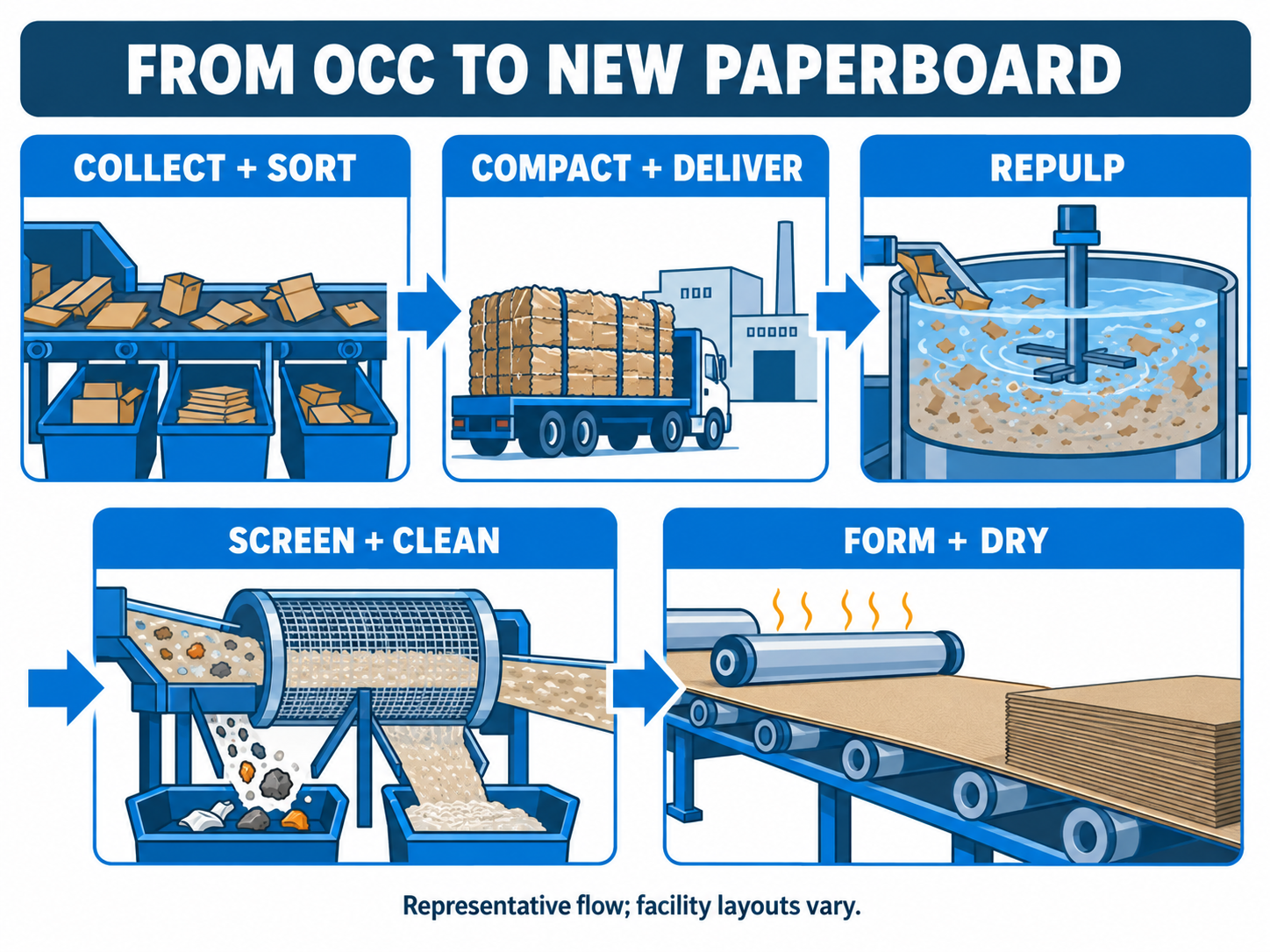
| Stage | What happens | Material leaving the stage |
|---|---|---|
| 1. Collection and sorting | Corrugated boxes enter a collection route and are separated from other recovered materials where the system requires it. | A corrugated-cardboard stream |
| 2. Compaction and delivery | Recovered boxes are consolidated, commonly compacted, and transported to a paper mill. | Baled or otherwise consolidated OCC |
| 3. Repulping | Agitation in a repulper disperses the paperboard into a wet fiber slurry. | Pulp containing usable fiber and remaining contaminants |
| 4. Screening and cleaning | Mill equipment removes unwanted material and prepares the fiber stock. | Cleaner fiber stock |
| 5. Sheet making | Fiber is laid onto a moving screen, then pressed and dried before the sheet is wound into rolls for later conversion. | Recycled paper or paperboard rolls |
5-stage overview: OCC moves from collection and sorting through compaction, mill repulping, fiber cleanup, and paper-machine forming and drying. The Fibre Box Association describes these as connected steps, while the EPA identifies OCC as a recovered-paper grade used for new shipping boxes and other paperboard packaging. The table is a reader-friendly summary, not a universal plant specification.
Collection and sorting prepare cardboard for the mill
In mill and recovery-industry language, old corrugated containers (OCC) means used corrugated boxes collected as a paper grade. It does not automatically mean every item a household calls "cardboard." Mixed paperboard packaging can be classified differently, and what a local program accepts is a separate question from how a mill processes an OCC bale.
After use, corrugated boxes are collected through commercial, retail, or community systems. Some streams are kept relatively separate at the source. Others travel with mixed recyclables and are sorted at a materials recovery facility, often shortened to MRF. The EPA collection overview describes both single-stream collection, where materials are separated later, and sorted-stream collection, where paper grades are separated earlier. Those are different routes to recovered material, not competing descriptions of one required system.
Once a corrugated stream is recovered, it may be consolidated and compacted to make transport to a paper mill practical. The Fibre Box Association overview describes used corrugated containers being collected, compacted, transported to a mill, and then placed in a repulper. A bale is therefore a transport form of recovered material, not the finished recycled product.
The important handoff is the material grade and its condition. A mill buys recovered paper that matches its production needs and specifications. The exact sorting equipment, acceptable material mix, and contamination rules depend on the collection contract and receiving facility. EPA’s collection information is an older archived overview, so it is useful here only for distinguishing single-stream and sorted-stream routes. It should not be treated as current local disposal instructions or a universal acceptance list.
The same feedstock-first principle appears in the plastic recycling process, although the material and mill operations differ.
That distinction prevents a common misunderstanding: the route from a used box to a mill is not necessarily one conveyor line. A source-separated commercial load may be handled differently from mixed curbside recyclables, even though both can enter an OCC stream. The next stage begins when recovered corrugated material reaches mill processing.
Repulping releases the usable fibers inside corrugated board
At the paper mill, repulping turns recovered corrugated board into a wet fiber suspension. The Fibre Box Association describes OCC entering a repulper, where agitation forms a slushy pulp. In plain terms, water and mechanical action loosen the paper fibers from the board structure so they can move through later stock-preparation steps.
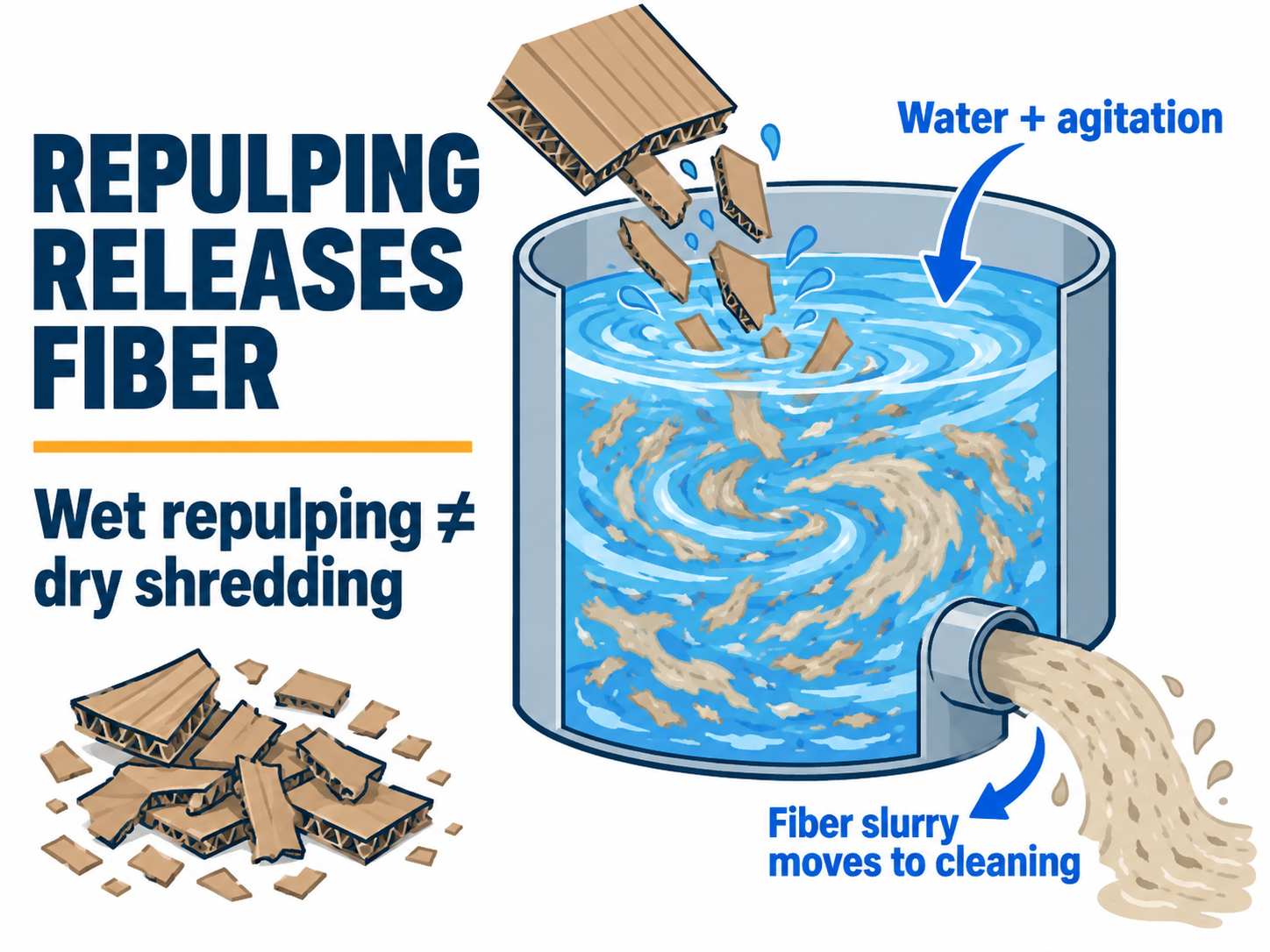
Dry shredding is a different operation from repulping. A shredder cuts material into smaller pieces; a repulper disperses paper fiber in water. Smaller pieces may affect how material is handled in a specific system, but a pile of cut cardboard is still not mill pulp and has not yet passed through the full fiber-recovery and paper-making route.
Repulping also does not mean that every part of the incoming load becomes usable fiber. Adhesives and dirt can remain in the suspension, as can plastics or other unwanted material; the mill may separate them at different points. The EPA overview of recycled-paper processing describes recovered paper being combined with water in a pulper, followed by screening and other separation steps, and notes that acceptable contaminant levels depend on the paper product. The FBA overview likewise describes cleaning after repulping, but neither source prescribes one universal machine arrangement or claims that all incoming material has the same composition.
The output, a fiber-bearing slurry, still needs preparation. Its condition and the downstream process depend on the recovered material and the mill’s product requirements. The key conceptual shift is from a dry, layered box to a wet stock of dispersed fibers, not directly from a box to a new sheet.
Corrugated board contains paper components bonded into a structure, so the repulper is doing more than making smaller dry pieces. Its wet agitation releases fiber into the process stream; later screening and cleaning address material that should not continue with the usable stock. The public FBA overview does not specify temperature, chemical recipe, residence time, or a recovery percentage, so no universal values are assigned to those conditions.
Repulping in the five-stage map: Stage 3 is the mill operation that agitates OCC with water to release paper fibers into a slurry. It is not synonymous with dry size reduction, and it is not the final recycling result. The Fibre Box Association places cleaning and paper-machine formation after repulping, so a complete explanation must follow the fiber beyond the pulper.
Screens and cleaners separate fiber from unwanted material
After repulping, the mill prepares the fiber stock for paper making. Screening and cleaning are related but distinct jobs. Screens separate material according to how it passes through an opening or screen geometry. Cleaners use physical differences in the suspension to remove selected contaminants. In OCC systems, equipment and its order vary; a supplier’s process description should not be mistaken for a standard layout used by every mill.
Valmet’s technical overview describes coarse screening as removing medium-sized contaminants and flakes from pulper accepts. It describes cleaners as helping remove foreign material, including plastics and adhesive residues. Dirt and other contaminants are also covered, with different cleaner configurations aimed at different contaminant types. That is useful technical context, but it is a supplier description of process options, not a universal plant recipe.
As one example rather than a universal line design, the USDA Forest Products Laboratory’s pilot-scale recycling plant lists high-consistency pulping, pressure screening, centri-cleaning, and flotation washing/dewatering among its processes. That illustrates available process equipment; it does not prescribe the order or configuration used by every corrugated mill.
The broader point is that "cleaning" is not one magic filter that makes every feed identical. A mill’s stock-preparation system is configured around the incoming furnish and the paper or board being made. The Fibre Box Association’s public process overview keeps the explanation simpler: after repulping, contaminants are cleaned from the pulp before the fiber moves to the paper machine.
Coatings and treatments also need a qualified answer. It is inaccurate to say that every coated or treated corrugated box is automatically unrecyclable. In 2025, AF&PA and the Fibre Box Association published an updated voluntary standard with test protocols for evaluating whether coated or treated corrugated packaging can be repulped and recycled using common mill technology. That supports a narrower conclusion: some materials can qualify under the standard, but that does not guarantee acceptance by every local program or mill.
Coated-board rule of thumb: The 2025 AF&PA/FBA update treats repulpability as something to evaluate through a voluntary test standard, not a blanket yes-or-no label for every coating. A result under that standard is not the same as a promise that every collection program or receiving mill accepts every coated package. Facility rules still matter.
Where shredding fits, and why it is not the whole process
Is shredding always required to recycle cardboard? The verified sources do not establish a separate shredder as a universal step in the OCC route. The Fibre Box Association’s overview moves from collection and compaction to transport, repulping, cleaning, and paper-machine operations without specifying a mandatory dry-shredding stage. Because that page is an overview rather than a blueprint for every mill, its sequence should not be used to claim that no facility ever uses size reduction.
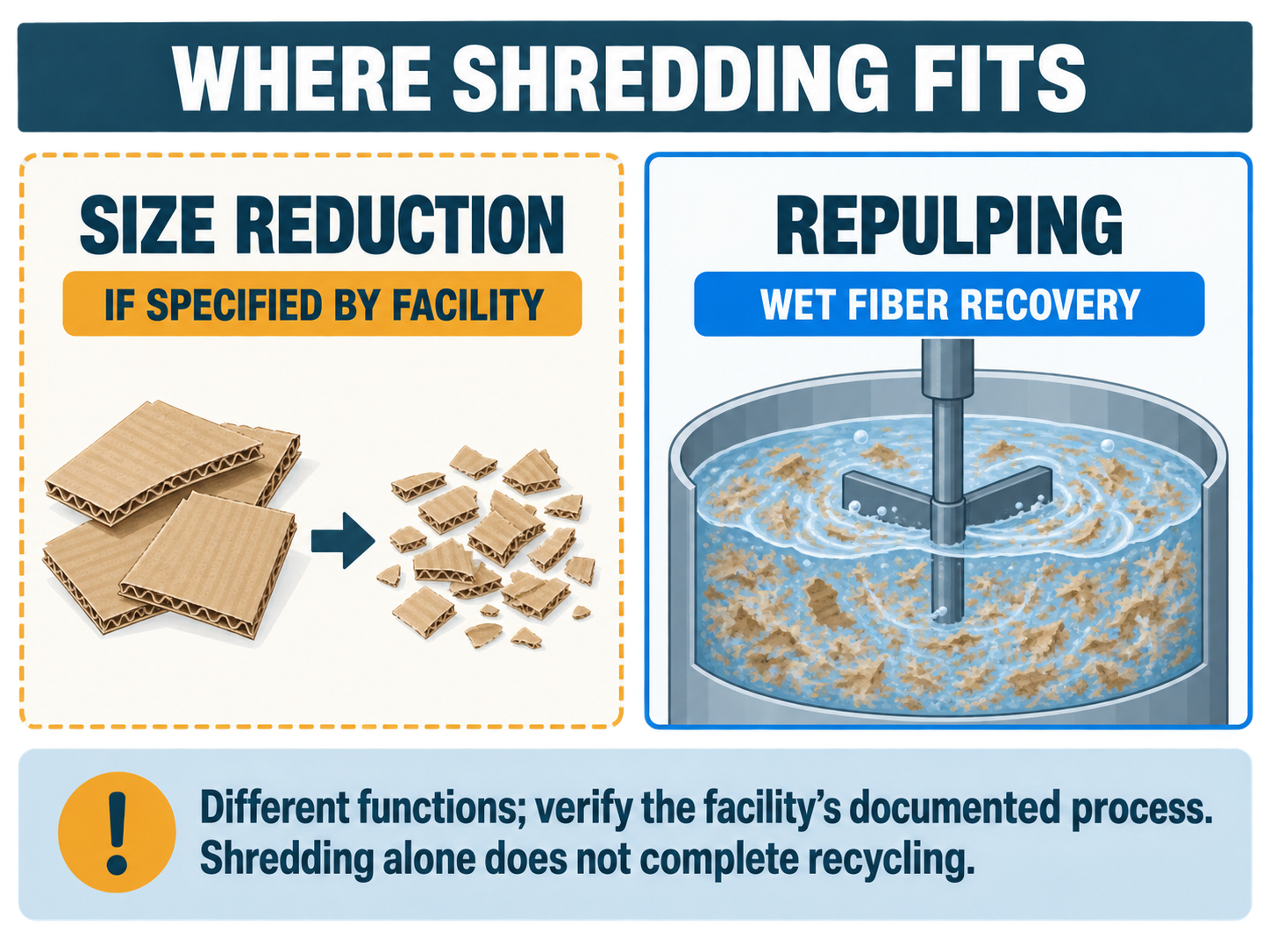
The careful answer is that a facility may describe a site-specific size-reduction or feed-preparation step, but the step should be confirmed against that facility’s process. If it exists, it is a preparation or handling operation. It does not by itself separate usable fiber from contaminants, make wet pulp, or form new paperboard.
That stage-versus-whole-process distinction also appears in the tire recycling process: one preparation step is not the same as the complete material-recovery route.
The distinction matters when reading equipment descriptions. "Shredded cardboard" describes a physical size or form. "Repulped fiber" describes material dispersed into a wet stock for downstream processing. They are not interchangeable terms, and neither a bale nor a cut piece is equivalent to the finished recycled sheet.
For a separate equipment-level distinction, see industrial shredders versus grinders; equipment terminology does not by itself describe the full recycling process.
What the source supports: In this article’s 5-stage map, shredding is not a required stage. The Fibre Box Association’s public OCC overview describes collection and compaction, mill delivery, repulping, cleaning, sheet forming, and drying without prescribing a separate universal shredder. This limits what that overview establishes; facility-specific preparation steps still need facility documentation.
Cleaned fiber is formed and dried into new paperboard
Once the mill has prepared the fiber stock, it can move to the paper machine. The Fibre Box Association describes clean fiber being poured onto a moving screen, forming a continuous fiber mat, and then being pressed between rollers to remove water. The sheet passes through a dryer section, is wound onto a spool, and is slit and rewound into rolls for shipment to box manufacturers.
Those rolls are an intermediate product, not necessarily a finished box. A converter forms corrugated board from paper layers joined with adhesive, then cuts and processes the board into boxes or other packaging. OCC can be used for new shipping boxes and other recycled-content paperboard packaging, but the exact product depends on the mill’s furnish and manufacturing requirements.
2 conversions complete the route: First, a paper machine turns cleaned fiber stock into a pressed, dried paper web and rewound rolls. Then a box manufacturer converts paper rolls into corrugated board and packaging. The Fibre Box Association describes both stages, while EPA lists shipping boxes and other paperboard packaging among OCC uses. Repulping is therefore only the middle of the material journey.
References
- American Forest & Paper Association. (2025, May 29). Industry publishes updated voluntary standard for recycling cardboard. https://www.afandpa.org/news/2025/industry-publishes-updated-voluntary-standard-recycling-cardboard
- Fibre Box Association. (n.d.). Recycled. https://www.fibrebox.org/recycle
- U.S. Environmental Protection Agency. (n.d.). Paper grades and collection. https://archive.epa.gov/wastes/conserve/materials/paper/web/html/grade.html
- Valmet. (2023, October 31). Maximizing operational performance of the OCC process with screening and cleaning. https://www.valmet.com/insights/articles/packaging-and-paper/maximizing-operational-performance-of-the-occ-process-with-screening-and-cleaning
- U.S. Environmental Protection Agency. (n.d.). Paper making and recycling. https://archive.epa.gov/wastes/conserve/materials/paper/web/html/papermaking.html
- U.S. Department of Agriculture, Forest Service, Forest Products Laboratory. (2023, September 18). Fiber Processing Pilot Plant. https://research.fs.usda.gov/fpl/labs/locations/fppp
Last reviewed and updated: September 2026. Author: kingstramblade Jack. For tailored guidance, contact our team.