
TL;DR
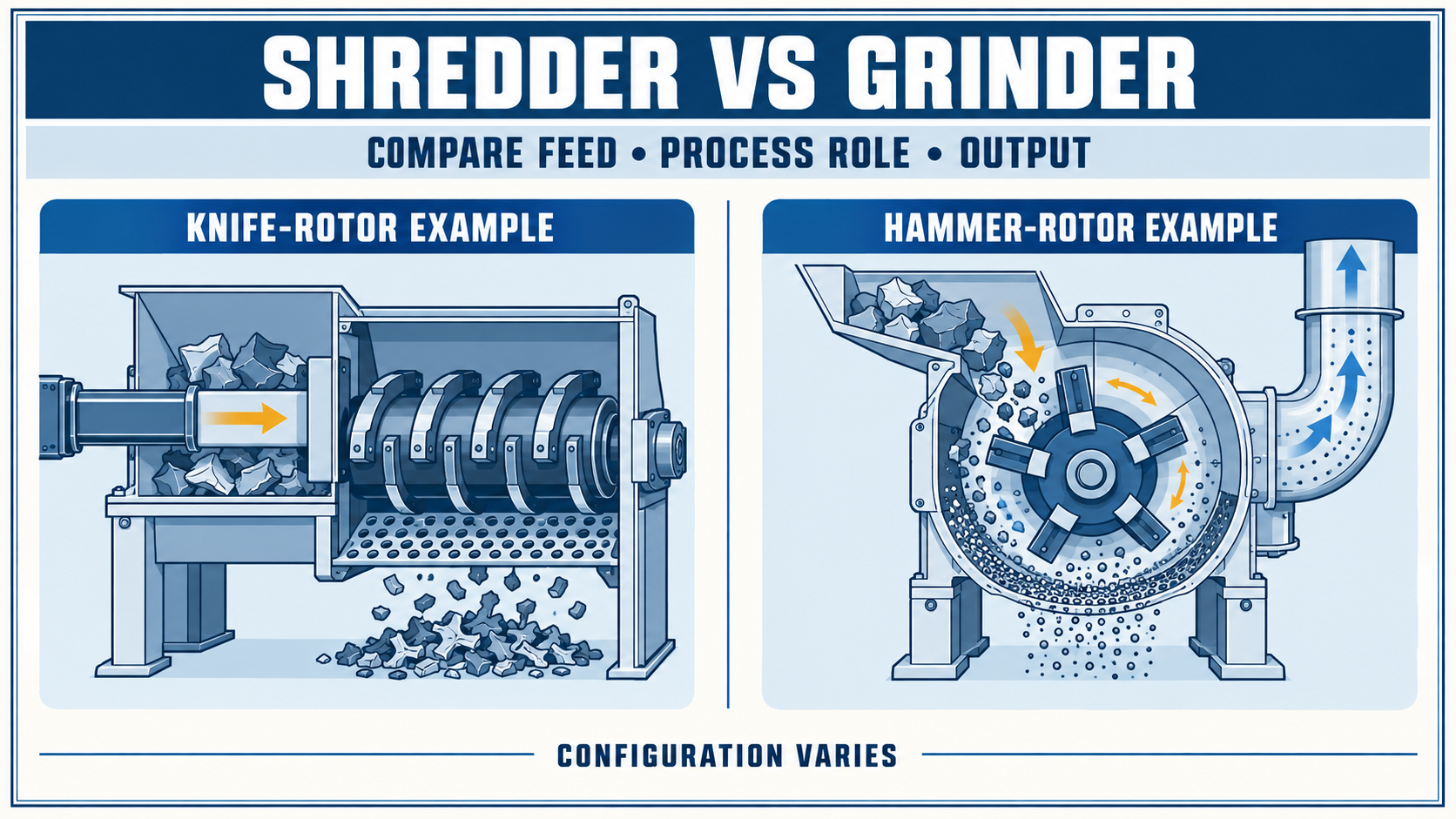
In industrial recycling, a knife-rotor shredder may prepare incoming feed, while a hammer-based unit may refine prepared material toward a finer fraction; machine labels overlap. Choose by the actual feed, tooling, required output, and next process step, then validate the setup with representative-material testing.
Abstract
This industrial comparison explains why machine names alone do not determine fit. It compares common reduction mechanisms, feedstock and output requirements, process roles, staged configurations, and a representative-material test.
Key Takeaways
- Machine labels do not establish a universal speed or output boundary.
- Compare actual cutter or rotor design, feed method, and sizing controls.
- Feedstock form and downstream acceptance shape the useful output target.
- A shredder and grinder can have separate roles in one line, but not by default.
- Test representative material against written operating and acceptance criteria.
What differs between an industrial shredder and a grinder?
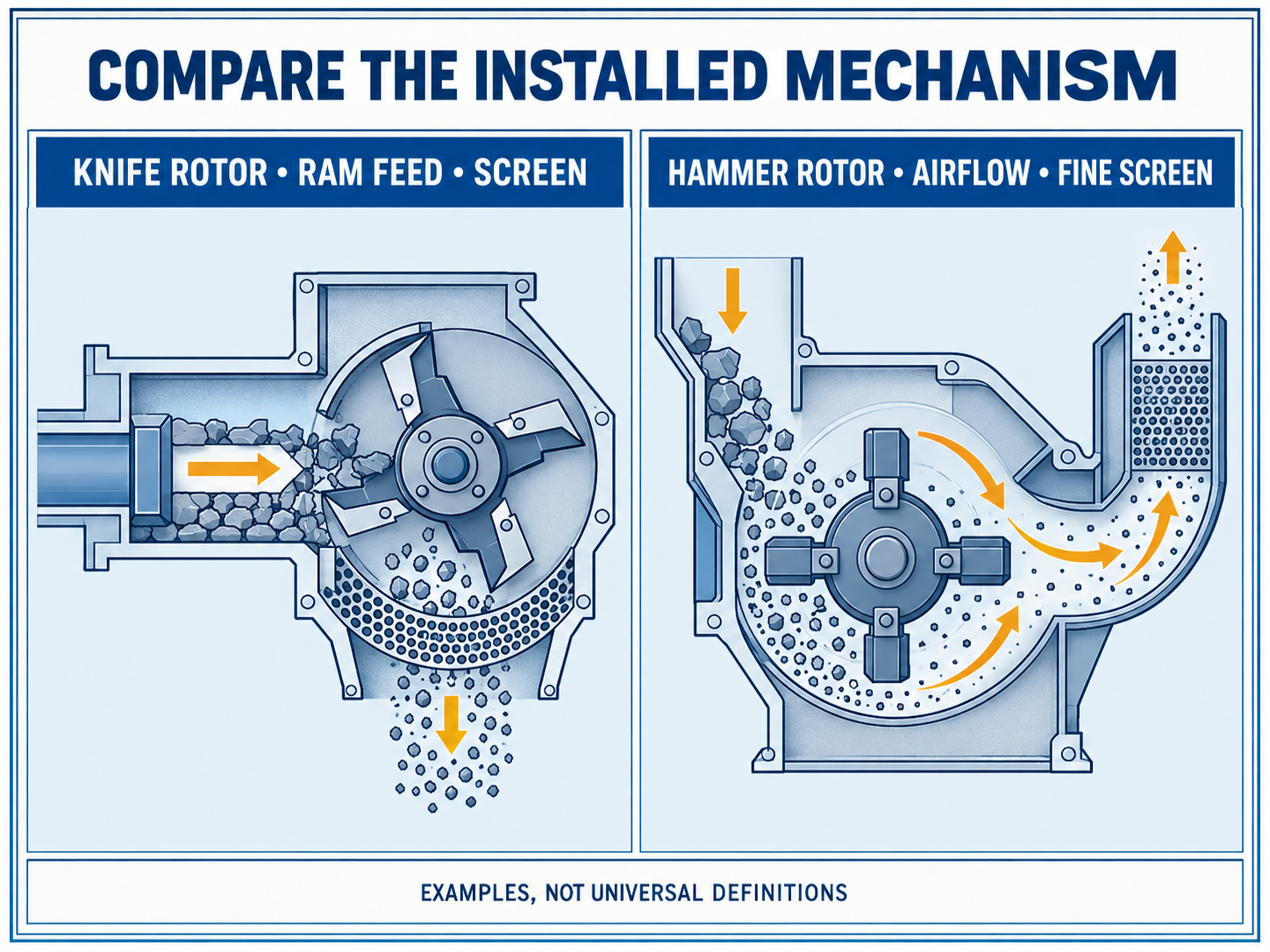
Both machines reduce material size, but installed reduction elements and process roles can differ. A documented single-shaft shredder uses a hydraulic ram to feed material to a knife-equipped rotor; its screen controls which fraction can discharge. A hammer-based fine-reduction configuration uses rotor-mounted hammers, with airflow carrying material through a fine screen after it reaches the intended size. These are examples, not universal definitions: actual machines may combine features, and some products called shredders perform fine grinding. Compare the actual rotor tooling, feed method, and output controls.
| Comparison point | Knife-rotor shredder example | Hammer-based fine-reduction example |
|---|---|---|
| Reduction action | Rotor knives cut material as the feed is advanced toward them | Rotor-mounted hammers grind the material in the chamber |
| Feed setup | A ram or other feed system must present the material to the rotor | The feed condition and delivery method must suit the grinding chamber |
| Sizing control | A screen may set the fraction allowed to discharge | A fine screen can retain material until it reaches the required passage size |
| Best comparison question | Will this setup accept the real feed and prepare it for the next stage? | Will this setup produce the size distribution the next stage requires? |
An ANDRITZ ADuro F marketed as a shredder uses rotor hammers and fine-screen discharge to produce fractions from 8 mm to fine powder. This range belongs to that configuration, not to all shredders or grinders. It shows why buyers should compare installed reduction elements and output controls instead of treating the product name as the selection rule.
Use the table as a request list, not a scorecard. It compares two documented arrangements, not every machine sold under either label. A screen is not exclusive to grinders: shredder configurations can also use screens to control discharge size. Ask for the proposed rotor or cutting elements, feed method, screen or other sizing control, and the output distribution under the intended duty.
"Low-speed shredder" and "high-speed grinder" are common labels, not definitions. Ask suppliers to identify the rotor, tooling, feed method, sizing controls, process duty, and required output.
Match the feedstock to the target output
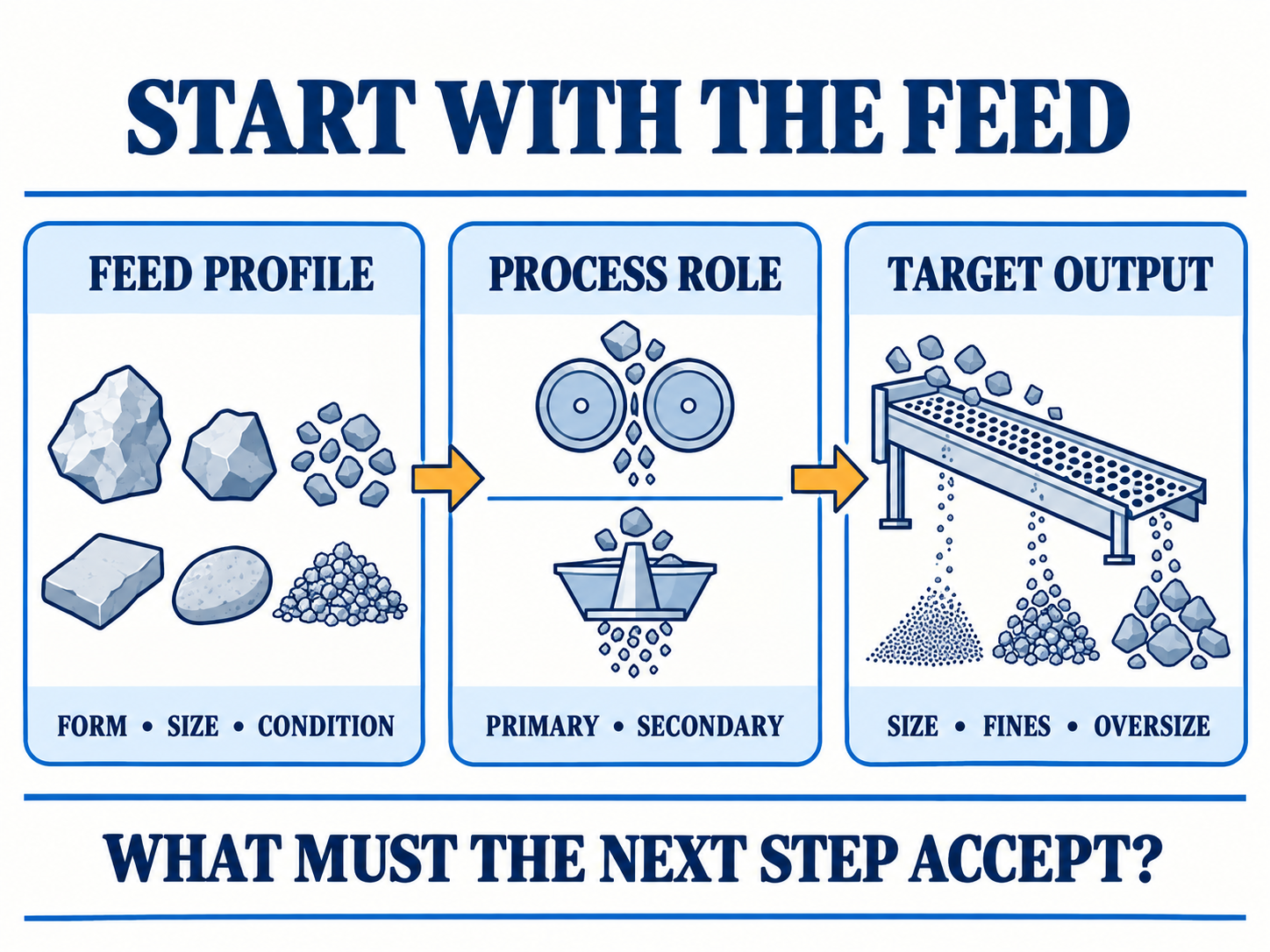
Broad labels such as "plastic feedstock," "wood," or "mixed waste" do not define feed conditions. Describe the actual feed across separate variables: form, size and consistency, composition, relevant condition, and toughness or flexibility. Do not infer these inputs from a machine label.
| Buyer input | What to describe | Why it changes the comparison |
|---|---|---|
| Material form | Loose pieces, bulky items, film, rigid parts, or another actual form | The feed opening and feed system must accept the material as it arrives |
| Size and consistency | Typical dimensions plus the range of irregular or oversized pieces | A nominal sample may not represent the difficult part of the stream |
| Composition | Material families present and known contaminants | Mixed inputs can behave differently from a clean, single-material sample |
| Condition | Moisture, temperature, or abrasiveness when relevant to the process | These conditions may affect feeding, tooling, or the test result |
| Toughness and flexibility | Whether the feed bends, stretches, tears, or resists deformation during handling | A broad material label may not describe how the proposed feed and reduction configuration handles it |
| Required output | Desired form, distribution, oversize limit, and fines tolerance | The next stage, not the machine name, defines acceptable output |
| Process role | Primary reduction, preparation before separation, or secondary finishing | The same machine may be judged differently at different points in a line |
Once the feed is described, define what the next operation will accept. "Smaller" is not enough: specify product form and size distribution, adding oversize and fines limits where relevant. Then identify process role: primary reduction, preparation before separation, or secondary finishing. This sequence links feed variables to output requirements and then to the machine’s role.
ASTM E959-83(2018) characterizes refuse size-reduction equipment using throughput, energy requirements, and product size. It provides a test framework, not a universal mapping from a material family to a shredder or grinder. Define the expected output distribution and downstream acceptance criteria when interpreting a comparison against that framework.
Use the same written feed description when asking suppliers to evaluate alternatives, and make differences in assumed setup visible. Results based on clean, dry feed are not directly comparable with results based on a plant’s usual contaminated stream. Slone Fox’s wood-waste comparison in Recycling Product News is a material-specific example, not a rule for every feedstock or recycling line.
If an output requirement or feed condition is unknown, label it as unknown and identify who must confirm it. Do not substitute another machine’s capacity or a sample result from different feed conditions.
Where each machine fits in a recycling line
The process role is a better starting point than asking which machine is "stronger." A line may need to reduce bulky incoming material, prepare a stream for sorting, or bring a prepared fraction closer to a downstream size requirement. Those are different jobs. The equipment description should say which one the machine is expected to perform.
Primary reduction and feed preparation
When incoming material is bulky or variable, the first size-reduction stage may be intended to make handling or later separation possible. The required result is not automatically a fine or uniform product. The relevant questions are whether the feed can enter reliably, whether the output supports the next operation, and whether unwanted material needs to be removed before reduction.
Secondary sizing and downstream control
Another line may receive material that has already been sorted or reduced. In that case, the objective may be to adjust output for a process specification rather than accept the full incoming stream. A grinder or a shredder can be considered for that role only after the required output and installed configuration are clear. The names alone do not establish which machine will meet it.
That distinction helps keep the process map honest. A machine can create an intermediate material for screening, separation, transport, or another reduction step. It does not follow that the same output is suitable for every downstream operation. Write the next step on the process diagram, then ask the supplier to explain how the proposed machine’s actual configuration supports that handoff.
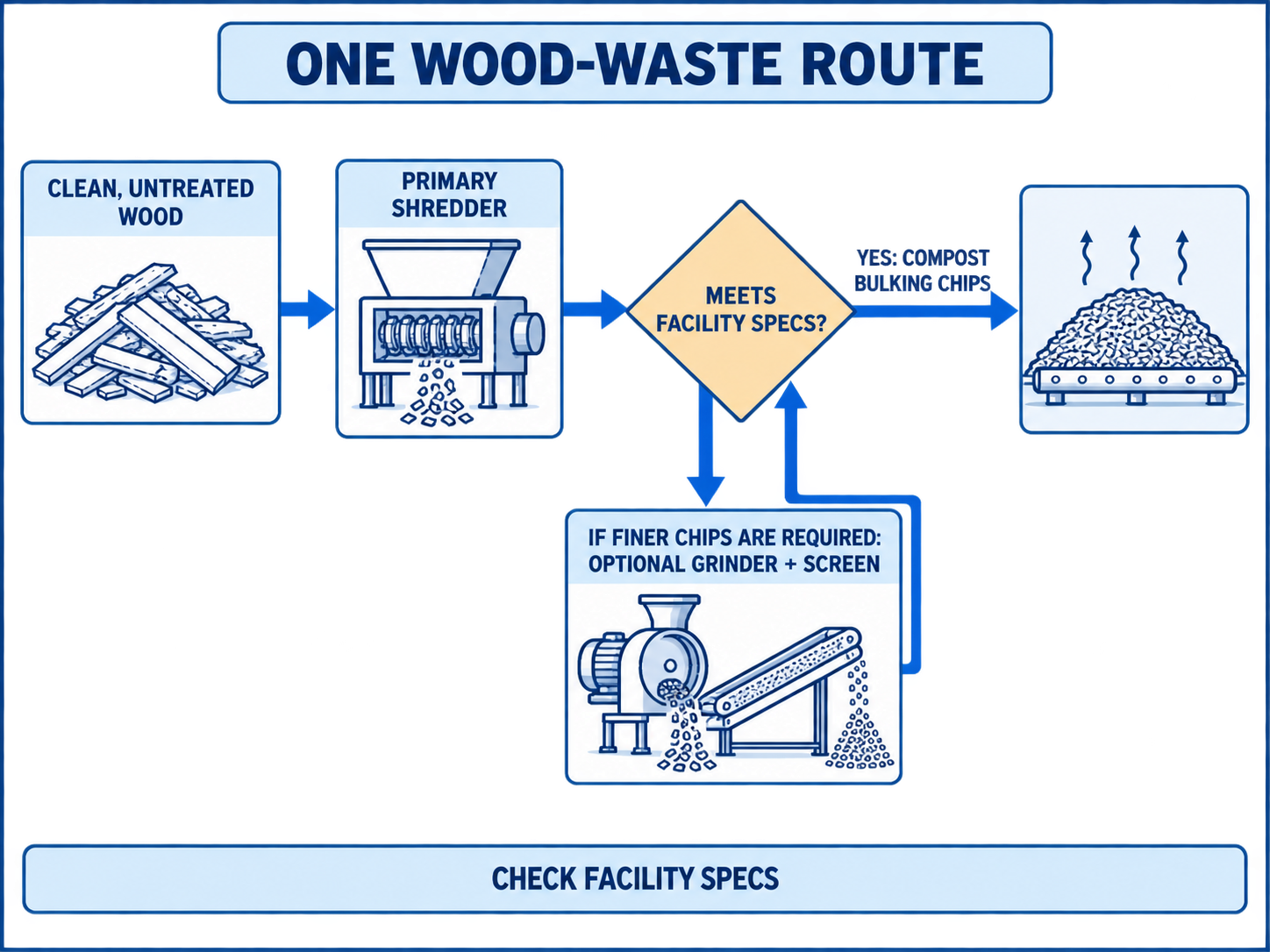
Illustrative wood-waste route, not a recommendation: clean, untreated wood trimmings → primary shredder → evaluate a grinder and screen only if a composting operation needs smaller, more uniform chips → use accepted chips as bulking material to aerate the compost pile. The facility’s accepted feed and chip size still govern; some screen-equipped shredders can make a sized product without the extra stage. Do not transfer this wood-specific route to another material.
When a line may use both a shredder and a grinder
A two-stage line is worth evaluating when the stages have separate, written jobs. One machine might reduce or prepare the incoming stream. A later machine might address an output requirement that the first stage was not designed to meet. That is a process hypothesis to test, not a reason to add equipment by default.
The useful question is not "Can both machines be installed?" It is "What measurable requirement does the second stage satisfy?" If it adds a distinct output-control step, test that benefit against the added handling and space. Also account for maintenance needs and process coordination. If the first stage already meets the downstream acceptance criteria, a second stage may add complexity without solving an identified problem.
Note: A shredder-plus-grinder sequence is not inherently better than a single stage. Evaluate it only when each machine has a distinct process role and the complete sequence can be tested against the required output.
Ask for results from the proposed sequence, not a standalone result from each machine interpreted separately. Material can change between stages, and a configuration that performs acceptably in isolation may not meet the line’s combined requirements. Any claimed improvement should identify the feed, configuration, operating conditions, output measure, and acceptance basis. If those details are missing, treat the claim as unverified rather than as a general advantage of using both machine types.
How to verify the choice with a material test
Use the feed profile and downstream requirement defined above to plan a repeatable test. Compare each candidate in a documented configuration; the result applies only to the material and setup that were tested.
ASTM E959-83(2018) characterizes refuse size-reduction equipment through throughput and energy metrics. It also defines how product size is measured. Its particle-size scope is 90% cumulative passing from 0.5 to 15 cm on an air-dry weight basis. These are method boundaries, not universal acceptance targets; set criteria for the actual feed and next process.
1. Agree on the sample and protocol
Choose material that represents the expected feed, including relevant variation and known contaminants. Record its origin and preparation. State the basis used to consider it representative. Agree in advance how it will be fed and which operating conditions must stay fixed. A selected clean sample can answer a question about that material, but it cannot stand in for a different plant stream.
2. Record the complete machine setup
For each candidate, document the installed rotor or cutting elements, screen or other sizing control, feed method, and relevant settings. Keep test conditions comparable. If a setting or sample must change, record the change and treat the run as a separate condition rather than attributing its result to one feature. This prevents a machine label from obscuring what was actually tested.
3. Measure the output that matters downstream
Set the measurement before the run. Depending on the process, it may include product-size distribution, oversize, fines, material condition, throughput, or energy use. State how any throughput figure is calculated and record stoppages or feed interruptions that affect it. Use only the measures relevant to the intended line.
4. Apply written acceptance criteria
Agree on the criteria with the downstream process before reviewing results. Save the protocol, sample ID, machine configuration, and operating conditions together. Record each measurement and any interruptions alongside the decision. If candidates were tested on different feeds or under different conditions, state that limitation instead of presenting the results as a direct comparison. The useful outcome is a traceable decision for the stated job, not a pass label detached from the material and process that produced it.
The practical verdict: compare the process, not the label
Start by asking what arrives and what must happen next. For a bulky or variable incoming stream, where the defined duty is primary reduction or preparation, a shredder configuration is a candidate to test. If the feed is already prepared and the next step requires a specified size or output adjustment, a grinder configuration is a candidate to test. These are screening paths, not guaranteed recommendations; contamination, composition, machine architecture, and setup can change the result.
Then match each candidate to the downstream requirement. If one machine must prepare inconsistent feed and produce a tightly defined final output, compare complete configurations against that duty rather than assuming the label settles it. Where written criteria require distinct intermediate and final outputs, evaluating a shredder and grinder as successive stages may be appropriate. Otherwise, the labels alone do not establish a need for a second stage.
The decision is conditional: feed profile narrows candidates, process role defines the task, and required output determines whether a single- or two-stage arrangement merits evaluation. Approval depends on results against agreed acceptance criteria, not terminology.
References
- ASTM International. (2018). Standard test method for characterizing the performance of refuse size-reduction equipment (ASTM E959-83(2018)). https://doi.org/10.1520/E0959-83R18
- Fox, S. (2025, March 14). Shredders vs. grinders: Are shredders replacing grinders for wood waste? Recycling Product News. https://www.recyclingproductnews.com/article/42996/shredders-vs-grinders-are-shredders-replacing-grinders-for-wood-waste
- WEIMA. WEIMApedia: Machine Portfolio: Shredders. https://weima.com/us/weimapedia/
- ANDRITZ. ADuro F shredder. https://www.andritz.com/products-en/recycling/aduro-f-shredder
- Hassanein, A., Lansing, S., & Delp, D. (2024). Composting (FS-2023-0687). University of Maryland Extension. https://extension.umd.edu/resource/composting-fs-2023-0687
Last reviewed and updated: September 2026. Author: kingstramblade Jack, Kingstream Blades. Contact.