
TL;DR
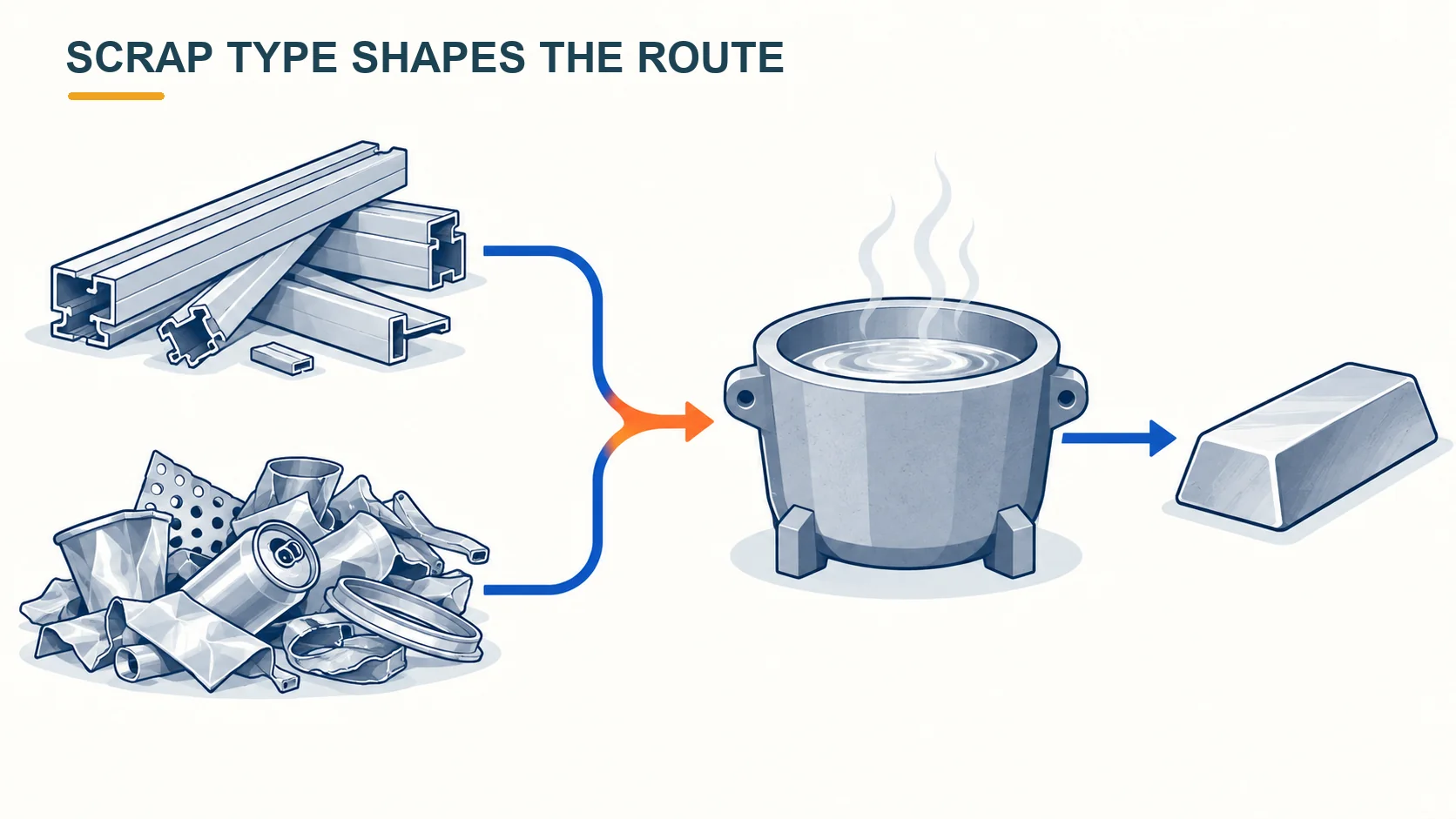
Aluminum recycling generally moves from receiving and sorting to any needed scrap preparation, remelting, melt treatment, and casting. The route changes with scrap form, alloy identity, coatings, contamination, facility setup, and the intended downstream product. Shredding is one possible preparation step, not a universal requirement.
Abstract
Aluminum scrap moves through stages that can turn it into reusable secondary metal. Receiving and sorting identify the material; size reduction or other pretreatment may follow when needed, before remelting, melt treatment, and casting. The sequence is a process overview, not a specification for a particular plant. Clean manufacturing scrap, coated material, and mixed end-of-life scrap can require different preparation choices. The exact route depends on the material and the product the recycler intends to make.
Key Takeaways
- Aluminum scrap is not one uniform feedstock; its form and alloy identity affect later processing.
- Sorting before melting helps keep unlike materials from being treated as interchangeable.
- Shredding, cleaning, drying, and decoating are conditional preparation options.
- Remelting, melt treatment, any required alloy adjustment, and casting are distinct process functions, although a facility may combine controls or omit conditional steps.
- The words "recycled aluminum" alone do not specify an alloy, cast form, or facility route.
Table of Contents
- How aluminum recycling moves from scrap to secondary metal
- Collecting and receiving aluminum scrap
- Sorting scrap by alloy, form, and contamination
- Preparing scrap only when the feed needs it
- Remelting and treating the molten metal
- Adjusting the alloy and casting secondary metal
- Why the route changes with scrap type and intended output
- What recycled aluminum does and does not guarantee
- References
How aluminum recycling moves from scrap to secondary metal
Aluminum recycling is the recovery and reprocessing of aluminum-bearing scrap into reusable metal. The Aluminum Association calls this process secondary production, distinguishing it from primary aluminum production. A common high-level route is:
The high-level route begins when a recycler or processor receives scrap. The material is identified and sorted into suitable streams, then prepared if its size, coatings, attached materials, moisture, or contamination call for it. Next, the scrap is remelted and the melt is treated for the intended output. Alloy chemistry may be adjusted when needed before the melt is cast into a form for the next production step.
That sequence is a map, not a universal machine layout. A clean, known stream may need fewer preparation steps than mixed or coated scrap. Some facilities perform more sorting or preparation upstream; others receive material that has already been processed. Even the word "shredding" describes only one possible size-reduction choice. It does not define the whole recycling process.
A useful 7-step map of aluminum recycling is receiving, sorting, conditional preparation, remelting, melt treatment, optional alloy adjustment, and casting. The Aluminum Association’s secondary-production overview supports this broad sequence. This is a process map, not a universal plant layout: facilities may combine controls or skip conditional steps when feed condition and intended output allow.
Collecting and receiving aluminum scrap
Aluminum scrap can come from manufacturing operations, construction or demolition, vehicle and equipment streams, packaging, or other products at the end of their useful life. These sources do not deliver identical material. A recycler may receive relatively consistent production scrap or a mixed load with varied shapes, alloys, coatings, or attached non-aluminum materials.
Receiving is where the processor begins to establish what the incoming stream contains and how it can be handled. Useful information can include the source of the material, its physical form, whether the alloy is known, and whether coatings or attached components are present. The point is not that every facility uses the same intake form. The point is that a process decision made before the material is understood can send unlike scrap into the same route without enough evidence.
The source of scrap often provides a first clue, but it is not a substitute for identification. A stream from one manufacturing process may be more consistent than a mixed end-of-life load, yet its chemistry and condition still need to match the requirements of the next process. Conversely, a visually mixed load may contain recoverable aluminum, but it can require additional separation before melting.
At receiving, the questions are practical and material-focused:
- Is the stream known and reasonably consistent, or mixed and uncertain?
- Is the aluminum clean, coated, painted, or attached to other materials?
- Is the scrap in pieces that can move directly to the next stage, or does its form call for preparation?
- What kind of secondary-metal output is the recycler trying to produce?
Those answers do not select a machine by themselves. They establish the conditions that later sorting and preparation need to address.
A receiving note is most useful when it separates documented facts from observations. A supplier record may identify the source or alloy; an inspection may describe the visible shape, coating, attachment, or contamination. Those are not interchangeable kinds of evidence. Keeping them distinct helps the next operator see whether a route choice rests on a verified material description or on a condition that still needs identification. It also makes later disagreements easier to trace: the question can be whether the incoming description was incomplete, the stream changed, or a preparation step was selected for the wrong reason. This is a record-keeping aid, not a claim that every recycler uses a particular intake form.
The distinction between manufacturing scrap and end-of-life material is useful, but it should stay descriptive. Manufacturing scrap may come from a defined production activity, while end-of-life material can arrive with more varied shapes and attached parts. Neither label alone proves the exact alloy, cleanliness, or preparation requirement. The stream’s actual condition and the information available determine what the processor can confidently do next.
Sorting scrap by alloy, form, and contamination
Sorting separates material that should not be treated as if it were interchangeable. Aluminum is a family of alloys, not one fixed chemistry. If different scrap types are mixed without adequate identification, the resulting melt may not suit the intended secondary-metal product. Sorting is therefore more than removing obvious nonmetal items. It is also part of managing alloy composition and directing each stream toward an appropriate route.
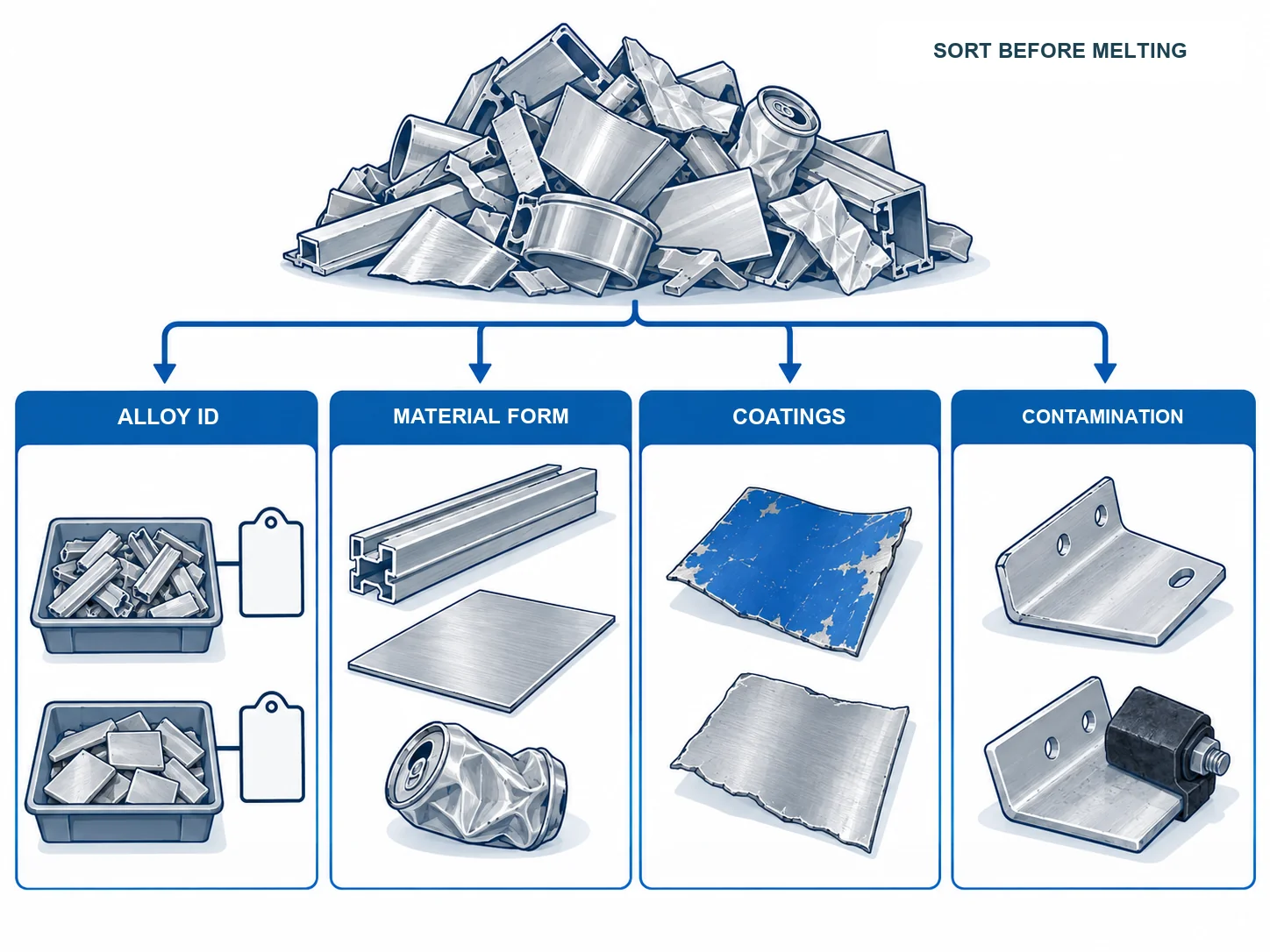
The methods used depend on the material and the facility. Manual inspection can identify visible differences and attached material. Automated systems may use technologies such as color sorting or laser-induced breakdown spectroscopy, often shortened to LIBS, to support material identification. These technologies are tools within a sorting system; their presence does not mean every plant uses the same configuration or that any one sensor alone guarantees a finished alloy specification.
| Incoming condition | Main process decision | Information to confirm |
|---|---|---|
| Known, relatively consistent production scrap | Check whether the identified stream can stay separate and proceed with limited extra sorting | Source and alloy records, physical form, and fit with the intended cast output |
| Mixed or uncertain scrap | Identify and separate non-aluminum material and unlike aluminum streams before deciding what can be combined | Material groups present and how confidently the facility can distinguish them |
| Coated or attached material | Determine whether attachments need separation or the surface needs cleaning, drying, or decoating | Type and condition of coatings, moisture, and attached non-aluminum material |
These examples show how feed condition changes the next question: known production scrap is checked against its records and target output; mixed scrap may need more identification and separation; coated or attached scrap raises a pretreatment question. They are process profiles, not universal grades or recipes. A facility still applies its own acceptance criteria.
The Aluminum Association’s secondary-production overview names color sorting and laser-induced breakdown spectroscopy (LIBS) among the sorting technologies used in this field. The review by Capuzzi and Timelli examines scrap preparation and melting approaches, including why material categories matter. These are descriptions of available methods, not a performance guarantee for a particular sensor or line. The intended metal output still determines which distinctions are useful to preserve.
Identification and separation are related but different jobs. Identification estimates what a piece or stream contains; separation physically routes it into a selected stream. A system may support either job or both, but the relevant distinctions depend on the feed and the required output. When reviewing a sorting method, ask what material categories it is intended to distinguish, how identified fractions are kept separate, and what evidence confirms the result. A sensor name alone does not establish which grades it can distinguish under a facility’s operating conditions.
That distinction matters when interpreting a process description. A system might detect a material category without proving that every item in a resulting fraction meets a buyer’s alloy specification. The separation step still has to produce streams the next operation can use, and the melt or cast output has its own requirements. The available sources describe sorting technologies and process choices; they do not provide a universal accuracy figure or a grade-by-grade guarantee. A useful technical discussion therefore names the incoming distinction, the separated output, and how that output is checked before it is combined or melted.
Preparing scrap only when the feed needs it
After sorting, some scrap can move toward melting with limited additional preparation. Other material may need one or more steps to make its form or condition suitable for the chosen process. Preparation options can include size reduction, cleaning, drying, or removing coatings. These steps are selected for the scrap and process; they should not be presented as a fixed checklist that every aluminum stream must complete.
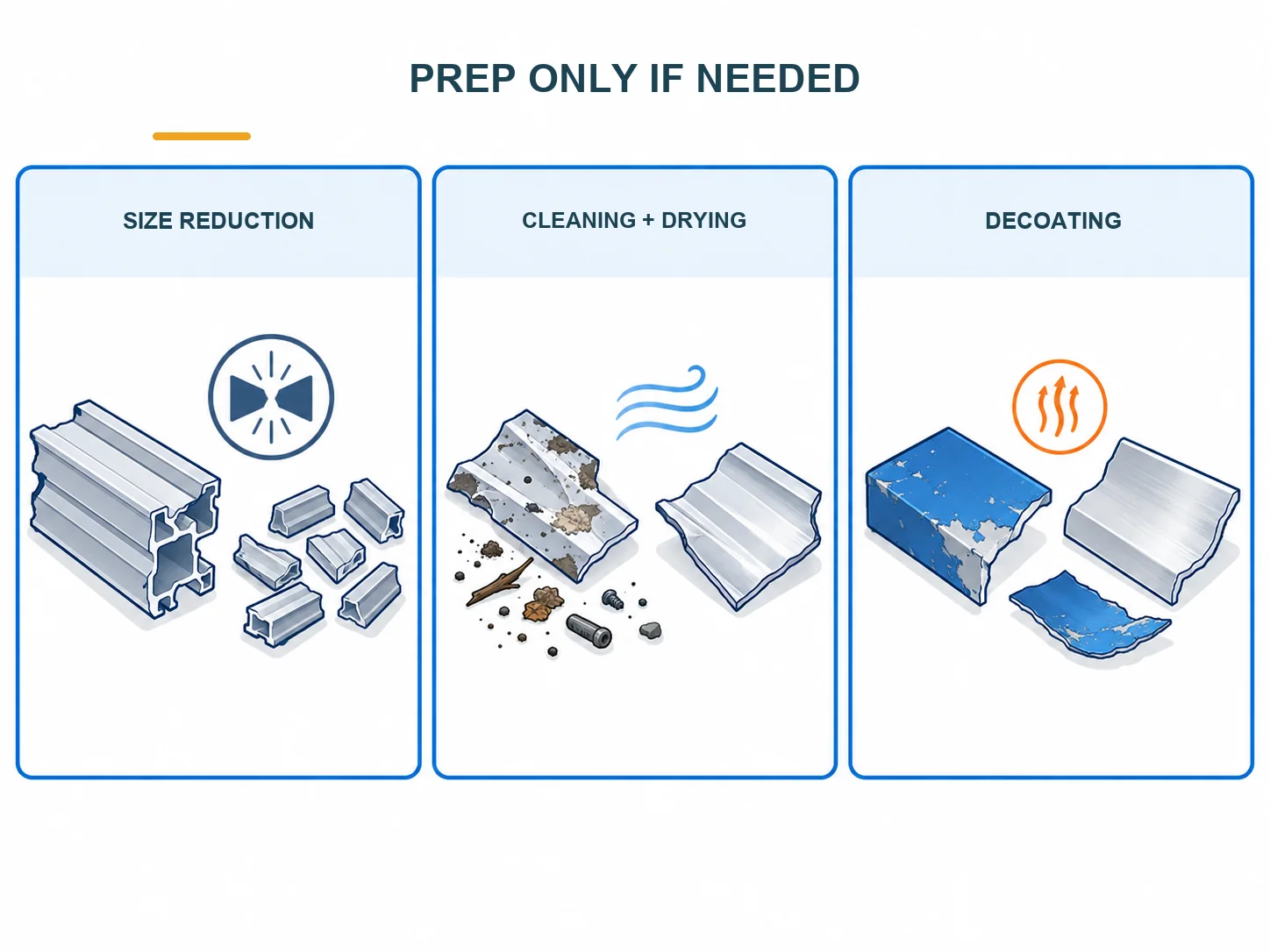
Size reduction changes the physical form of scrap. Shredding or crushing may be used where the material and process call for smaller or more manageable pieces. Other streams may be handled by different means or may not need a separate size-reduction stage at all. A facility’s decision depends on its material, existing process stages, and the requirements of the following operation.
Cleaning and removal of coatings address a different issue from size reduction. Paints, oils, plastics, attached components, or other nonmetal material can affect preparation and melting choices. Industry life-cycle material on semi-fabricated aluminum products identifies several pretreatment options, including size reduction by shredding or crushing. It also discusses drying and decoating. A technical review of scrap preparation describes multiple preparation and melting approaches rather than one mandatory recipe.
Preparation addresses specific feed conditions rather than a mandatory checklist:
- If the scrap’s size or shape is unsuitable for its next handling stage, a size-reduction step may be considered.
- If coatings or attached material remain, the processor may need a separation or decoating route.
- If the material condition calls for it, drying or another preparation step may be relevant before melting.
- If the feed is already suitable, adding a preparation stage without a process reason may add complexity without answering a real need.
These are separate functions: shredding or crushing changes physical size; cleaning and drying address material condition; decoating targets surface coatings. They may be combined, reordered, or omitted according to the feed and the next operation. The Aluminum Association’s 2022 life-cycle report discusses pretreatment options such as shredding or crushing, drying, and decoating in the context of semi-fabricated aluminum products; the review by Capuzzi and Timelli surveys preparation and melting approaches more broadly. Neither source is a layout specification for a named facility, so the practical question is which feed property each proposed step is meant to address.
Before adding a preparation step to a route, identify what should be different after it. Is the material meant to be smaller or easier to handle? Is an attachment meant to be separated? Does the surface need a treatment before the next operation? The answer helps distinguish a process requirement from a familiar equipment list. It also provides a simple handoff check: describe the incoming condition, state the intended change, and confirm that the material leaving the stage is suitable for the next operation. The article’s sources support these as distinct process questions, but do not prescribe a plant acceptance test.
Important: Shredding can be part of aluminum scrap preparation, but not every aluminum recycling stream requires shredding.
For a separate overview of where shredding fits in industrial material processing, see metal shredder applications and the materials they can process. That related guide should be treated as context for one possible stage, not proof that a shredder belongs in every aluminum line.
Remelting and treating the molten metal
Once the material is sorted and prepared as required, remelting converts solid scrap into a liquid metal stream. The equipment and operating sequence depend on the feedstock and the facility. A general article can explain what the stage does, but it cannot specify a furnace, temperature, charge sequence, or treatment recipe for a plant it has not inspected.
Melting is not the same thing as producing a finished, specification-ready material. The melt must be managed for the output the recycler intends to make. Depending on the scrap and process, a facility may use additional melt-treatment steps or alloy adjustment. The sources used here discuss different melting technologies and process choices, so the article should not imply that one technique is universal or that every operation performs the same treatment steps.
It helps to keep three ideas separate:
- Remelting changes prepared aluminum from solid scrap into molten metal.
- Melt treatment refers to additional controls selected for the process and intended material; the details are facility-specific.
- Alloy adjustment changes composition when required for a target output. It is not an automatic step for every load.
The distinction prevents a common oversimplification: "the scrap goes into a furnace and comes out as new aluminum." Between those two points, the processor must manage the relationship between incoming material and the next product. Sorting upstream helps, but it does not remove the need to control the melt in line with the intended output.
Melt treatment can include different controls, and the choice depends on the feed and required downstream material. The cited sources describe process options, but without a named facility and specification they do not support a universal treatment recipe, furnace setting, or charge sequence.
Adjusting the alloy and casting secondary metal
Where the target product requires it, alloying additions can be used to adjust the melt’s composition. The Aluminum Association’s overview of secondary production describes alloy adjustment as a possible part of the process, not an obligatory action for every batch. Keeping that distinction matters: a known, compatible stream may follow a different control path from a mixed stream with more uncertainty.
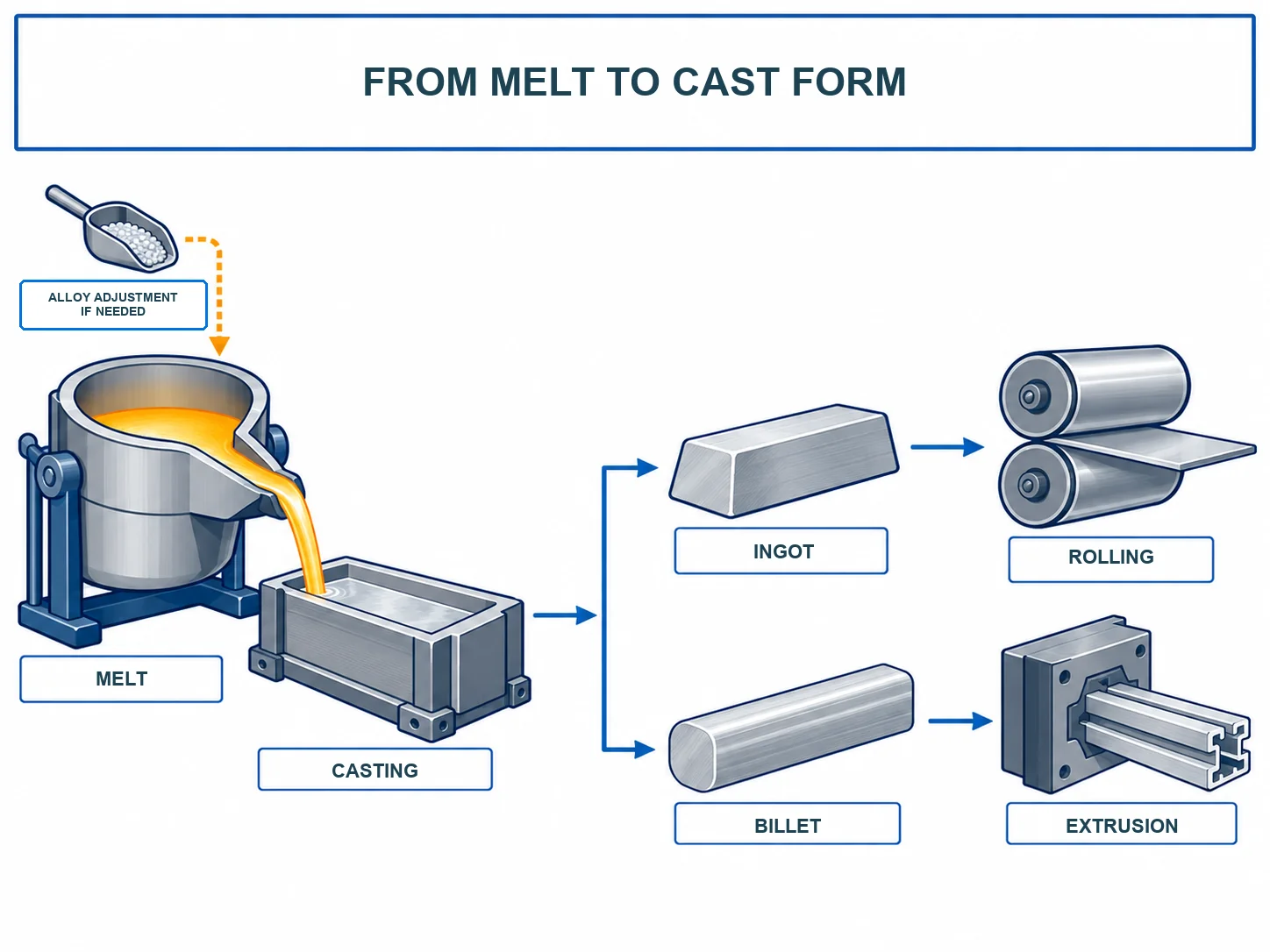
After melt preparation and any required adjustment, the metal is cast into a form for further processing. Ingots and billets are examples of cast forms used in secondary production. They are not the same thing as finished consumer or industrial products. A billet may go on to extrusion; other cast forms may be rolled or processed by a different manufacturing route. Rolling and extrusion occur downstream from scrap recycling, even though they are part of the larger journey from scrap to a new product.
For a process map, the cast form is a useful end point because it marks the handoff from secondary-metal production to later manufacturing. It does not, by itself, identify the exact alloy or prove that the material suits a particular use. Those details belong in the applicable material documentation and product specification. Keeping the boundary visible prevents a diagram from implying that the recycler also performs every downstream forming, machining, or fabrication operation.
The sequence can be summarized without assuming a single end use:
- Scrap enters a route after collection and identification. Sorting follows, with preparation added only when needed.
- Molten metal is managed for the intended output, with adjustment where required.
- Cast feedstock leaves the recycling stage in a form suited to later manufacturing.
- Finished products are made through subsequent forming and fabrication steps.
For that reason, "recycled aluminum" can refer to different points in a supply chain. It may describe a secondary-metal input or a product made from that input, but the phrase alone does not state the alloy, casting form, or later manufacturing route.
The next manufacturing step is what gives the cast form its practical role. An ingot or billet is an intermediate material, not a finished part. It may enter a later forming process, such as rolling or extrusion, but the chosen route depends on the target product and the specifications attached to it. A reader should not infer that every recycled-aluminum output becomes the same kind of product or passes through the same forming operation.
The distinction also clarifies where the recycling process description ends. The secondary-metal route runs from collection through casting. It includes sorting and preparation before remelting and melt management. Rolling or extrusion may follow, with machining or final fabrication later in production. Including those downstream steps as context explains where cast metal goes without suggesting that every recycler performs them on the same site.
Why the route changes with scrap type and intended output
The process varies because the input and the required output vary. Relatively consistent production scrap may arrive with better-known source information than a mixed end-of-life stream. Coated or attached material can raise different preparation questions from clean scrap. Alloy separation matters when the planned product requires control of composition. These differences affect what a facility does before melting and what it needs to verify after the melt is prepared.
The three feed profiles in the sorting table lead to different checks before melting.
Known production scrap
Start with the available source and alloy records, then compare them with the material’s actual form and the intended cast output. That can show whether extra identification or physical preparation should be considered. "Known" describes the information available; it does not confirm that the material meets a particular acceptance limit.
Mixed or uncertain scrap
First establish which material groups are present and whether unlike material should be separated before melting. The Aluminum Association identifies color sorting and LIBS; the review by Capuzzi and Timelli discusses scrap-preparation and melting choices. Those sources show that such approaches exist, not that every mixed load needs the same sensor or sorting line. The practical test is whether separation leaves streams that can be directed toward the intended output.
Coated or attached material
Inspect the condition rather than relying on a broad source label. An attachment may call for separation; a coating can raise a cleaning or decoating question; moisture may make drying relevant; and bulky form may call for size reduction. The Aluminum Association’s 2022 report discusses these pretreatment options, but does not establish a compulsory order. Each step should address a specific condition before the next operation.
Comparing process diagrams
Check the material entering each flow, what condition its preparation stages address, and the cast output it is designed to produce. A diagram that starts with sorted scrap cannot be compared box for box with one beginning at mixed receiving. The start point and output boundary matter when deciding whether a line or equipment choice is relevant to a different stream. Shredding may be one useful preparation step, but a generic diagram alone cannot establish that a particular feed needs it.
What recycled aluminum does and does not guarantee
The phrase "recycled aluminum" is not a full material specification. It does not identify an alloy, describe the scrap’s condition or preparation, state which cast form was produced, or show whether two scrap streams are compatible for a particular output. Those details need to be supported by the relevant material or product documentation; a general process overview cannot supply facility-specific chemistry, acceptance limits, recovery rates, or quality controls.
When evaluating a scrap stream or a supplier’s process description, record what is known and what remains open:
- Incoming material: source or lot, known alloy information, physical form, coatings or attachments, and visible contamination.
- Required output: the intended cast form and any material or acceptance specification that applies.
- Open process questions: which sorting or preparation steps address a documented feed condition, and what the recycler verifies before casting.
This short record makes process diagrams and supplier claims easier to compare on the same basis. Ask the recycler or process owner to connect each proposed stage to a specific material condition or output requirement. If that link is not stated, treat the equipment choice or performance claim as unresolved rather than assuming the broad label "recycled aluminum" answers it.
References
- The Aluminum Association. (n.d.). Secondary production 101. https://www.aluminum.org/secondary-production-101
- The Aluminum Association. (2022). The environmental footprint of semi-fabricated aluminum products. https://www.aluminum.org/sites/default/files/2022-01/2022_Semi-Fab_LCA_Report.pdf
- Capuzzi, S., & Timelli, G. (2018). Preparation and melting of scrap in aluminum recycling: A review. Metals, 8(4), 249. https://doi.org/10.3390/met8040249
Last reviewed and updated: September 2026. Author: kingstramblade Jack. For tailored guidance, contact our team.