
TL;DR
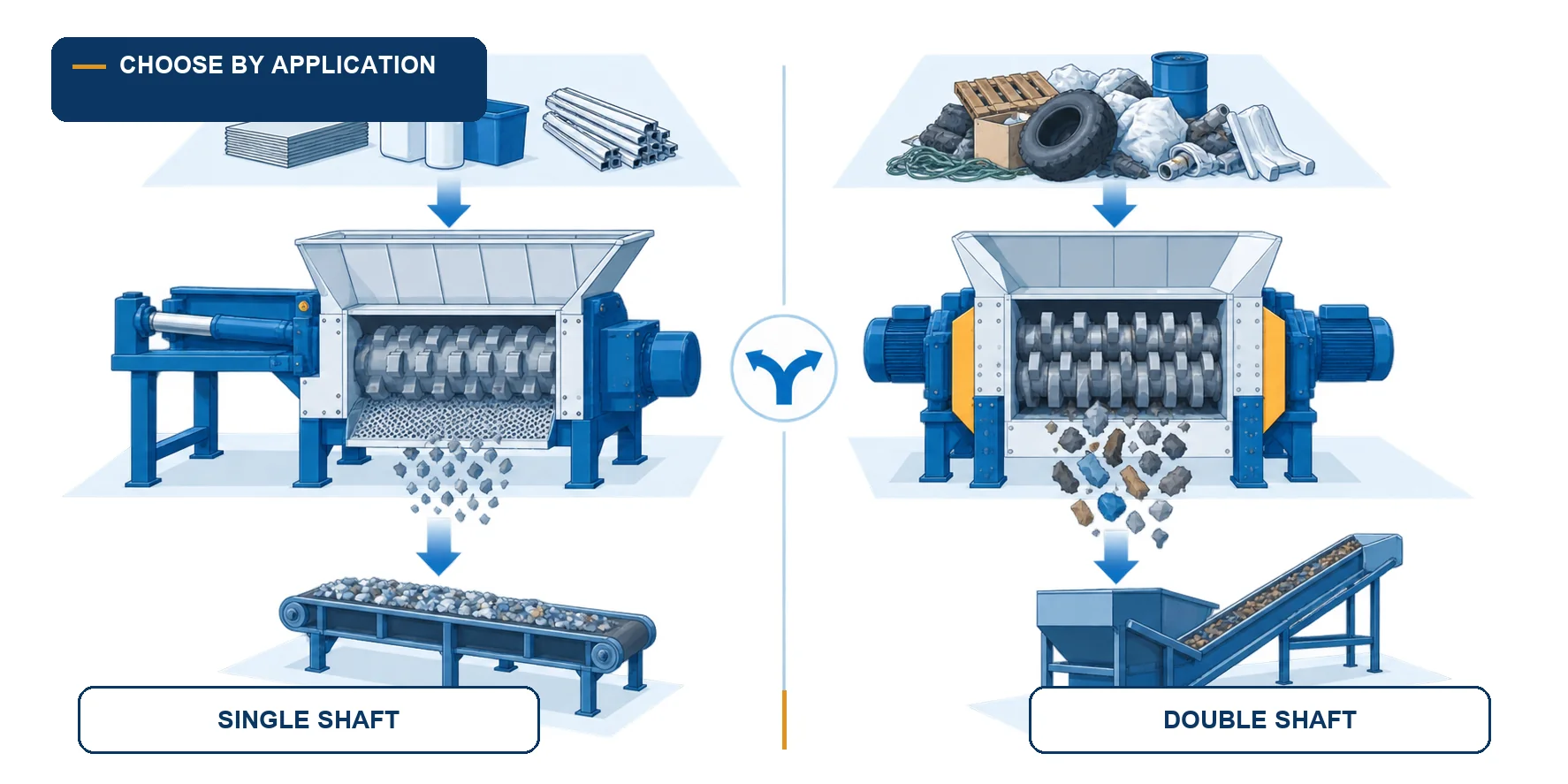
Choose a single-shaft route when the downstream process needs controlled, repeatable output from a defined feed. Choose a double-shaft route when the first problem is reducing bulky, mixed, tangled, or contaminated material. If the feed is difficult and final output is tightly specified, plan a two-stage process and test the real material.
Abstract
The guide compares single-shaft and double-shaft shredders by feedstock behavior, output tolerance, downstream process, and the evidence a buyer should request before approval.
Key Takeaways
- Choose by feedstock behavior and downstream limits, not shaft count alone.
- Single-shaft routes favor controlled output when a screen-defined size matters.
- Double-shaft routes favor bulky, mixed, tangled, or contaminated primary reduction.
- A two-stage line can separate intake tolerance from final particle-size control.
- Require a representative-feed test before accepting throughput or wear claims.
- Delay the decision when feed composition or downstream limits are undefined.
Table of Contents
- Abstract
- Key Takeaways
- Why the application should decide the shredder architecture
- The decision framework: feedstock, output, and process role
- Use-case path 1: clean or pre-sized feed that needs controlled output
- Use-case path 2: bulky, mixed, tangled, or contaminated feed
- Use-case path 3: when a two-stage arrangement is the better answer
- Single-shaft vs. double-shaft: application comparison table
- How to test before buying
- Fields to verify, and claims to ignore
- When to delay the shredder decision
- Conclusion
- References
Why the application should decide the shredder architecture
A single shaft shredder and a double shaft shredder are not interchangeable names for the same job. They create different material-flow patterns, output conditions, and downstream responsibilities. The useful starting point is the application brief: what arrives at the hopper, what condition the next process needs, and how much variation that process can accept.
Why a direct machine comparison can mislead
Machine labels hide variables that decide whether the process will be stable. Film, rigid plastics, production scrap, bulky pieces, tangled streams, and contaminated loads do not present the same feeding or wear problem. A feed can also change during the week, while the downstream process may require a much narrower output condition than the incoming material suggests.
The application therefore deserves three early definitions:
- Feedstock: material type, form, dimensions, moisture, normal mix, and expected variation.
- Output: whether the goal is opened material, a coarse reduction, a screened size, or a controlled feed for another process.
- Downstream role: conveying, sorting, washing, compounding, fuel preparation, secondary shredding, or another defined handoff.
Application callout: Select the architecture that solves the first limiting step in the material path. Do not treat a product category page, a shaft count, or a single test sample as a complete fitment decision.
A credible comparison should make the downstream process visible. One machine may be the right first stage and the wrong final stage. Another may offer better output control but require a prepared feed. When both difficult feed and tight final output matter, the correct answer may be a two-stage arrangement rather than a forced choice between one-shaft and two-shaft equipment.
A shredder decision is a process decision, not a shaft-count preference. Single-shaft designs emphasize controlled discharge through a screen, while double-shaft designs commonly emphasize aggressive primary reduction of difficult feed. Neither description replaces a representative-material test or a clear downstream specification. Keep 3 boundaries visible: feed, output, and downstream acceptance.
The decision framework: feedstock, output, and process role
Use four fields before comparing machine layouts: feedstock form, contamination and tramp material, target output, and downstream process role. A fifth field, representative test throughput, turns the discussion into evidence. Each field should describe the normal operating case rather than the easiest material a site can find.
1. Describe feedstock as a physical problem
“Plastic waste” is too broad for a useful selection review. Record whether the stream is film, bags, molded rigid parts, pipes, purge lumps, bales, production offcuts, or a mixed load. Add the largest routine piece, the smallest routine piece, thickness or geometry where relevant, moisture, and how the feed is presented to the hopper.
Form affects feeding as much as cutting. Long film can wrap or bridge. Hollow pieces can trap air and behave differently from solid pieces. Dense lumps can load the cutting zone suddenly. Baled or bundled material can arrive as a large mass even when each component is small. A good description lets a supplier discuss the loading pattern, not just the material name.
2. Separate contamination from the material name
Contamination should be stated as a defined input. Identify metal, stones, wood, glass, dirt, fasteners, residual product, or other unwanted pieces, along with frequency and maximum routine size. “Dirty” or “mixed” is not a test condition until the unwanted material is described.
The purpose is not to promise that a shredder will accept every tramp item. The purpose is to identify risks to cutters, shafts, bearings, screens, drive protection, and the downstream line. A rare abnormal object may need a different handling rule from contamination that appears in every load.
3. Define the output in process terms
Output size is only one part of the requirement. State whether the next process needs a coarse reduction, an opened bundle, a stable feed presentation, a screened fraction, or a narrower size distribution. Explain the allowable variation and whether oversize can recirculate.
A screen-controlled single-shaft route can be relevant when the line needs a more controlled discharge condition. A double-shaft primary route can be relevant when reducing the incoming mass is the first obstacle. Neither statement means that one architecture automatically produces a required particle size. The requested output has to be matched to the complete cutting, screening, conveying, and recirculation arrangement.
4. Name the downstream process
The next process sets the meaning of “good output.” A sorting line may prioritize a predictable presentation and limited oversize. A wash line may need material opened and conveyed reliably. A compounding line may require a more controlled fraction. A secondary shredder may accept coarse primary output while a final product process may not.
Write the downstream requirement as an acceptance test. Examples include stable feeding, no large pieces above a stated limit, a defined screen fraction, or a measurable reduction in rework. Avoid treating a generic capacity statement as proof of downstream fit. The same nominal feed rate can produce different value if the output causes stoppages or extra handling.
5. Add representative test throughput
Ask how the proposed arrangement performs on the actual material mix under the intended feeding method. A test should record input condition, operating time, output condition, interruptions, visible wrap or carryover, and wear observations. Throughput is meaningful only beside the feed description and acceptance criteria.
Capture the result in a small test record:
- Sample composition and normal variation.
- Feed presentation and loading method.
- Run duration and observed interruptions.
- Output condition, including oversize or recirculation.
- Energy or load observations when the supplier can provide them.
- Cutter, screen, and wear observations after the run.
Decision checklist: A useful brief can answer what the material is, what unwanted material arrives with it, what output the next stage accepts, and how a representative test will prove the answer. If one field is missing, the machine comparison remains provisional.
Use the public product pages for context, not as a substitute for the brief. The single-shaft shredder overview and double-shaft shredder overview explain the two product families, while the application article should connect those families to a material path and a verification plan.
The framework produces three common application paths. Clean or pre-sized feed with a controlled output requirement points in one direction. Bulky, mixed, tangled, or contaminated feed points in another. Difficult feed combined with tight final sizing can require both stages.
Feedstock form, contamination, output condition, and downstream role are the four fields that define the shredder job. A fifth field, representative test throughput, supplies operating evidence. Comparing shaft layouts without those fields can produce a technically plausible machine choice that still fails at feeding, output acceptance, or maintenance review. Keep all 4 fields in the test brief.
Use-case path 1: clean or pre-sized feed that needs controlled output
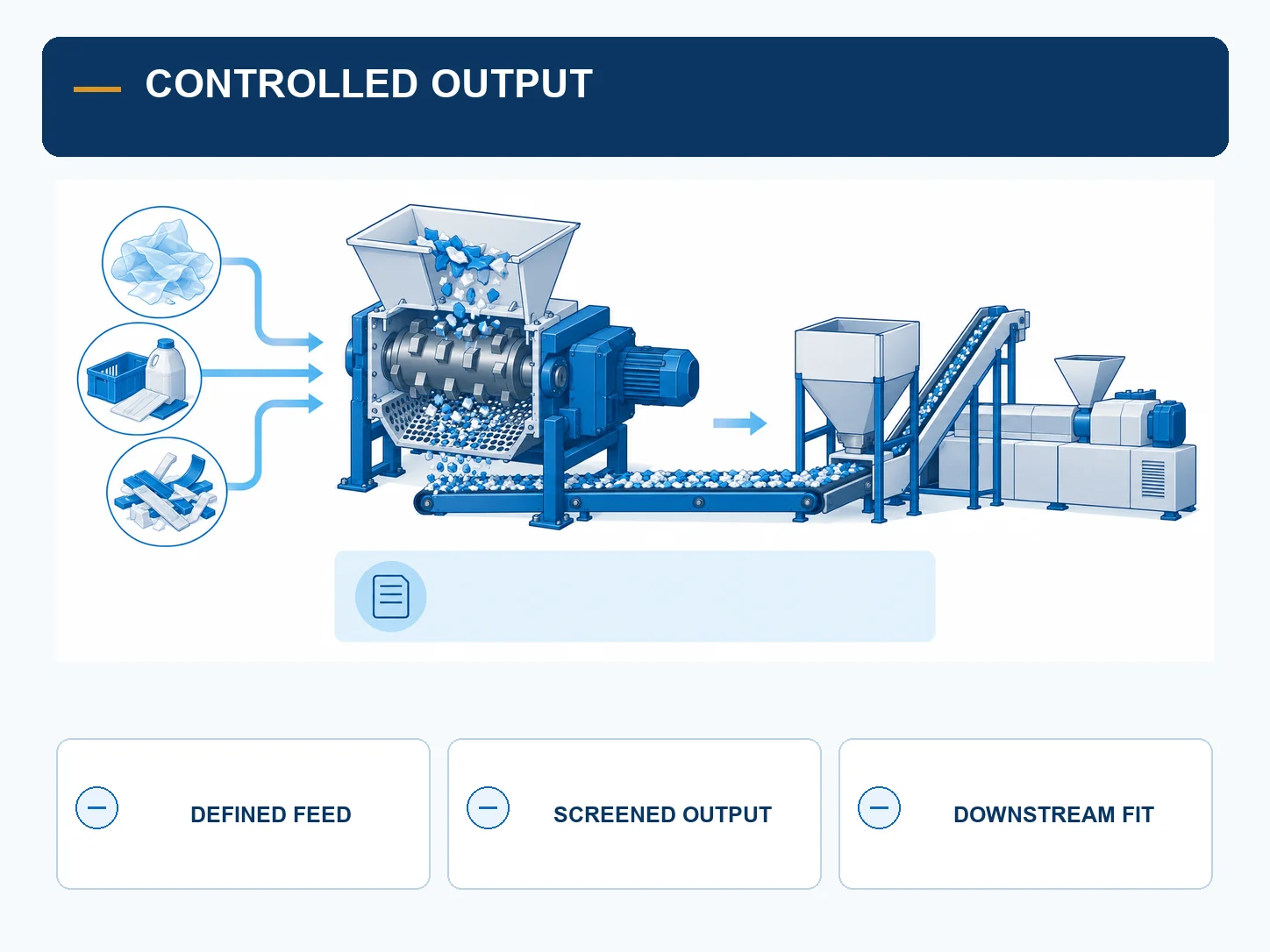
A single-shaft route is worth examining when the feed is defined, the loading pattern is reasonably stable, and the next process needs a controlled output condition. Typical examples can include clean production scrap, pre-sized rigid plastic, or a prepared stream that must pass through a screen before moving to sorting, washing, or compounding. The decision depends on the complete process, not on the feed label alone.
What makes the application a controlled-output case
The material arrives with enough definition that the machine is not being asked to solve every upstream problem. Pieces have a known range, the normal mix is documented, and the downstream process can describe what it accepts. A single rotor, counterknife, and screen can then be assessed as one cutting and classification path.
Controlled output does not mean perfectly uniform output. It means the site has a stated acceptance range and a way to manage oversize. Ask whether oversize returns to the cutting zone, moves to a later stage, or is removed for inspection. Ask how screen openings, feed rate, and material presentation affect the result. Do not turn a general screen description into a guaranteed particle-size claim.
Check the downstream handoff
A stable handoff can matter more than the name of the shredder. Conveyors need a manageable flow. Sorting equipment may need material opened or separated enough for its sensing and picking method. Washing or compounding may require a more predictable fraction. The single-shaft option becomes more credible when its discharge condition matches the next machine’s actual acceptance rule.
Use a short acceptance list:
- State the target output condition and the allowable oversize.
- Explain whether the next process needs a screened fraction or only a consistent feed presentation.
- Identify any material that can wrap, bridge, smear, or compact in the chamber.
- Test the normal feed mix, not only clean pieces selected for a demonstration.
- Record interruption, carryover, and screen-cleaning observations.
Ask for evidence, not a generic capacity line
Request a test using representative material and the intended feeding method. Record run time, input condition, output condition, any recirculation, and visible wear. A throughput value without those observations cannot show whether the next stage will remain stable. A small amount of extra preparation upstream may be acceptable if it removes a larger downstream failure mode, but that tradeoff should be explicit.
Application callout: Choose a controlled-output path when the feed is defined and the downstream process can state an acceptance range. Keep the screen, output handling, and representative-material test in the same discussion as the rotor.
The route becomes less convincing when the feed contains frequent bulky objects, tangled material, or unknown tramp inputs. Those conditions shift the first problem from output control to intake and primary reduction, which is the focus of the next path.
A controlled-output brief should also state what happens when the feed changes. Identify the point at which material preparation, slower feeding, recirculation, or a different process stage becomes necessary. That boundary is part of fitment, not an afterthought.
A single-shaft shredder is best evaluated as a screened process stage for a defined feed, not as a universal solution for all plastic streams. The key evidence is the relationship among feed presentation, screen-controlled discharge, downstream acceptance, and observed interruptions during a representative test. 1 test should use the normal feed mix.
Use-case path 2: bulky, mixed, tangled, or contaminated feed
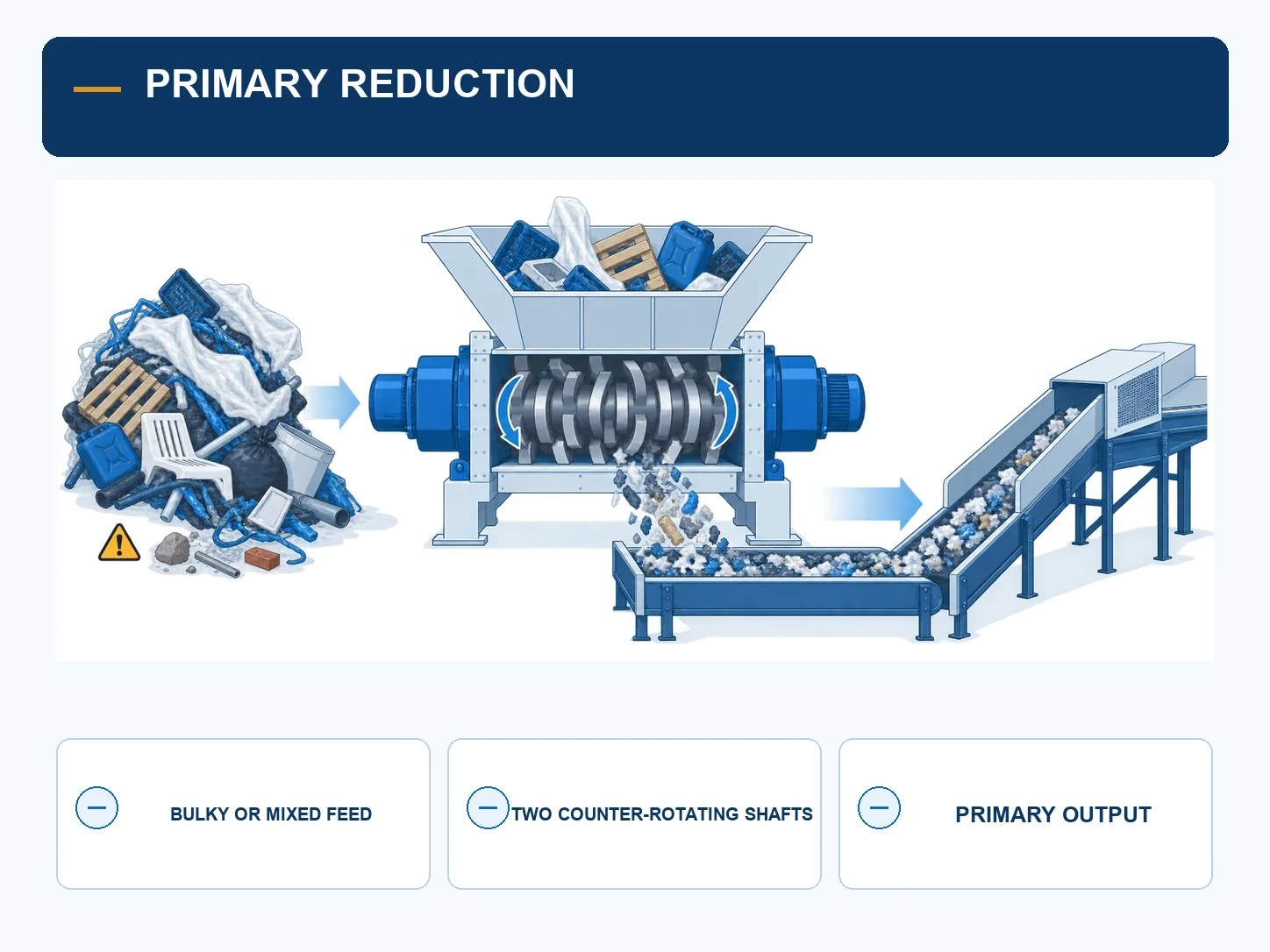
A double-shaft route is worth examining when the first obstacle is getting a bulky, heterogeneous, tangled, or contaminated load into a manageable primary-reduction flow. The machine may be asked to pull in irregular material, tear or open it, and create a coarse output for sorting, conveying, or a later sizing stage. The output should not be assumed to be the final product.
Start with the intake problem
Describe the material that makes feeding difficult. Long film, bundled items, bulky plastic, mixed industrial waste, or irregular pieces can create a different loading pattern from a clean, pre-sized stream. Include the largest routine piece and any shape that can bridge, wrap, or hang across the hopper.
Two counter-rotating shafts with intermeshing cutters can create a pulling and tearing action suited to primary reduction. That description explains a process role, not a performance guarantee. Feed density, moisture, contamination, loading method, cutter geometry, drive protection, and downstream handling still need review.
Treat contamination as a test input
Separate normal contamination from exceptional abuse. State what unwanted material appears, how often it appears, and how the site currently removes it. Metal, stones, glass, fasteners, and dirt can change wear and protection requirements. A machine that reduces a mixed load is not automatically approved for every tramp object or every operating condition.
Ask for evidence on the normal mix. Record interruptions, reverse or protection events, visible wrap, bearing or shaft observations, and cutter condition after the trial. If the material changes by supplier, shift, or season, include more than one sample. A single clean test can hide the operating problem that matters most.
Define what the coarse output must do
Primary output can be acceptable when the next stage is sorting, separation, conveying, or secondary sizing. The output requirement may be “no large pieces above a stated limit,” “open enough for the next separator,” or “stable enough for transfer,” rather than a narrow final particle-size distribution.
If the downstream line needs a tight size range, ask whether the double-shaft unit is only the first stage. Designing the primary step around a final-size promise can shift too much responsibility onto one machine. State where screening, recirculation, inspection, or secondary cutting will occur.
Application callout: Use a primary-reduction path when intake difficulty is the limiting step. Document contamination and wear evidence separately, and judge the output by the next process instead of calling coarse reduction a finished specification.
A double-shaft route becomes less complete when a downstream process requires tight, repeatable output and the incoming stream remains difficult. In that case, a two-stage arrangement may protect the first machine from an impossible brief while giving the second stage a more defined feed.
The operating boundary should be written down before approval. Note which objects are removed upstream, which variation is normal, and which event stops the line for inspection. That record makes later wear, protection, and maintenance discussions specific enough to review.
Double-shaft shredders are commonly discussed as primary-reduction tools for bulky or heterogeneous material, while the application still determines whether coarse output is sufficient. Contamination, feed presentation, and wear evidence must be tested against the normal load. A broad “handles mixed waste” statement is not a substitute for defining tramp material and downstream acceptance. Record 1 operating boundary.
Use-case path 3: when a two-stage arrangement is the better answer
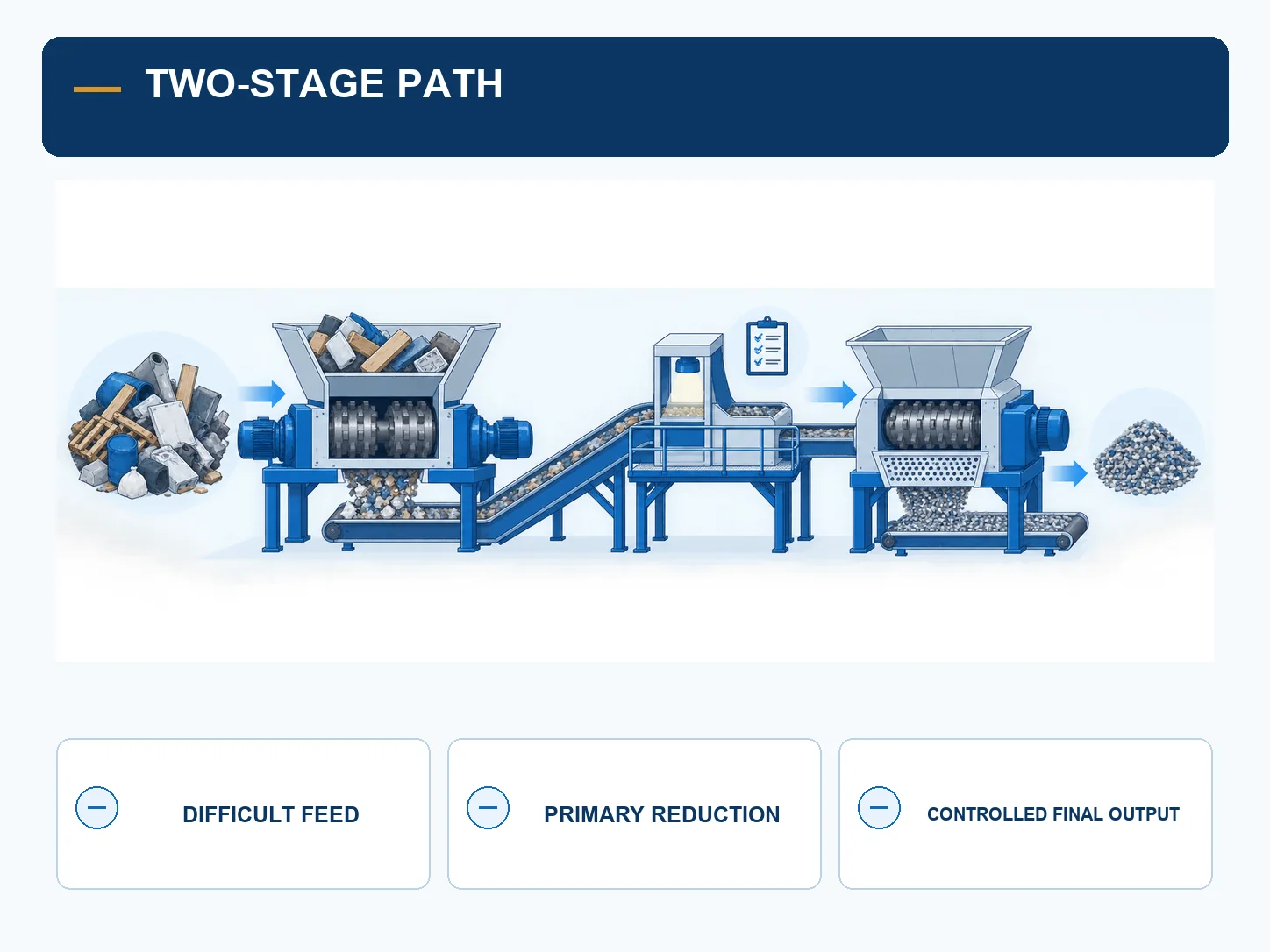
Some applications should not be reduced to a single-shaft versus double-shaft verdict. When the incoming material is difficult to feed and the downstream process needs controlled final output, two different process jobs exist. A primary stage can reduce the bulky or mixed load. A secondary stage can then work on a more defined stream and control the final handoff.
Separate primary reduction from final sizing
The first stage answers an intake question: can the line accept and reduce the representative load without unacceptable interruption or wear? The second stage answers an output question: can the prepared material reach the downstream process in the required condition? Keeping the jobs separate makes the test plan clearer and prevents a generic final-size claim from carrying the whole line.
A common process logic is a double-shaft primary shredder followed by transfer, inspection or screening, and a single-shaft secondary shredder with screen-controlled discharge. That is a process pattern, not a fixed prescription. Some lines may use different equipment, bypass the second stage for certain material, or add separation before secondary cutting.
Know when two stages add value
A two-stage arrangement deserves review when at least two of these conditions are present:
- The feed is bulky, tangled, mixed, or frequently variable.
- The first reduction must protect the next conveyor, separator, or handling step.
- The final process needs a narrower output condition than the incoming feed can support.
- Oversize can be screened, recirculated, inspected, or routed separately.
- The site can measure each stage instead of judging the line only by one combined throughput number.
The arrangement also adds interfaces. Conveying, buffer storage, dust control, inspection, screening, and control logic become part of the decision. A second shredder is not automatically better if it introduces a bottleneck, an unmanageable transfer, or a maintenance burden that the site cannot support.
Process quote: A two-stage line is justified when primary reduction and final sizing are separate acceptance tests. The first stage should make the feed manageable; the second should make the output usable. The design still needs a representative trial across both stages, including transfer behavior and any recirculation.
Build the test around the whole line
Test the difficult feed through the primary stage, then pass representative output to the secondary stage under the proposed transfer conditions. Measure interruptions and output at each handoff. A strong result identifies where the line fails, rather than hiding a primary-stage jam behind a final throughput figure.
When the feed description, contamination profile, final output, or transfer arrangement is unknown, do not select two stages merely because the material sounds difficult. Ask for missing information first. Two-stage design is a way to divide process roles, not a shortcut around an incomplete brief.
The same discipline applies to controls and maintenance. Define who monitors the transfer, where oversize is returned, how accumulated material is cleared, and which observations trigger a stop. A second stage adds value only when the site can operate and verify the connection between stages.
A two-stage shredding process separates intake reduction from final output control. The primary stage handles the difficult feed; the secondary stage handles a more defined stream and its screen or sizing requirement. The evidence must cover both stages, the transfer between them, and the downstream acceptance condition before the arrangement is treated as fit. Keep 2 stages distinct in the test record.
Single-shaft vs. double-shaft: application comparison table
The table below compares process roles rather than promising a universal winner. “Single shaft” describes a route commonly considered when feed and output are defined. “Double shaft” describes a route commonly considered when primary reduction and difficult intake are the first problems. Actual fit still depends on material testing and downstream requirements.
| Application question | Single-shaft route | Double-shaft route |
|---|---|---|
| Feed condition | Defined, pre-sized, or reasonably consistent feed | Bulky, mixed, tangled, irregular, or variable feed |
| First process job | Cutting with more controlled discharge and screening | Pulling, tearing, opening, and primary size reduction |
| Output expectation | A stated screened or controlled feed condition | A manageable coarse output for handling, sorting, separation, or later sizing |
| Contamination question | Define tramp material because screens and cutters still need protection | Define tramp material because cutters, shafts, bearings, and protection may face mixed loads |
| Downstream fit | Useful when the next stage can state an output acceptance range | Useful when the next stage first needs a reduced and more handleable feed |
| Main verification | Screen behavior, output variation, recirculation, and interruptions | Intake behavior, load variation, interruptions, wear, and coarse-output handoff |
| Common wrong assumption | “A screen guarantees the required final product” | “Primary reduction means final sizing is complete” |
Read the table from left to right
Begin with the feed condition, then ask what the next process needs. If the feed is already defined and the output must be screened, examine the single-shaft route. If the feed is the main obstruction, examine the double-shaft route. If both descriptions are true, examine the two-stage path before choosing one architecture.
Product-family pages can help explain the starting options. The single-shaft shredder page and double-shaft shredder page should be read alongside the material brief, test plan, and downstream acceptance rule. They should not be used as evidence that a specific untested load will meet a specific result.
Comparison callout: Shaft count is a useful first distinction, not the decision itself. Feed form, contamination, output condition, and downstream role determine which architecture deserves a representative-material test.
Single-shaft and double-shaft shredders differ mainly in the process problem they are commonly used to address: controlled screened discharge for a defined feed versus primary reduction of difficult feed. The comparison becomes defensible only when the table’s feed, contamination, output, and downstream fields are tied to a test. Use 1 acceptance rule.
How to test before buying
A representative-material test should answer one question: does the proposed process produce an acceptable handoff under the operating conditions the site will actually use? A machine demonstration using selected clean pieces can show that cutting occurs, but it cannot establish stable feeding, output acceptance, wear behavior, or line fit for a variable stream.
Prepare the test brief
Send a sample description before the trial. Include normal composition, expected variation, largest routine piece, moisture or residue where relevant, contamination, feed presentation, target output, and downstream process. State what would make the trial pass or fail. A supplier should know whether the goal is primary reduction, controlled screened output, or both.
Use one brief for each meaningful feed lane. Combining clean production scrap with bulky mixed waste can produce an average that represents neither operating condition. If the plant has seasonal or supplier-driven variation, explain it and ask how the test will cover it.
Record the run, not only the headline rate
Capture the following during the trial:
- Sample composition and total input condition.
- Feed method, loading pattern, and any pre-sorting.
- Run duration and observed interruptions.
- Output form, oversize, recirculation, and carryover.
- Load or energy observations when the test system provides them.
- Visible wrapping, bridging, tramp events, and protection actions.
- Cutter, screen, shaft, bearing, and other wear observations after the run.
- Condition of the material delivered to the next process.
A rate without feed and output context is incomplete. Ask how the number was measured, whether stoppages were excluded, whether oversize was counted as accepted output, and whether the same feeding method is available at the plant. Avoid converting an observed test number into a guaranteed production rate without the same material and conditions.
Test the acceptance rule
Use samples from the output to check the requirement the next process actually cares about. Measure the relevant size range or inspect the output condition using a method agreed before the trial. Check whether the line maintains that condition as the feed changes. When primary and secondary stages are both proposed, check the primary output, transfer behavior, secondary output, and final handoff separately.
Verification checklist: A defensible test has a defined sample, defined feeding method, defined output acceptance, recorded interruptions, and a wear or maintenance observation. It also records what the machine did not process, not only what it processed successfully.
Turn the result into a purchase condition
Ask for the test record and the assumptions behind it. Separate industry-level process guidance from supplier-specific observations. Keep buyer-supplied conditions visible in the final specification so later changes in material or feeding do not silently invalidate the result.
Delay approval if the sample does not represent daily material, if the downstream acceptance rule is missing, or if the report gives only a headline rate. A slower but repeatable process may be more useful than a faster demonstration that creates oversize, rework, or frequent intervention.
A shredder test is evidence only when its sample, feed method, run observations, output acceptance, and wear review are recorded together. The most useful result is not a standalone throughput number. It is a traceable connection between the actual material, the selected process stage, and the next operation’s acceptance rule.
Fields to verify, and claims to ignore
A buyer can improve a shredder comparison by asking for evidence in the same fields that define the application. Verify feed condition, output condition, representative test results, interruptions, and wear observations. Treat broad claims such as “handles all plastics,” “best for heavy waste,” or “final size guaranteed” as prompts for a more specific question, not as acceptance criteria.
Verify these fields
- Feed composition, dimensions, normal variation, and loading method.
- Contamination profile, including frequency and routine maximum.
- Target output, allowable oversize, and downstream acceptance.
- Test duration, interruptions, recirculation, and protection events.
- Screen, cutter, shaft, bearing, and other wear observations.
- Conditions that would change the result, such as pre-sorting or special feeding.
A useful supplier response should show which statements are based on an industry rule, which are observations from a named test, and which items still require site confirmation. Keep those evidence types separate in the purchase file.
Numbers need the same context as words. Ask whether a reported rate includes stoppages, recirculated oversize, pre-sorting, a particular moisture level, or a selected sample. Ask which result is measured at the shredder and which result is accepted by the next process. A number without those conditions is not a transferable operating expectation.
Buyer callout: Do not compare a clean demonstration result with a mixed-load operating requirement. Compare like with like, then ask what remains unverified.
A shredder claim becomes useful only after it is tied to a material, a process stage, and an acceptance rule. Without those links, a precise-looking number can create false confidence, while a cautious test plan may provide more decision value.
When to delay the shredder decision
Delay the choice when the feedstock is described only by a broad category, contamination is unknown, the downstream process has no acceptance rule, or the test sample is not representative. A shaft comparison cannot repair an undefined application. Record the missing fields first, then request a test that can distinguish controlled output, primary reduction, and a possible two-stage path.
Decision callout: Waiting is justified when the material brief cannot yet tell you what enters the machine, what leaves it, or what the next process must accept.
Delay also makes sense when the proposed test changes the material before it reaches the machine, or when the test report omits interruptions and wear. In either case, the evidence does not represent the operating decision. Ask for a revised brief or a second trial with the missing conditions restored.
A clear brief may show that one architecture fits, that the line needs two stages, or that upstream preparation should happen before shredding. The right next step is evidence collection, not a universal best-machine claim.
Conclusion
For a single shaft shredder versus a double shaft shredder, start with the first process problem rather than the machine label. A defined, reasonably consistent feed that needs controlled, screened output points toward a single-shaft route. Bulky, mixed, tangled, or contaminated material that first needs to be opened and reduced points toward a double-shaft primary step. When both intake tolerance and final-size control matter, separate those jobs into a two-stage process and test each handoff.
Before approval, record the feed condition, contamination, target output, downstream acceptance rule, interruptions, and wear observations from a representative-material test. If one of those fields is missing, the right next action is to improve the test brief, not to declare one shaft arrangement universally best.
References
- Arlington Machinery. (n.d.). Single shaft vs. dual shaft shredders: How to choose. Retrieved September 15, 2026, from https://www.arlingtonmachinery.com/knowledge-center/choosing-a-shredder/
- UNTHA shredding technology. (n.d.). S25: Compact 2-shaft shredding system for volume reduction. Retrieved September 15, 2026, from https://www.untha.com/en-us/products/s25
- Khodier, K., & Sarc, R. (2021). Distribution-independent empirical modeling of particle size distributions: Coarse-shredding of mixed commercial waste. Processes, 9(3), 414. https://doi.org/10.3390/pr9030414
- Lasch, T., Khodier, K., Feyerer, C., Lehner, M., & Sarc, R. (2024). Influence of material-material interactions and wear on coarse waste shredders. Waste Management & Research, 43(8), 1234. https://doi.org/10.1177/0734242X241306602
Last reviewed and updated: September 2026. Author: kingstramblade Jack. This guide is educational and should be validated with representative material before equipment approval.