
TL;DR
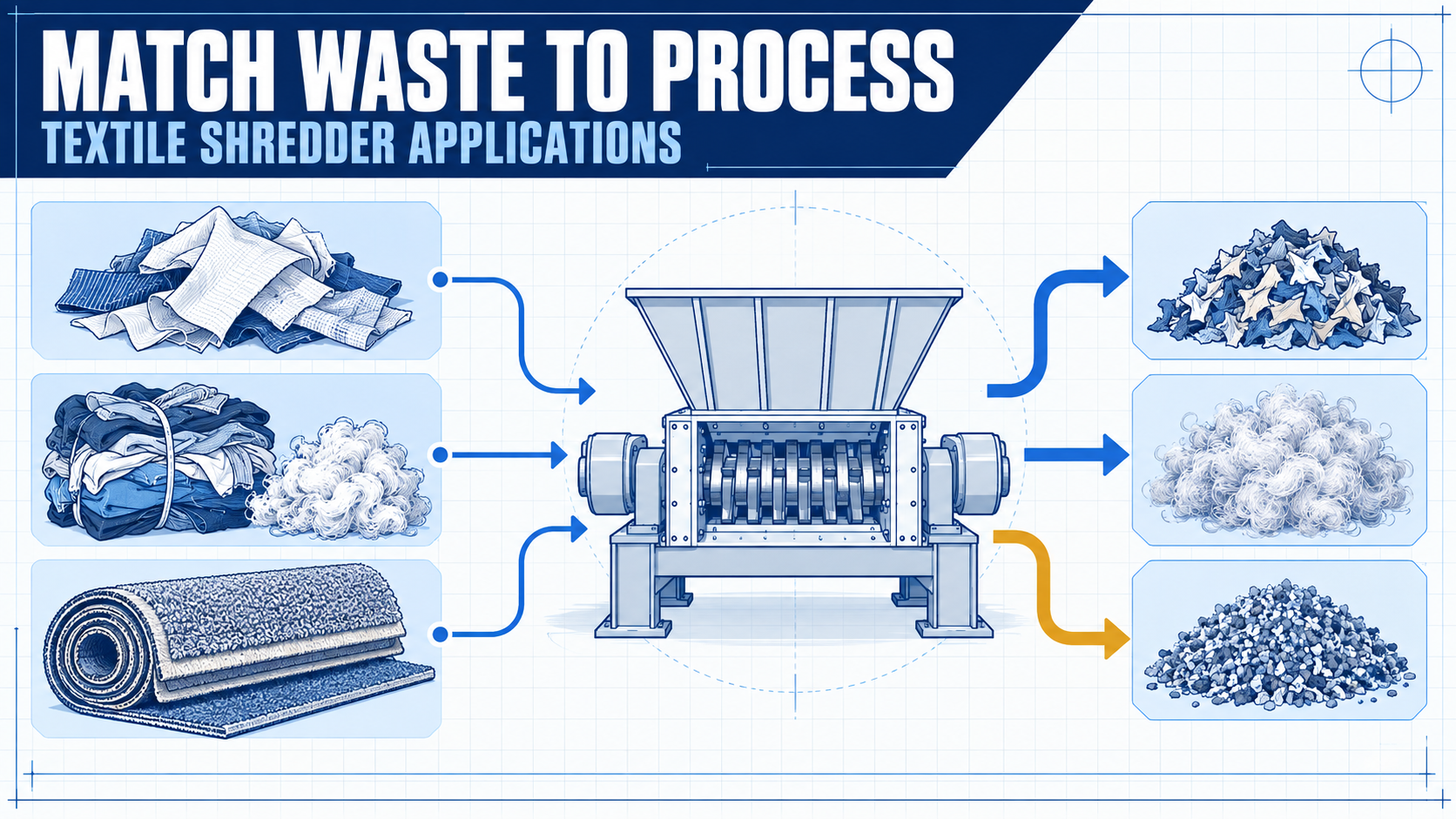
Start with the textile stream and the next process, not the machine name. Fabric offcuts, garments, nonwovens, carpet, and mixed fibers can require different feeding, cutting, output, contamination, and safety checks.
Key Takeaways
- Start with fiber behavior, material form, and the downstream process instead of the machine label.
- Separate clean production scrap from mixed post-consumer textiles before discussing configuration.
- Treat carpet, backing, hardware, and blended fibers as application-specific test inputs.
- Define the required output condition from the next process, not from a nominal screen size alone.
- Request a sample test and confirm dust, metal, feeding, and acceptance criteria before purchase.
Table of Contents
- Key Takeaways
- Why textile shredder applications start with the next stage
- How to choose: the textile application decision framework
- Application path: clean production scrap and fabric offcuts
- Application path: garments, nonwovens, and mixed soft fibers
- Application path: carpet and bulky composite textiles
- Textile application comparison: compare the question, not just the machine
- How to test a textile shredder application before buying
- Fields to verify and textile-shredder claims to ignore
- When to delay a textile shredder purchase
- Conclusion
- References
Why textile shredder applications start with the next stage
A textile shredder is not selected from the word “textile” alone. Fabric offcuts, worn garments, nonwovens, carpet, and mixed soft materials can behave differently in feeding, cutting, discharge, and the process that follows. The useful starting point is therefore the complete application: what enters the machine, what condition it is in, and what the next stage needs to receive.
The European Environment Agency describes several mechanical textile-recycling routes, including outputs such as rags, nonwovens, insulation, and stuffing. That range matters because a shredder may be preparing material for different downstream purposes rather than creating one universal finished product. (European Environment Agency, n.d.)
The European Environment Agency describes multiple textile-recycling routes, including mechanical outputs such as rags, nonwovens, insulation, and stuffing. This guide groups that variety into 3 application lanes: clean production scrap, soft mixed fibers, and composite textiles, so the next test follows material behavior and downstream acceptance.
A shredder is one stage, not the whole textile process
Size reduction can make a textile stream easier to convey, store, meter, separate, or feed into another process. It does not by itself decide fiber quality, remove every contaminant, or prove that the output meets a downstream specification. A buyer should name the next operation before treating a machine comparison as meaningful.
For example, a clean production offcut may need controlled presentation for a fiber-opening or nonwoven route. A garment stream may need sorting and hardware checks before cutting. Carpet may require a separate review because backing, adhesives, fillers, and non-fiber components change the material question. These are different application briefs even though all three may be described as textile waste.
Working rule: Define the feedstock and the next stage first. Treat a textile shredder configuration as a response to that brief, not as a substitute for it.
The same label can hide different equipment questions
“Fabric waste” can mean loose trimmings, wound rolls, compacted bales, returned garments, or blended scraps. Record the normal form, not only the material name. Also state whether the stream contains zippers, buttons, hooks, elastic, labels, metal fragments, plastic film, or other hardware that can affect the test and the line review.
The first useful handoff is a short application brief. It should identify the material, the downstream process, the required output condition, the contamination question, and the throughput basis to be confirmed. The next section turns those fields into a practical screening framework.
How to choose: the textile application decision framework
Before asking for a textile shredder recommendation, prepare a brief that a supplier can review without guessing. The brief is not a machine specification. It is a description of the job and the evidence needed to decide whether a proposed configuration deserves a controlled test.
A defensible textile shredder brief has 5 input groups: feedstock form, downstream process, output condition, contamination and hardware, and target throughput. The European Environment Agency’s multiple-route view supports defining the handoff before comparing equipment; these five fields are buyer inputs, not universal machine limits.
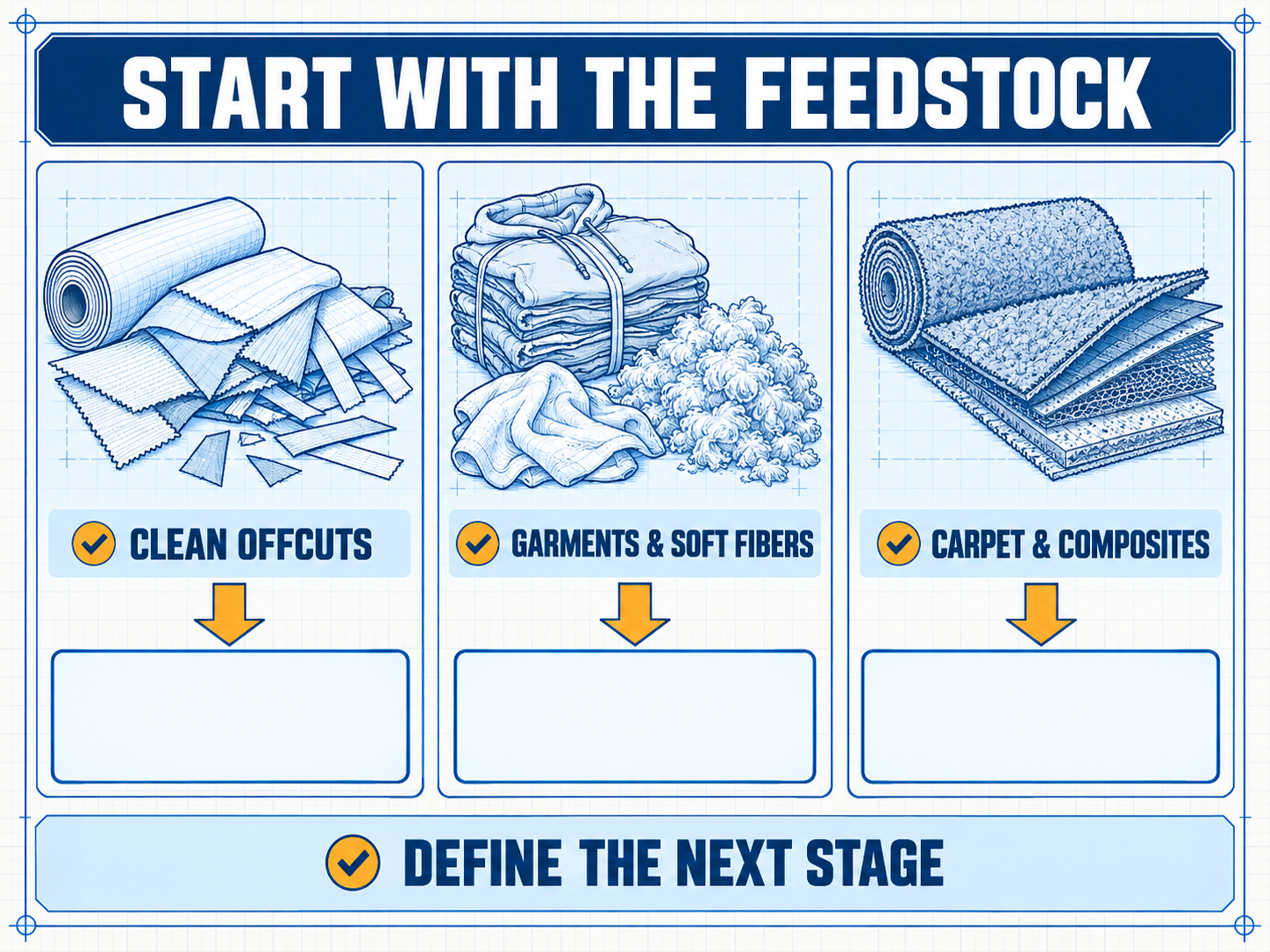
1. Describe the feedstock as it arrives
Start with the physical form and the normal variation. Identify whether the stream is loose fabric, narrow strips, rolls, whole garments, nonwoven sheets, carpet sections, bulky bundles, or a mixture. Add representative dimensions, bale or bundle condition, moisture condition when relevant, and the largest routine piece.
Do not send only the easiest sample. If the daily stream contains occasional dense bundles, long strips, sewn seams, or layered materials, include those conditions in the brief. A sample that does not represent the difficult but normal part of the feed can produce an overconfident conclusion.
The buyer should also distinguish a clean production stream from post-consumer or returned material. Clean does not mean identical, and mixed post-consumer material may contain hardware, labels, dirt, packaging residue, or different fiber blends. Those differences should be visible in the test request.
2. Name the next process and its acceptance condition
The next stage gives the output question its meaning. Possible destinations include sorting, separation, fiber opening, nonwoven production, insulation or stuffing preparation, fuel preparation, storage, or another size-reduction step. The article does not assume that every textile application has the same route.
Describe what the next process can accept. It may care about presentation, consistency, contamination, degree of opening, bulk density, or a particular classification method. State how acceptance will be checked, such as a visual inspection, a sampling protocol, a downstream trial, or a buyer-defined screen or separation check. Avoid converting this field into an unsupported universal output-size promise.
3. Separate contamination and hardware from the fiber label
List the non-fiber elements that are part of normal operation. Garments may contain zippers, buttons, hooks, rivets, elastic, labels, and attached plastic parts. Carpet may include backing, adhesive, filler, or other layers. Production scrap may be cleaner, but the actual line should still define trimming, packaging residue, and accidental metal conditions.
This field has two purposes. First, it tells the supplier what the sample must contain. Second, it tells the buyer which downstream and safety questions must be reviewed. The presence of hardware does not automatically disqualify an application, but it does make a generic textile claim insufficient.
4. State the feeding and site conditions
Explain how material will reach the cutting chamber and how the output will leave it. Include manual loading, conveyor feeding, bale breaking, roll handling, available footprint, access for maintenance, utilities, dust control, discharge direction, and the relationship to sorting or separation equipment. A machine page cannot establish fitment for an installation it has not seen.
OSHA identifies combustible dust hazards in workplaces that create or handle certain dusty materials and provides inspection guidance for affected operations. Textile dust control therefore belongs in the line review when the actual material and process can create that exposure. The correct control design depends on the installation, not on a generic blog statement. (Occupational Safety and Health Administration, n.d.)
5. Make throughput a test question, not a headline number
Record the target operating basis: material condition, expected operating hours, loading pattern, batch or continuous feed, and how throughput will be measured. A number without a stated material and method cannot be compared fairly. Ask which conditions the supplier used for any figure and whether the proposed test will measure the buyer’s actual objective.
Use this first-pass checklist:
- Describe the normal textile form, variation, largest routine piece, and representative sample.
- Name the next process and the output condition it can accept.
- List fiber blends, hardware, backing, adhesive, packaging residue, and other normal contaminants.
- State feeding, discharge, footprint, utilities, dust, maintenance, and access constraints.
- Define the throughput basis and the evidence required before approval.
For broader machine-type context, the site’s single-shaft shredder overview and double-shaft shredder overview can help a reader understand the vocabulary. They should not be treated as proof that one type fits every textile stream. The application brief and representative-material test remain the decision points.
Application path: clean production scrap and fabric offcuts
Clean production scrap is often the clearest textile shredder application to define, but “clean” is not a complete specification. A textile mill may produce narrow trim, irregular offcuts, long strips, edge waste, rolls, layered pieces, or compacted bundles. The selection question is whether the representative stream can be fed consistently and whether the resulting material is suitable for the stated next stage.
Clean production scrap is 1 application lane, but the EEA describes more than one mechanical textile output route, including rags and nonwovens. The practical implication is that a textile shredder test should name the next stage and acceptance condition, because a clean label alone does not define the required preparation.
When the main goal is controlled preparation
Begin with the material’s form at the point of loading. Loose offcuts may present a different feeding question from wound strips or dense bundles. Long, flexible pieces may wrap or bridge in ways that are not visible from a small handful of flat samples. If rolls or compacted waste are part of normal operation, include them in the test plan rather than treating them as an exceptional case.
Then name the downstream purpose. The goal may be easier internal handling, a stable feed for fiber opening, preparation for nonwoven production, reduction before storage, or another defined process. Each purpose may use a different acceptance check. “Smaller” is not enough if the next stage requires a particular presentation or has a contamination limit.
The EEA lists rags and nonwovens among possible outputs in mechanical textile recycling, which illustrates why the downstream route has to be stated before the shredder output is judged. The route is an industry context, not evidence that a particular machine produces a specified textile product. (European Environment Agency, n.d.)
Questions for a production-scrap sample
Send a sample that includes the normal fabric types, thickness variation, seams, coatings, and packaging conditions. If several production lines create materially different waste, identify them separately. A single “fabric” sample can conceal the very variation that affects feeding or cutting.
Use the following checklist before a sample test:
- Identify the fabric family, form, thickness variation, and normal piece dimensions.
- Include long strips, rolls, bundles, or layered pieces when they occur in routine production.
- State whether the aim is handling, storage, fiber preparation, nonwoven preparation, or another next stage.
- Define what the next stage will inspect or measure in the test output.
- List coatings, labels, thread concentrations, packaging residue, and accidental hardware.
- Ask the supplier to describe the proposed feeding method and the conditions used in any test video or result.
A clean production stream may be a good candidate for an early test because its composition is easier to document. It still needs a real material sample and a defined acceptance condition. If the site changes fabric families by season or customer order, those changes belong in the application review.
Application path: garments, nonwovens, and mixed soft fibers
Garments, nonwovens, and mixed soft fibers introduce behavior that a simple material label does not capture. The stream may be flexible, compressible, layered, loosely connected, wound around a feed component, or mixed across fiber types. It may also contain hardware that is harmless to one downstream route but unacceptable to another. The correct question is which behaviors must be demonstrated during testing.
The European Environment Agency describes at least 3 mechanical textile output examples, including nonwovens, insulation, and stuffing. For garments and soft fibers, that variety reinforces a practical rule: separate material behavior, blends, winding, and hardware before asking whether a proposed textile shredder test demonstrates the intended downstream route.
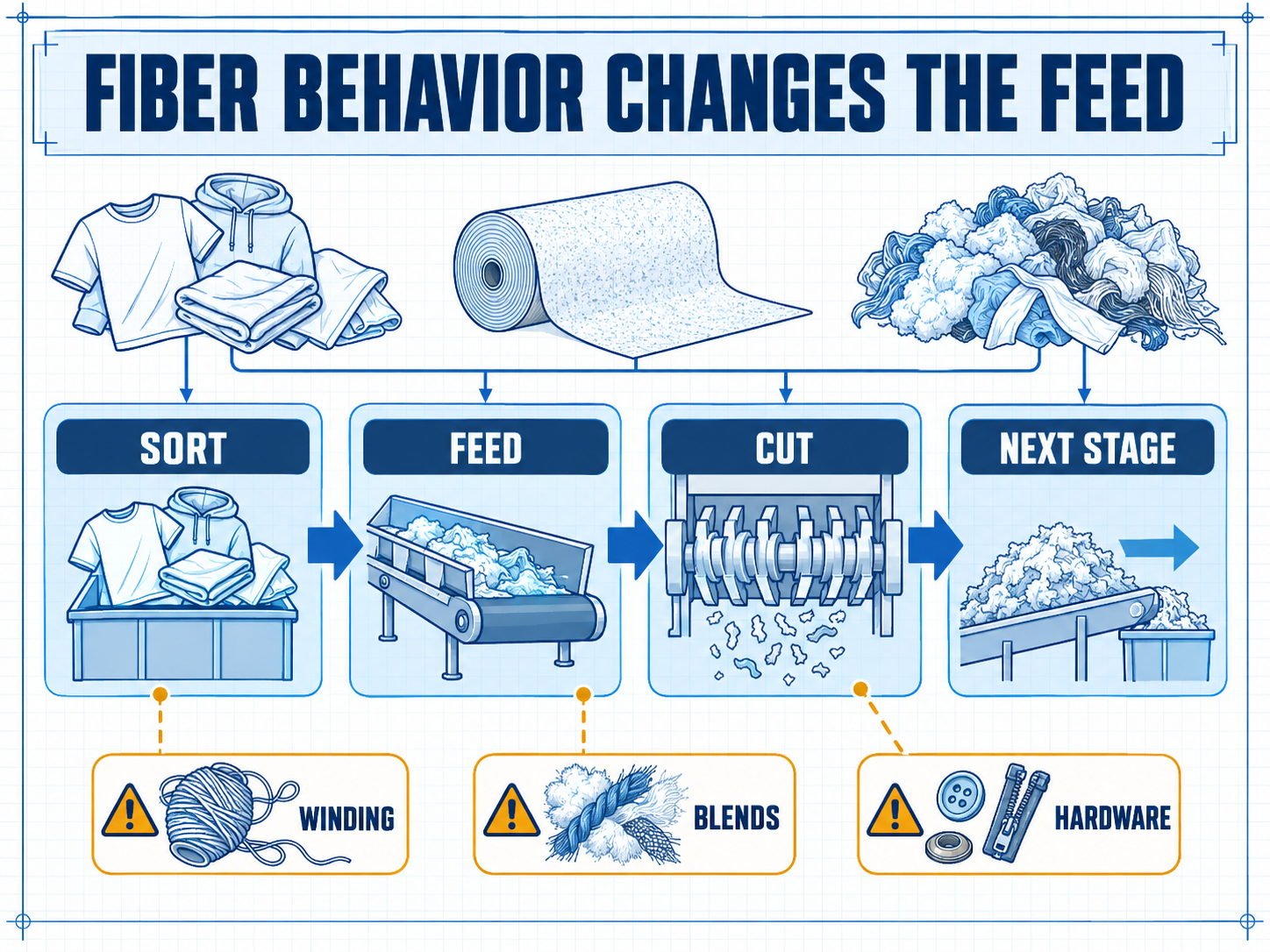
Sort the application before choosing the test
Separate the major lanes in the brief. Whole garments, loose textile pieces, nonwoven rolls, and mixed fiber bales should not be collapsed into one sample description if they behave differently. Note whether material arrives flat, tangled, compressed, bundled, or in rolls. Record the proportion of blended or unknown composition when that affects the downstream decision.
The EEA describes multiple routes for used and waste textiles, including mechanical outputs such as nonwovens, insulation, and stuffing. That does not mean that every mixed stream is suitable for every route. It means the buyer should connect the feedstock description to the intended output and keep the route-specific acceptance question visible. (European Environment Agency, n.d.)
Treat winding and hidden hardware as test inputs
Long flexible strips, elastic, thread, and loosely connected fabric can behave differently from short flat offcuts. Include the longest routine pieces and any material that tends to wind, bridge, or form a dense bundle. Ask how the feed system is expected to handle that behavior and what observation would count as an acceptable run.
For garments, list zippers, buttons, hooks, rivets, labels, plastic parts, and any attached packaging. For nonwovens, state whether the material is a sheet, roll, trim, or mixed offcut. For mixed fibers, document the known composition and identify what is unknown. The purpose is not to reject the stream automatically. It is to prevent a clean demonstration from being mistaken for proof of fit.
Use this application checklist:
- Split garments, nonwovens, loose pieces, and mixed bales into meaningful sample groups.
- Mark flexible, wound, compressed, layered, or unusually bulky material.
- Identify blended fibers and unknown composition instead of presenting them as one uniform feedstock.
- List normal hardware and define what must happen to it downstream.
- Describe the target output condition and how the next stage will verify it.
- Ask for a test that includes the difficult but routine portion of the load.
Where a line also handles non-textile feedstocks, keep the textile brief separate from a general material-selection article. The site’s plastic feedstock selection guide is a useful example of application-first thinking, but its material conclusions should not be transferred to textiles without a new sample and downstream check.
Application path: carpet and bulky composite textiles
Carpet and bulky composite textiles deserve a separate application path because the visible textile layer may not describe the whole feed. Backing, adhesive, filler, foam, plastic, dirt, and attached material can change feeding, cutting, discharge, separation, dust, and wear questions. A carpet sample should therefore be described as a layered composite, not simply as fabric.
European Commission guidance distinguishes textile-dominant materials from materials where textile fiber is not dominant, including heavily backed carpet context. That distinction does not select a machine. It tells the buyer to treat composite carpet as a separate lane and verify 3 linked questions: layers, downstream acceptance, and line safety.
Define the layer structure and the next handoff
Record the carpet type, backing condition, roll or section form, bulk, moisture or dirt condition when relevant, and the largest routine piece. Identify whether the immediate purpose is volume reduction, preparation for separation, storage, fuel preparation, or another route. The required output condition should be written in the language used by the next process.
European Commission guidance on separate textile collection distinguishes textile-dominant materials from materials such as heavily backed carpet where textile fiber is not dominant. That distinction does not decide a machine application, but it is a useful reminder that a broad textile label can hide a materially different composition. (European Commission, n.d.)
Why composite streams need a bounded test
Use a sample that includes the layers and contamination found in normal operation. If carpet is stripped, sorted, or pre-cut before shredding, describe that preparation as part of the application. If it is not, include the unprepared form in the test. Do not infer suitability from a test on a clean textile layer when the line will process a backed composite.
The line review should also cover discharge, metal or foreign-material handling, dust control, access, and the relationship to downstream separation. The exact controls are site-dependent. The buyer’s task is to state the hazards and acceptance conditions; the supplier’s task is to explain the proposed configuration and test evidence for that defined material.
Pause point: If the carpet composition, pre-treatment, or downstream route is still unknown, the next action is material characterization and a bounded sample plan, not a universal shredder recommendation.
Textile application comparison: compare the question, not just the machine
The three application lanes below are not a ranking of machines. They are a way to decide which material and downstream questions belong in the next test.
The matrix compares 3 application lanes, not 3 machine types. Clean offcuts, garments and soft fibers, and carpet or composites differ in feed behavior and next-stage questions. The EEA’s multiple-route overview supports this lane-based framing, while a fair comparison still holds material, feeding conditions, and acceptance criteria constant before interpreting equipment evidence.
| Application lane | Defining material behavior | Next-stage question | Test emphasis |
|---|---|---|---|
| Clean production scrap | Known fabric family, trims, offcuts, rolls, or bundles | Is the prepared material suitable for handling, fiber preparation, or the stated reuse route? | Include normal form, length variation, coatings, moisture, and the required handoff condition. |
| Garments and soft fibers | Flexible, compressible, blended, wound, or hardware-bearing material | How will sorting, fiber preparation, nonwoven, insulation, stuffing, or another route accept the output? | Include winding, blends, difficult routine pieces, zippers, buttons, hooks, and other hardware. |
| Carpet and composites | Layered textile with backing, adhesive, filler, foam, plastic, or dirt | Does the composite need pre-treatment, separation, or a different downstream acceptance check? | Include layers, bulky sections, foreign material, dust, discharge, and the real pre-treatment state. |
Read the matrix by feedstock behavior
Choose the row that best describes the material as it arrives at the shredder. If the stream contains more than one materially different lane, split the sample and the acceptance criteria instead of averaging the differences into one label. The matrix is useful because it makes the next question visible before a configuration is compared.
Compare evidence at the next-stage handoff
For each row, ask what the next process must receive and how the buyer will recognize acceptance. A clean offcut route may emphasize consistent presentation. A garment route may emphasize winding, blends, and hardware. A carpet route may emphasize composite layers and line controls. The next test should follow the row with the greatest routine uncertainty, not the row that produces the easiest demonstration.
Comparison rule: Compare like material, like feeding conditions, and like acceptance criteria. If those three are different, the machine claims are not directly comparable.
How to test a textile shredder application before buying
A useful textile shredder test answers the buyer’s application question with representative material and a written acceptance rule. It is more informative than a generic demonstration because it connects the feed, the process conditions, the output, and the next stage. The test does not need to predict every future load, but it should make its boundaries explicit.
A representative textile shredder test should document 6 items: sample variation, composition, downstream target, feeding conditions, observed output, and written acceptance criteria. OSHA’s combustible-dust guidance adds a safety-review context for operations that handle relevant dusty materials, while the test record remains specific to the actual site and material.
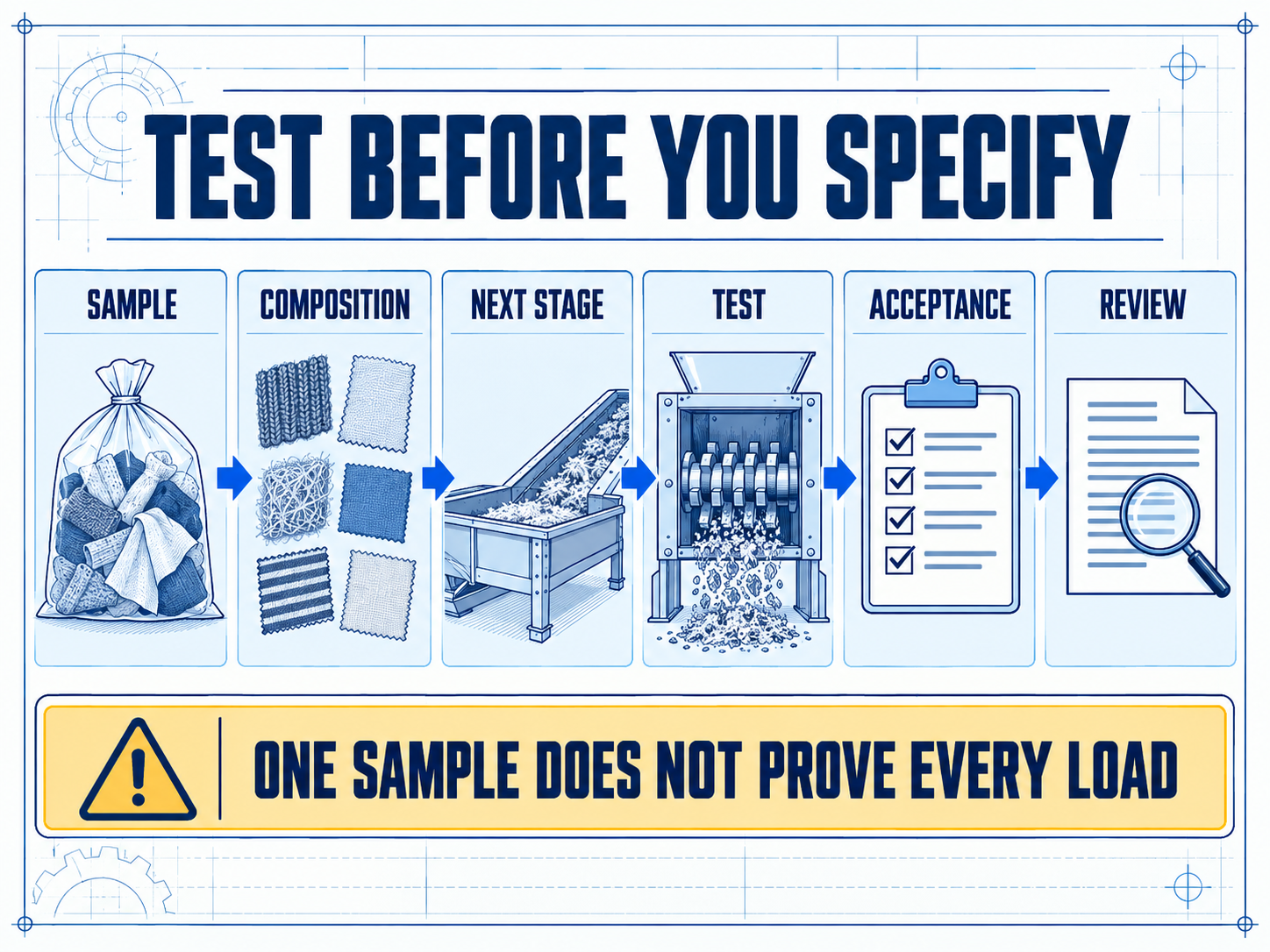
1. Define the sample and its normal variation
Prepare samples that represent the material groups the line will actually process. Include ordinary material, the largest routine pieces, difficult but normal bundles, and known hardware or composite layers. If the feed changes by supplier, season, product family, or collection source, list those lanes separately.
Write down what the sample excludes. A test on clean flat offcuts cannot prove fit for wound strips, compressed garments, backed carpet, or hardware-bearing material that was not present. Clear exclusions make the result more useful because they show what requires another test.
2. Connect the test to the next stage
State what the output must do after size reduction. The next stage may be a separator, fiber-opening operation, nonwoven route, storage system, fuel-preparation route, or another process. Define the acceptance observation before the test starts. It might include feed presentation, visible contamination, output handling, a downstream trial, or a buyer-defined classification method.
Do not let the test become a contest to produce the smallest visible pieces. If the next process needs stable feeding or a defined separation behavior, those conditions belong in the acceptance rule. Smaller is not automatically better.
3. Record process and site conditions
Document the feeding method, sample quantity, sequence, interruptions, discharge arrangement, and observations about winding, bridging, dust, hardware, or layered material. Record the conditions needed to interpret any throughput or output statement. The same headline number can mean something different when the material, loading pattern, or measurement method changes.
Dust and foreign-material handling should be included in the line review when the material creates those concerns. OSHA’s combustible-dust guidance is a reminder that workplace controls must be considered for the actual operation. It is not a substitute for a site-specific hazard review. (Occupational Safety and Health Administration, n.d.)
4. Put acceptance criteria in writing
Ask the supplier to return the result against the buyer’s stated criteria. The record should identify the tested material, the proposed configuration, the test conditions, the observed output, unresolved questions, and the limits of the conclusion. If the run passes one sample but leaves composition or downstream uncertainty unresolved, mark the application as conditional rather than complete.
Use this test-request checklist:
- Sample description, normal variation, exclusions, and representative difficult pieces.
- Composition, blends, backing, hardware, contamination, moisture, or dirt conditions.
- Feeding, discharge, process sequence, observation method, and site assumptions.
- Next-stage requirement and measurable or observable acceptance condition.
- Output observations, unresolved risks, and what a second test must cover.
- Written statement of what the test does and does not demonstrate.
Only after this record is complete should a buyer compare configurations, service arrangements, or commercial terms. The goal is a defensible application decision, not a polished demonstration video.
Fields to verify and textile-shredder claims to ignore
A supplier page or quotation becomes useful when it allows the buyer to compare a defined application with defined evidence. It becomes risky when broad claims are treated as proof of compatibility. Read the page in two passes: first collect the fields that can be verified, then mark the claims that still require a sample test or line review.
A supplier claim such as “handles all textiles” has no defined scope until the material, feed conditions, measurement method, and downstream acceptance are stated. The buyer can screen 4 evidence groups first: feedstock, process handoff, operating conditions, and test limitations. OSHA and EEA context does not replace fitment evidence.
Verify these fields first
Check that the material description matches the actual feed. The useful fields include textile form, normal piece size, rolls or bundles, fiber mix, moisture or dirt condition when relevant, backing or coatings, hardware, and the largest routine piece. If the page gives no way to relate its test material to the buyer’s stream, record that as an open question.
Next check the downstream requirement. A quotation should state what the proposed configuration is intended to prepare, how the output will be observed or measured, and which conditions are assumed. The phrase “textile shredder” does not tell a buyer whether the target is handling, separation, fiber preparation, storage, or another stage.
Then verify the operating and site questions: feeding method, discharge, maintenance access, utilities, dust controls, foreign-material handling, and the basis for any throughput figure. These are buyer and supplier questions together. The buyer owns the actual material and site brief. The supplier should own the explanation of its proposed configuration, test method, and limitations.
The shredder-blades reference page can help explain why cutting components are part of a fitment conversation, but a blade description is not a textile compatibility certificate. Blade arrangement, wear, screen, feeding, and other configuration fields must be confirmed for the stated material and application.
Treat these claims as prompts for evidence
Be cautious with “handles all textiles,” “works with any fabric,” “high capacity,” “maintenance-free,” “uniform output,” or “ready for recycling” when the page does not define material, feed conditions, measurement method, or downstream acceptance. Such language may describe a marketing position, not a bounded test result.
Do not accept a single output-size number as proof that every textile load will leave in that condition. Do not compare horsepower, blade count, or a stock photograph as if they were equivalent evidence. Do not transfer a competitor’s textile example to another supplier, and do not transfer a plastic, tire, or wood result to textiles without a new test.
A practical verification checklist
- Is the sample representative of the normal textile stream and difficult routine pieces?
- Are composition, layers, blends, hardware, and contamination stated?
- Is the next process named, with an observable acceptance condition?
- Are feeding, discharge, dust, foreign-material, access, and maintenance questions open or answered?
- Are throughput and output statements tied to a material, method, and test condition?
- Does the supplier identify what still requires quote-stage or fitment confirmation?
If several answers are “not stated,” the correct conclusion is not that the machine fails. The correct conclusion is that the application is not yet evidenced. Ask for the missing information before ranking configurations.
When to delay a textile shredder purchase
Delay the purchase decision when the feedstock is described only as “textile waste,” the next process is undefined, or the required output condition has not been agreed. A machine comparison made before those fields are clear will usually compare brochures instead of applications.
Pause when the representative sample is missing, when difficult routine material was excluded, or when blends, hardware, backing, adhesive, and contamination are unknown. Also pause when a supplier presents a capacity or output statement without material, feed, and measurement conditions. Those gaps do not prove that a configuration is unsuitable. They show that the evidence is incomplete.
Use the time to characterize the material, split it into meaningful application lanes, define the next-stage acceptance rule, and prepare a bounded sample test. If dust, metal, foreign-material, or access questions remain open, include them in the line and safety review before approval.
Decision rule: If you cannot explain what enters the machine, what must leave it, and how the next stage will accept it, the next purchase step is process definition and testing, not a final configuration choice.
Conclusion
Textile shredder applications are defined by three linked questions: what waste arrives, what the next process must accept, and what test evidence will show fit. Clean offcuts, soft mixed fibers, and carpet composites should be separated when their behavior or contamination differs. Document form, composition, hardware, feeding, output condition, site controls, and the throughput basis. Then run representative material and record acceptance criteria before comparing configurations. If any of those inputs remains unknown, delay the purchase and characterize the stream first. That sequence keeps the equipment decision tied to the actual process rather than a broad material label.
References
- European Environment Agency. (n.d.). Management of used and waste textiles in Europe’s circular economy. Retrieved September 14, 2026, from https://www.eea.europa.eu/en/analysis/publications/management-of-used-and-waste-textiles-in-europes-circular-economy
- European Commission. (n.d.). Guidance for separate collection of municipal waste. Retrieved September 14, 2026, from https://ec.europa.eu/environment/pdf/waste/studies/15.1.%20EC_DGENV_Separate_Collection_guidance_DEF.pdf
- Occupational Safety and Health Administration. (n.d.). Combustible dust: National emphasis program (Directive CPL 03-00-006). Retrieved September 14, 2026, from https://www.osha.gov/enforcement/directives/cpl-03-00-006
Last reviewed and updated: September 2026. Author: kingstramblade Jack. For tailored guidance, contact our team.